
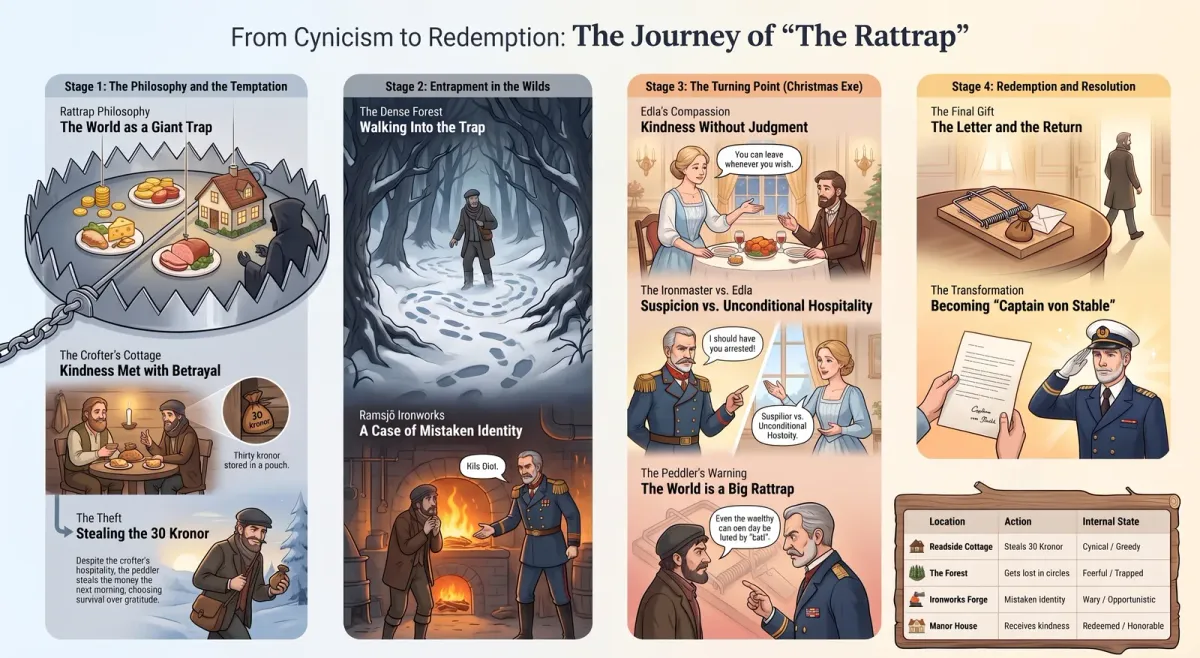
“The Rattrap” is Chapter 4 of the CBSE Class 12 English Flamingo textbook, written by the Swedish author Selma Lagerlöf. Told in the gentle tone of a fairy tale, the story follows a poor peddler who compares the whole world to a giant rattrap — and then discovers, through a series of unexpected encounters, that kindness can pull even the most hardened person out of the trap he has built for himself. This post gives you a complete summary and quick analysis to help you revise before your CBSE Class 12 English exam.
About the Author: Selma Lagerlöf
Selma Lagerlöf (1858–1940) was a Swedish writer whose work has been translated into many languages. A recurring idea runs through almost everything she wrote: her conviction that every human being carries an essential goodness that can be awakened through understanding and love. The Rattrap is set against Sweden’s iron-ore mining region, and Lagerlöf tells it in a style that deliberately echoes a traditional fairy tale.
Setting and Background
The story unfolds in rural Sweden, moving between a lonely roadside cottage, a dense winter forest, and the forge of the Ramsjö Ironworks, in the days leading up to Christmas. This festive backdrop matters — it is precisely because it is Christmas that the ironmaster’s daughter chooses compassion over suspicion, and that single choice changes the course of the story.
The Rattrap: Full Summary
The Peddler’s Philosophy of Life
The story opens with an unnamed peddler who survives by selling small rattraps made from wire begged off shops and farms, supplementing this with begging and petty theft. One day an idea strikes him as entertaining: the whole world, he decides, is nothing but one enormous rattrap, offering riches, comfort, food and shelter exactly the way his own traps offer cheese and pork. The moment anyone reaches for that bait, the trap closes on them. Since the world has never treated him kindly, this bitter theory gives him a strange, private joy.
A Night at the Old Crofter’s Cottage
One evening the peddler asks for shelter at a small grey cottage. Its owner, a lonely old crofter who once worked at the Ramsjö Ironworks, is delighted for company. He feeds the peddler, shares tobacco, teaches him a card game, and proudly shows off the thirty kronor he keeps in a leather pouch on the window frame. The two part ways the next morning on friendly terms.
The Theft and the Lost Peddler
Half an hour later, the peddler doubles back, breaks the window, and steals the crofter’s money. Fleeing into the forest, he soon loses his way. As darkness falls he recalls his own theory about the world being a rattrap — and realises he has walked straight into the trap himself.
Shelter and Mistaken Identity at Ramsjö
Exhausted, he follows the sound of hammers to the forge of the Ramsjö Ironworks and asks the blacksmiths for shelter. The ironmaster, arriving on his nightly round, mistakes the ragged stranger by firelight for Nils Olof, an old regimental comrade. Hoping the mistake might earn him a few kronor, the peddler stays silent. He refuses the ironmaster’s invitation home, wary because of the stolen money — until the ironmaster’s daughter, Edla Willmansson, comes herself, treats him gently, and promises he can leave freely if he simply stays for Christmas Eve. Reassured, he agrees.
The Christmas Eve Transformation
At the manor house, the peddler is bathed, groomed and dressed in the ironmaster’s clothes. In daylight, the ironmaster realises his mistake and angrily demands an explanation. The peddler admits the truth and, when threatened with the sheriff, delivers his famous rattrap speech, warning that the ironmaster too could one day be lured by his own piece of pork. Amused, the ironmaster lets the matter go — and Edla insists the stranger stay anyway, so that one lonely wanderer can enjoy a single day of peace.
The Final Twist
The peddler rests peacefully through Christmas Eve, receives the suit as a gift, and is invited to return next year. The next morning Edla learns at church that a nearby crofter was robbed by a travelling rattrap peddler. Rushing home, she finds their guest already gone — but he has left behind a small rattrap containing the stolen thirty kronor and a letter signed “Captain von Stahle,” asking that the money be returned and thanking her for treating him like an honourable man.
Analysis of The Rattrap
The story’s strength lies in how completely Lagerlöf turns her central metaphor inside out. The peddler begins convinced the world exists only to trap people through greed, yet it is an act of undeserved generosity — Edla’s insistence on treating him with dignity despite her doubts — that frees him from the very trap he describes. The narrative moves through three stages: cynicism, entrapment, and redemption, with each character reflecting a different way of responding to a stranger.
Why This Chapter Matters for CBSE Students
The Rattrap is a CBSE favourite because it blends a strong central metaphor with testable material on character, theme and narrative technique. Keeping the sequence clear — cottage, forest, forge, manor house — helps with both factual and analytical questions.
Related Reading
-
Deep Water Summary and Analysis – CBSE Class 12 English Flamingo Chapter 3
-
Lost Spring Summary and Analysis – CBSE Class 12 English Flamingo
Prepare Smarter with ChampionsPrep
Revising Flamingo chapters like The Rattrap is far easier with structured practice questions, quick concept notes, and instant doubt support on ChampionsPrep . It is free to register & pay as you use — so you only spend on the practice you actually need, whenever you need it.
Test Your Knowledge

The Rattrap Summary and Analysis – CBSE Class 12 English Flamingo Chapter 4
Frequently Asked Questions
Who wrote The Rattrap and what is it about? +
Selma Lagerlöf wrote The Rattrap. It follows a peddler who steals from a kind old crofter, gets lost in the woods, and is transformed by an ironmaster's daughter's compassion on Christmas Eve.
What is the central metaphor in The Rattrap? +
The peddler's idea that the world works like a giant rattrap, luring people with riches only to trap them, is later turned around to show how kindness can release someone from that same trap.
Why did the peddler steal from the old crofter? +
He survived by begging and petty theft, and the sight of thirty kronor casually kept in a leather pouch proved too tempting despite the crofter's hospitality.
How does Edla Willmansson change the peddler's fate? +
Edla treats him with genuine respect even though she suspects dishonesty, insisting he stay for Christmas Eve — unconditional kindness that ultimately persuades him to reform.
What does the peddler leave behind at the end? +
A small rattrap holding the stolen thirty kronor and a letter signed 'Captain von Stahle,' asking that the money go back to the crofter.
AI-powered practice — free to start