
This post walks through model answers to the end-of-chapter exercises in “Indigo,” covering the “Understanding the Text,” “Talking about the Text,” “Working with Words,” and “Thinking about Language” sections from the NCERT Flamingo textbook. All prompts below are paraphrased rather than reproduced verbatim, and answers are written in a way students can adapt for board exam responses.
Think as You Read: Quick Recall Answers
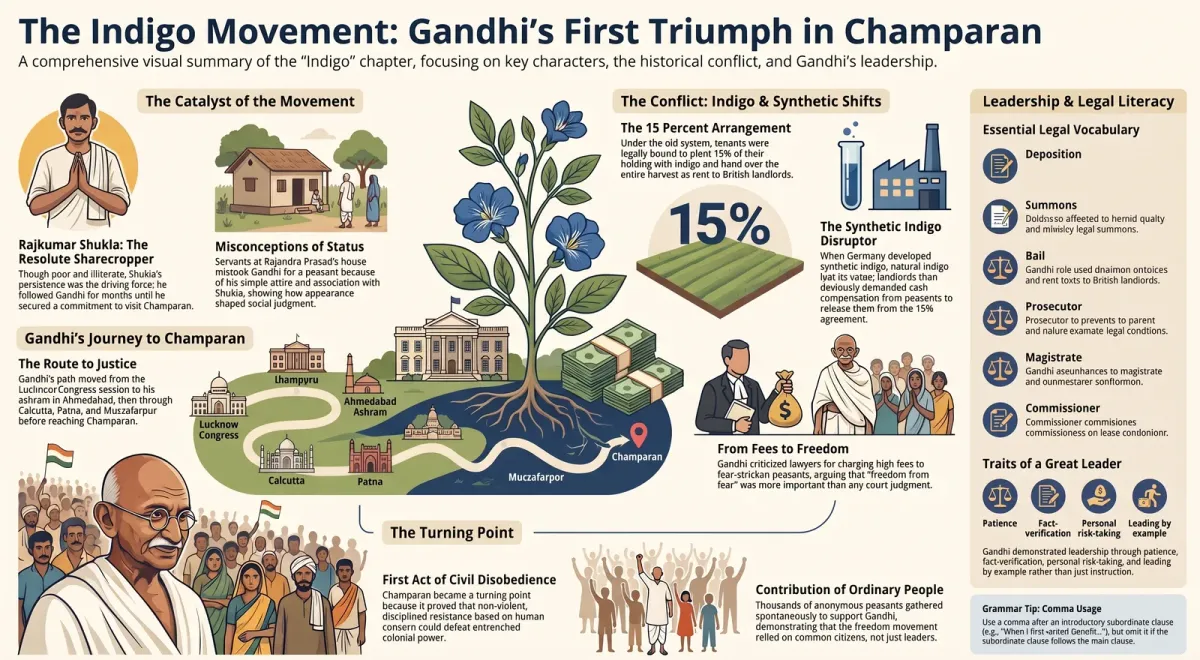
Early in the chapter, students are asked to identify true and false statements about Rajkumar Shukla, and to reflect on his character and the servants’ assumptions. Shukla was a sharecropper and a delegate who attended the Congress session to raise his community’s grievance — he was neither a politician nor a landlord. He was poor and illiterate, but not physically strong; his power lay in persistence rather than physical presence. He is called “resolute” because he refused to give up on his request, following Gandhi across cities and waiting patiently for months until Gandhi could visit Champaran. The servants at Rajendra Prasad’s house assumed Gandhi was another peasant because he arrived alongside Shukla, dressed simply, with no outward markers of status or importance — appearance, not achievement, shaped their judgment.
A later “Think as you read” prompt asks students to trace Gandhi’s route between meeting Shukla and reaching Champaran: he travelled from the Lucknow Congress session, back to his ashram near Ahmedabad, then to Calcutta, on to Patna, and finally to Muzzafarpur before entering Champaran itself. Students are also asked what peasants paid landlords as rent, and why the British landlords’ demands changed. Under the old arrangement, tenants had to plant 15 per cent of their land with indigo and hand over the entire harvest as rent. Once Germany developed synthetic indigo, natural indigo lost commercial value, so the landlords shifted to demanding cash compensation instead, hoping to extract money from peasants before they learned the crop itself was becoming worthless — a shift that would have driven natural indigo prices down further.
A further prompt connects the episode to Gandhi’s method of working and his ideas on satyagraha and non-violence. Relevant instances include gathering facts before acting, calmly refusing to leave Tirhut despite official pressure, pleading guilty and accepting punishment rather than resisting forcefully, and accepting a partial settlement rather than demanding full repayment — all consistent with principled, non-violent resistance.
Understanding the Text
Why was Champaran a turning point for Gandhi? It was his first major experiment in organised civil disobedience within India, proving that disciplined, non-violent resistance rooted in everyday human concerns could successfully challenge entrenched colonial authority.
How did Gandhi influence the lawyers? He challenged their fee-driven approach to representing peasants, criticised the limited value of court cases for fear-stricken clients, and — most powerfully — led by personal example, prompting the visiting lawyers to abandon their plan to go home if he were jailed and instead choose to risk arrest alongside him.
What was the attitude of ordinary Indians in smaller localities toward supporters of home rule? They were generally fearful of openly showing sympathy for advocates of self-governance, wary of the consequences of being associated with anti-colonial activity — which makes Professor Malkani’s willingness to host Gandhi notably unusual for the time.
How do we know ordinary people contributed to the freedom movement? Rajkumar Shukla’s persistence sets the entire episode in motion, and thousands of anonymous Champaran peasants gather spontaneously to support Gandhi without knowing anything about his earlier record — showing that unnamed, ordinary individuals played an essential role alongside recognised leaders.
Talking about the Text (Discussion Points)
On whether freedom from fear matters more than legal justice for the poor, students can argue that Gandhi’s own experience in Champaran supports this view — peasants gained more from losing their fear of authority than from any single court judgment. Whether the poor remain fully free from fear even after Independence is a matter for open class discussion, weighing continuing social and economic inequalities against constitutional protections.
On the qualities of a good leader, the chapter suggests patience, willingness to verify facts, courage to accept personal risk, practical compassion for immediate human needs, and leading by demonstrated example rather than instruction — all visible in Gandhi’s conduct throughout the episode.
Working with Words: Legal Vocabulary
The chapter uses several terms tied to legal procedure, such as deposition, summons, bail, prosecutor, magistrate, and commissioner. Students are encouraged to expand this list with related terms they already know, such as affidavit, plaintiff, defendant, verdict, and testimony, building useful vocabulary for both language exams and general comprehension of civic and legal contexts.
Thinking about Language
Why does the author rely so heavily on quoted, direct speech? Because Fischer had direct access to Gandhi and his contemporaries, quoting their actual words lends the account credibility and immediacy that indirect reporting would lose, letting readers experience conviction firsthand rather than through summary.
Comma usage with subordinate clauses: When a subordinate clause introduces a sentence, it is typically followed by a comma, as in a sentence beginning with “When I first visited Gandhi in 1942…” When the subordinate clause instead follows the main clause, no comma is needed, as in a sentence structured around “He had not proceeded far when the messenger overtook him.” Students should practise identifying this pattern across multiple textbook sentences to internalise the rule for their own writing.
Start Learning Smarter with ChampionsPrep
Want fully worked NCERT solutions and practice questions for every Flamingo chapter, ready for quick revision? ChampionsPrep gives CBSE and Maharashtra Board Class XI–XII students structured, exam-focused content for boards and entrance exams like CUET, IPMAT, NPAT, and SET. It is free to register & pay as you use — explore ChampionsPrep today.
Test Your Knowledge

Indigo NCERT Solutions: Understanding the Text and Working with Words – CBSE Class 12
Frequently Asked Questions
Why is the Champaran episode considered Gandhi's turning point? +
Because it was his first successful organised civil disobedience campaign in India, demonstrating that non-violent resistance rooted in real human need could challenge colonial power.
What change did synthetic indigo bring to the sharecropping system? +
It made natural indigo commercially worthless, prompting landlords to demand cash compensation from peasants instead of crop-based rent, which would have further depressed indigo's value.
What legal vocabulary appears in the chapter Indigo? +
Terms such as deposition, summons, bail, prosecutor, magistrate, and commissioner appear throughout, reflecting the chapter's courtroom and investigative scenes.
What is the comma rule discussed in the Thinking about Language section? +
A comma generally follows an introductory subordinate clause, but is omitted when the subordinate clause comes after the main clause.
What leadership qualities does the chapter highlight through Gandhi's actions? +
Patience, fact-based decision-making, personal courage, compassion for immediate human needs, and leadership by example rather than command.
AI-powered practice — free to start