
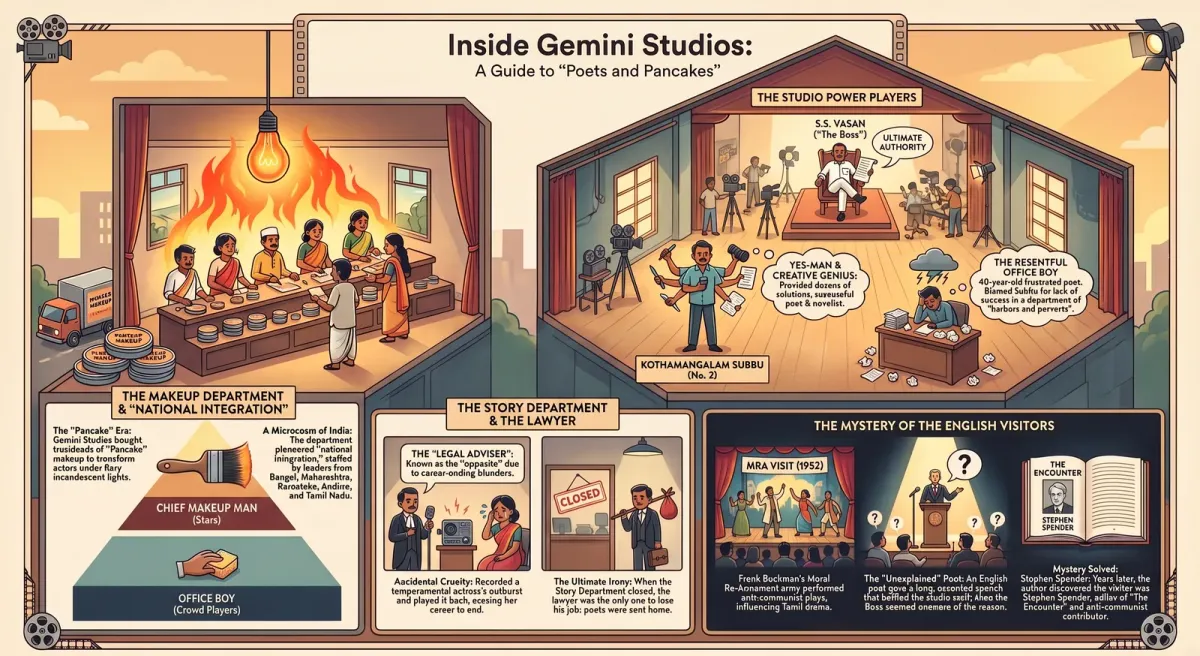
“Poets and Pancakes” is a witty, rambling memoir-essay by the Tamil writer Asokamitran, drawn from his book My Years with Boss. Set inside Gemini Studios, one of early Indian cinema’s most influential production houses, it uses gentle humour to sketch the insecure, status-conscious world of a 1950s Madras film studio through a chain of small, funny, revealing episodes. Here is a complete summary and analysis for CBSE Class 12 exam preparation.
About the Author and the Setting
Asokamitran (1931–2017) worked at Gemini Studios, Chennai, cutting out and filing newspaper clippings by hand — an unglamorous role that made him one of the best-informed people there. Gemini Studios was founded in 1940 by S.S. Vasan, called “The Boss” throughout, and became one of early Indian cinema’s most influential production houses.
Pancake, Make-Up, and the Studio’s Colonial Backdrop
The chapter opens with “Pancake,” the make-up material Gemini Studios bought in truckloads. The author imagines stars like Greta Garbo and Vyjayantimala using it, then wryly notes a newer star like Rati Agnihotri might not know the name — a joke on how fast film-world trends fade. The make-up department sat above a building rumoured to have been Robert Clive’s stables, letting Asokamitran poke fun at Madras’s habit of attaching colonial legends to ordinary buildings. The make-up room, ringed with incandescent lights and mirrors, resembles a hair-cutting salon and its “fiery misery.”
A Hierarchy Dressed Up as National Integration
The department was led, in succession, by men from very different regions — Bengali, Maharashtrian, Dharwar Kannadiga, Andhra, Madras Indian Christian, Anglo-Burmese, and Tamil. Asokamitran jokes this was “national integration” long before All India Radio and Doordarshan promoted the idea officially. Underneath the humour lies a rigid hierarchy: the chief make-up man worked on the leads, his assistants on the “second” hero/heroine and comedian, and the office boy on the crowd players — mirroring the studio’s obsession with status.
The Office Boy’s Resentment
This “office boy” is a man in his forties who had joined Gemini Studios hoping to become a star actor, writer, director, or lyricist. Instead he ended up slapping paint onto crowd extras — “a bit of a poet,” in the author’s dry words. Seeing the author tearing up newspapers all day, he assumes he is doing nothing and barges in to lecture him about talent wasted in a department “fit only for barbers and perverts.” All his frustration is really aimed at one person: Kothamangalam Subbu, the studio’s unofficial No. 2.
Kothamangalam Subbu — Loyalty as Genius
Subbu had no more privileged a start than the office boy. What set him apart was his willingness to be “inspired when commanded” — when a producer described a tricky scene he couldn’t picture, Subbu instantly offered four approaches, then fourteen more on demand. He was also a poet and novelist (Thillana Mohanambal) and a fine supporting actor, running an open house for dozens of relatives without seeming aware of his own generosity. Yet precisely because he was close to The Boss, Subbu had enemies — including the bitter office boy.
The Story Department and the Lawyer’s Irony
Subbu officially belonged to the Story Department, alongside writers, poets, and a lawyer nicknamed “the opposite” of his formal title, “legal adviser.” In one episode, a temperamental actress loses composure on set; the lawyer quietly records the outburst and plays it back to her. Hearing her own voice, she is left “struck dumb,” her career effectively over — an accidental cruelty inside an otherwise comic passage. Later, when The Boss shuts the Story Department down, it is the lawyer, not the poets, who loses his job — the only instance in history, the author quips, where a lawyer lost his job because poets were sent home.
Two Strange Visitors: The MRA Troupe and the English Poet
Gemini Studios was also a favourite haunt of poets — S.D.S. Yogiar, Sangu Subramanyam, Krishna Sastry, and Harindranath Chattopadhyaya — mostly apolitical khadi-wearers wary of “Communism” without understanding it. In 1952, Frank Buchman’s two-hundred-strong Moral Re-Armament (MRA) troupe visits Madras and is hosted lavishly; their plays Jotham Valley and The Forgotten Factor shape Tamil theatre for years. Only later does the author learn the MRA was a counter-movement to Communism. Months after, a mysterious “poet from England” gets an equally grand reception though nobody, including The Boss, knows who he is. His accented speech baffles everyone, and he departs as “an unexplained mystery.”
Solving the Mystery: Stephen Spender
Years later, the author enters a short story contest run by The Encounter and discovers, while checking the magazine, that its editor is the same English visitor: Stephen Spender. Later, he buys a cheap footpath copy of The God That Failed, in which six writers, Spender included, describe their disillusionment with Communism. The mystery is solved: The Boss’s reception was less about Spender’s poetry than his standing as an anti-Communist voice.
Analysis: Humour with a Point
The chapter moves in loose, associative jumps — make-up to office boy, office boy to Subbu, Subbu to lawyer, lawyer to poets, and finally to the two visitors — exactly the “chatty, rambling style” the NCERT textbook asks students to notice. Asokamitran’s humour is gentle, not cruel, and he mocks his own “insignificant” job as readily as he mocks others. Only in the final lines does the deeper point surface: Cold-War politics quietly shaped even a provincial film studio’s behaviour, without most people ever realising why.
Start Learning with ChampionsPrep
Want chapter-wise notes and practice questions for CBSE Class 12 English Flamingo? It is free to register & pay as you use — explore ChampionsPrep and study every Flamingo chapter the smart way.
Test Your Knowledge

Poets and Pancakes Summary and Analysis – CBSE Class 12 English Flamingo Chapter 6
Frequently Asked Questions
Who is the author of "Poets and Pancakes," and which book is it taken from? +
The chapter is written by Asokamitran and is an excerpt from his memoir My Years with Boss, based on his time working at Gemini Studios in Chennai.
Why does the author call the make-up department an example of "national integration"? +
Because it was headed and staffed, over time, by people from many different regions and communities - Bengali, Maharashtrian, Kannadiga, Andhra, Anglo-Burmese, and Tamil - long before official programmes promoted the idea.
Why did the lawyer lose his job at Gemini Studios? +
The Boss shut down the entire Story Department, which included the lawyer along with the poets and writers, so the lawyer lost his position because the poets were being sent home - an ironic twist the author highlights.
Who turns out to be the mysterious "poet from England" who visits Gemini Studios? +
He is later revealed to be Stephen Spender, the English poet and essayist, whom the author recognises as the editor of the magazine The Encounter.
What role does the book "The God That Failed" play in the chapter? +
It helps the narrator finally understand why Gemini Studios gave Spender such a grand welcome - not for his poetry, but because he was known as a writer who had turned decisively against Communism.
AI-powered practice — free to start