
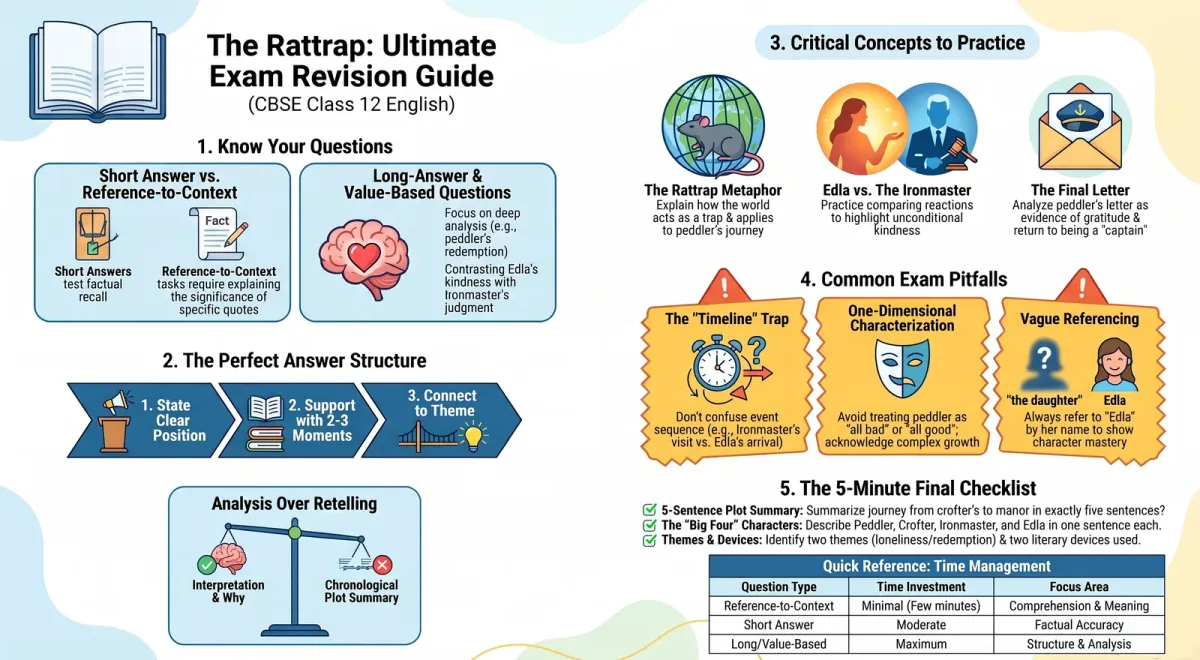
With the summary, characters, themes and devices of The Rattrap already covered, this final post in the series focuses on exam strategy: the question types you’re most likely to see, common mistakes to avoid, and a quick checklist for your last revision pass before the CBSE Class 12 English exam.
Common Question Types on The Rattrap
CBSE question papers on this chapter tend to fall into a few recognisable categories. Short-answer questions test basic recall — why the crofter showed his money, why the ironmaster mistook the peddler’s identity, or what the peddler leaves behind at the end. Reference-to-context questions quote a short passage (often the peddler’s rattrap speech, or Edla’s insistence that he stay) and ask you to explain its meaning and significance. Long-answer or value-based questions ask you to analyse theme or character in depth — for instance, discussing how kindness transforms the peddler, or contrasting the ironmaster’s and Edla’s responses to a stranger. Occasionally, you may be asked to imagine and write from a character’s point of view, such as a diary entry from Edla’s perspective on Christmas night.
Important Questions to Practise
Before your exam, make sure you can confidently answer the following:
-
Trace the peddler’s journey from cynicism to redemption across the story.
-
Explain the rattrap metaphor and how it applies to the peddler himself by the story’s end.
-
Compare the ironmaster’s and Edla’s reactions to the peddler once his true identity is revealed.
-
Discuss why the old crofter’s hospitality makes his eventual loss more poignant.
-
Analyse the peddler’s final letter — what does it reveal about his character and his gratitude toward Edla?
-
Why does the story end on an act of restitution rather than punishment, and what does this suggest about Lagerlöf’s view of human nature?
-
How does the story’s fairy-tale narrative style shape the reader’s expectations and response to its ending?
Answer-Writing Tips for Long Questions
For analytical or value-based questions, structure your answer in three parts: state your position clearly in the opening line, support it with two or three specific details or moments from the story (not vague generalisations), and close with a brief line connecting your point back to the story’s central theme of kindness and redemption. Avoid simply retelling the plot when a question asks for analysis — examiners are looking for interpretation, not summary. When quoting from memory, keep it brief and accurate; a misremembered line can cost more marks than a well-paraphrased idea.
Common Mistakes Students Make
A frequent error is confusing the sequence of events — particularly mixing up when the ironmaster first meets the peddler versus when Edla first visits the forge. Another common slip is treating the peddler as either wholly good or wholly bad, when the story deliberately presents him as a complex, changing character; strong answers acknowledge both his dishonesty and his eventual growth. Students also sometimes forget to mention Edla by name and instead vaguely refer to “the daughter,” which weakens character-based answers. Finally, avoid overlong plot summaries in theme-based questions — examiners reward focused analysis over exhaustive retelling.
Quick Revision Checklist
Before you close your notes, confirm you can do each of the following without looking back at the chapter:
-
State the author’s name and one detail about her recurring theme of human goodness.
-
Summarise the plot in five sentences, covering the crofter’s cottage, the theft, the forest, the forge, and the manor house.
-
Name all four major characters and describe each in one line.
-
Explain the rattrap metaphor and identify at least two moments where it is directly referenced.
-
List two themes beyond materialism (for example, loneliness and redemption) with one supporting detail each.
-
Identify two literary devices used in the story and explain their effect in one sentence each.
-
Recall how the story ends and what the peddler’s final letter contains.
If you can tick off every item on this list confidently, you are well prepared to handle any question CBSE sets on The Rattrap.
A Final Note on Time Management
In the exam hall, resist the urge to spend equal time on every question. Reference-to-context questions are usually worth fewer marks and should take only a few minutes each, since they mainly test comprehension. Save your remaining time for the long-answer or value-based question, where a well-structured, specific answer earns disproportionately more marks than a rushed, generic one. Reading the question carefully before you begin writing — noting whether it asks for summary, analysis, or comparison — will also save you from answering a slightly different question than the one actually asked, a mistake that costs marks even when the content itself is accurate.
Related Reading
-
The Rattrap Summary and Analysis – CBSE Class 12 English Flamingo Chapter 4
-
The Rattrap Character Sketch: Peddler, Crofter, Ironmaster and Edla – CBSE Class 12
-
Themes in The Rattrap: Materialism, Loneliness and Redemption Explained
-
The Rattrap NCERT Solutions – Understanding the Text, Working with Words & More
Prepare Smarter with ChampionsPrep
Turn this revision checklist into a real exam advantage with topic-wise practice questions and instant feedback for every Flamingo chapter, including The Rattrap. It is free to register & pay as you use — so you only spend on the practice you actually need, whenever you need it.
Test Your Knowledge

The Rattrap Exam Tips: Important Questions and Revision Checklist
Frequently Asked Questions
What type of questions are most commonly asked on The Rattrap in CBSE exams? +
A mix of short factual recall, reference-to-context passages, and longer analytical questions on theme, character and the rattrap metaphor.
What is the biggest mistake students make while answering questions on this chapter? +
Treating the peddler as purely dishonest or purely good, instead of recognising the story's central arc of change from cynicism to redemption.
How should I structure a long-answer question on The Rattrap? +
Open with a clear position, support it with two or three specific story details, and close by linking back to the theme of kindness and redemption.
What is the single most important idea to remember for this chapter? +
That unconditional kindness, shown by Edla, succeeds in reforming the peddler where threats and suspicion fail — the story's core philosophical point.
How can I revise The Rattrap quickly the night before an exam? +
Use a short checklist covering the plot, all four main characters, the central metaphor, two themes, and the story's ending — this covers most question types efficiently.
AI-powered practice — free to start