
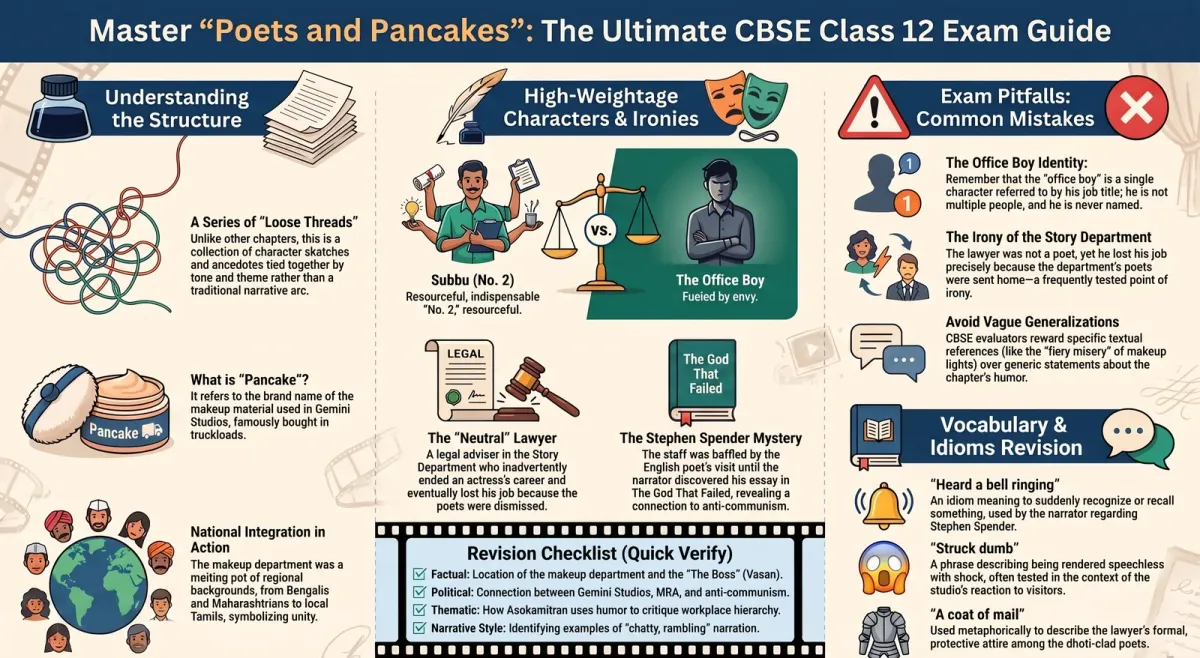
With board exams in mind, “Poets and Pancakes” rewards students who can move beyond the plot and discuss character motivation, humour, and the chapter’s larger themes with specific textual evidence. This post gathers practical exam strategies, a set of important questions across formats, common mistakes to avoid, and a quick revision checklist for CBSE Class 12 English Flamingo Chapter 6.
Why This Chapter Trips Students Up
Unlike more plot-driven Flamingo chapters, “Poets and Pancakes” is structured around a series of loosely connected character sketches and anecdotes rather than a single narrative arc. Students who try to summarise it as a straightforward story often lose marks because there isn’t one central event — the make-up department, the office boy, Subbu, the lawyer, the MRA troupe, and Stephen Spender are all separate threads tied together by tone and theme rather than plot. Exam answers should reflect this structure explicitly rather than force it into a conventional beginning-middle-end summary.
High-Weightage Question Types
CBSE typically tests this chapter through a mix of formats. Expect very short-answer questions on factual details (who the office boy resented, what Pancake refers to, who The Boss was); short-answer questions asking students to explain a specific incident (the lawyer’s recording of the actress, the rat-and-tigress anecdote); and long-answer questions asking for character analysis, thematic discussion, or an explanation of the chapter’s narrative style. Some papers also include value-based or opinion questions connecting the chapter’s themes — such as envy or workplace hierarchy — to real-life situations.
Important Short-Answer Questions
-
Why does the author describe the make-up department as an example of “national integration”?
-
What was the “fiery misery” experienced by those subjected to make-up, and why?
-
Why did the office boy direct his frustration specifically at Kothamangalam Subbu?
-
What made Subbu indispensable to The Boss and to Gemini Studios’ productions?
-
Why is the lawyer described as “a neutral man in an assembly of Gandhiites and khadiites”?
-
What incident led to the end of the temperamental actress’s acting career?
-
Why did the Story Department eventually get shut down, and what was ironic about the lawyer’s fate?
-
What was the Moral Re-Armament troupe, and how did its visit influence Tamil theatre?
-
Why did the studio staff misunderstand the purpose of the English visitor’s reception?
-
How did the narrator eventually learn the true identity of the English visitor?
Important Long-Answer Questions
-
Describe the character of Kothamangalam Subbu and explain why he attracted both admiration and enmity at Gemini Studios.
-
Discuss how Asokamitran uses humour to comment on workplace hierarchy and envy in the chapter.
-
Explain the significance of Stephen Spender’s visit to Gemini Studios and how the narrator eventually understands its true purpose.
-
“Poets and Pancakes” has been called an example of chatty, rambling narration. Discuss this narrative style with examples from the text.
-
Compare the office boy and Kothamangalam Subbu as two contrasting responses to disappointment and ambition.
-
Discuss the theme of political innocence as it appears in the chapter, with reference to both the MRA troupe and Stephen Spender.
Common Mistakes to Avoid
Many students mistakenly treat the office boy and the “office boy” who works in the make-up department as two different characters — they are the same person, simply described by his job title rather than his name, since he is never given one in the text. Another frequent error is confusing the lawyer’s role: he is not one of the poets, but a rational outsider within the same Story Department, and his losing his job is ironic precisely because he was not one of the writers being dismissed. Students also often summarise the Stephen Spender episode without connecting it back to The God That Failed, missing the chapter’s actual point about Cold War politics. Finally, avoid writing generic answers about “humour” without citing specific incidents — CBSE evaluators consistently reward precise textual references over vague generalisations.
Quick Vocabulary and Phrase Revision
The NCERT textbook highlights several idiomatic expressions worth revising before the exam: “blew over” (an outburst subsided), “catapulted into” (suddenly thrust into), “played into their hands” (unknowingly helped someone’s plan), “heard a bell ringing” (suddenly recognised or recalled something), “was struck dumb” (rendered speechless with shock), “a coat of mail” (protective armour, used here to describe the lawyer’s formal coat), and “the favourite haunt” (a frequently visited place). Being able to define these in context, and use them correctly in a sentence, is a common short-answer requirement.
Final Revision Checklist
-
Can you explain what “Pancake” refers to and where the make-up department was located?
-
Can you list the different regional and community backgrounds of the make-up department’s successive heads?
-
Can you explain why the office boy resents Kothamangalam Subbu specifically?
-
Can you describe Subbu’s talents and his position in the Story Department?
-
Can you explain the irony behind the lawyer losing his job?
-
Can you summarise the Moral Re-Armament troupe’s visit and its lasting effect on Tamil theatre?
-
Can you explain who Stephen Spender is and how the narrator eventually identifies him?
-
Can you connect The God That Failed to the chapter’s final revelation about Spender?
-
Can you identify at least three examples of gentle humour or irony in the chapter?
-
Can you define the key idiomatic phrases highlighted in the textbook?
Related Reading
-
Poets and Pancakes Summary and Analysis – CBSE Class 12 English Flamingo Chapter 6
-
Poets and Pancakes Character Sketch – Subbu, the Lawyer & More (CBSE Class 12 Flamingo)
-
Poets and Pancakes Themes Explained – CBSE Class 12 English Flamingo Chapter 6
-
Poets and Pancakes NCERT Solutions – CBSE Class 12 English Flamingo Chapter 6
Start Learning with ChampionsPrep
Want practice questions, revision checklists, and exam-focused notes for every Flamingo chapter? It is free to register & pay as you use — explore ChampionsPrep for CBSE Class 12 English resources built around exactly what your board exam expects.
Test Your Knowledge
Poets and Pancakes Exam Tips, Important Questions & Revision Checklist – CBSE Class 12 Flamingo
Frequently Asked Questions
What kind of questions does CBSE usually ask from "Poets and Pancakes"? +
A mix of short factual questions, incident-based explanations, and long-answer questions on character analysis, themes, and narrative style.
What is the most common mistake students make with this chapter? +
Treating it as a single connected story rather than a series of linked character sketches and anecdotes, which leads to weak, unfocused summaries.
Why is the lawyer's storyline important for exam answers? +
Because the irony of his losing his job - the least "poetic" member of the Story Department losing his job because the poets left - is a frequently tested point.
How should students approach the Stephen Spender episode in an answer? +
By connecting his visit to its later explanation through The God That Failed, showing they understand the chapter's point about Cold War politics rather than just narrating the visit itself.
Are vocabulary and idiom questions common for this chapter? +
Yes - the textbook itself highlights specific idiomatic expressions, and CBSE papers often test whether students can explain or use them in context.
AI-powered practice — free to start