
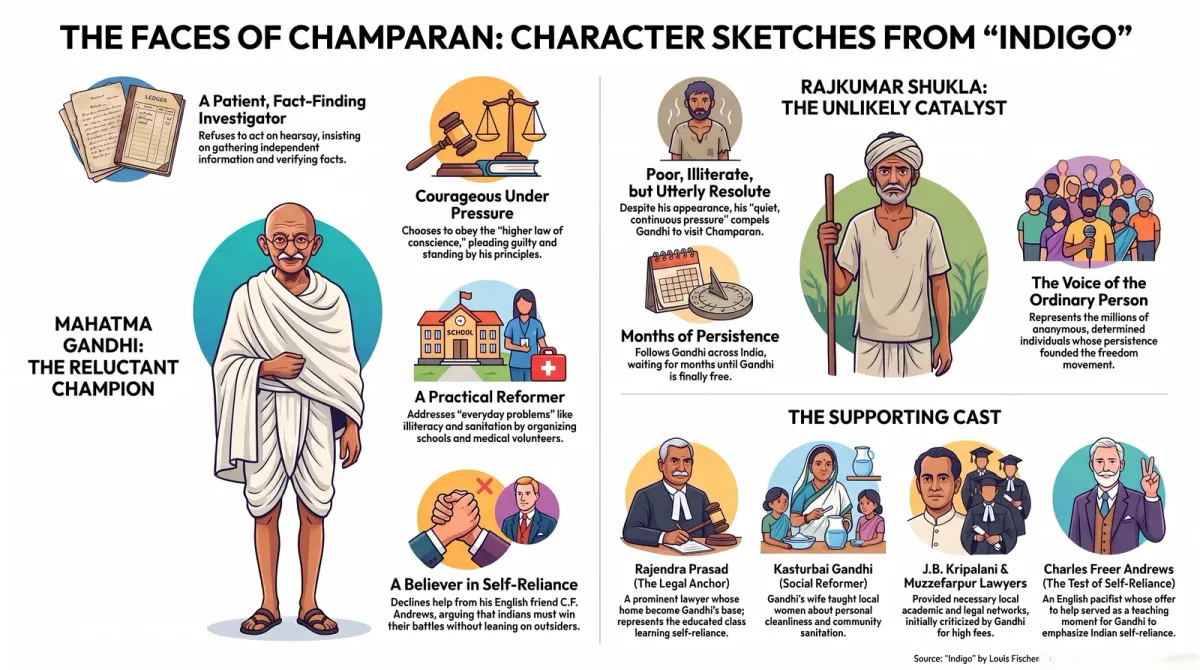
Louis Fischer’s “Indigo” is built around a small cast of real, historical figures, each drawn with restraint but sharp specificity. This post examines the two central characters — Mahatma Gandhi and Rajkumar Shukla — along with the supporting figures whose actions shape the Champaran episode, a frequent focus of CBSE Class 12 exam questions.
Mahatma Gandhi: The Reluctant Champion Who Became a Leader
A Patient, Fact-Finding Investigator
Gandhi enters the chapter not as a firebrand but as a busy public figure with commitments in Cawnpore and elsewhere in India. He does not rush to Champaran on Shukla’s word alone; instead, he insists on visiting Muzzafarpur first to gather independent information, wiring Professor Kripalani ahead of arrival. This instinct — verify before you act — defines his approach throughout the chapter. When British officials refuse him information, calling him an outsider, he calmly rejects the label rather than arguing the point emotionally.
Courageous Under Pressure
When served an official notice to leave Champaran, Gandhi does not flee or negotiate quietly. He signs the notice and openly states he will disobey it, then pleads guilty in court while explaining his reasoning: obedience to a higher law of conscience outweighs the risk of appearing to break civil law. He refuses bail during the recess, choosing to await judgment rather than secure comfort. This willingness to accept punishment without protest or fear becomes the moral center of the chapter.
A Practical Reformer, Not Just a Political Strategist
Gandhi’s leadership does not end with the legal victory. He immediately turns to Champaran’s everyday problems — illiteracy, poor sanitation, inadequate healthcare, and neglected schooling — and organises volunteers, including his own son Devadas and his wife Kasturbai, to address them. This reveals a leader who treats large political struggles and small human needs as inseparable, a quality the chapter repeatedly emphasises as distinctly Gandhian.
A Believer in Self-Reliance
When his English friend Charles Freer Andrews offers to stay and help the Champaran effort, Gandhi firmly declines, telling his lawyer colleagues that leaning on an Englishman — however sympathetic — would betray weakness in an unequal fight the Indians must win on their own terms. Rajendra Prasad later admits Gandhi had judged their unspoken thinking correctly, calling it a lesson in self-reliance rather than dependence.
Rajkumar Shukla: The Unlikely Catalyst
Poor, Illiterate, but Utterly Resolute
Shukla is introduced as a peasant who looks “like any other peasant in India” — poor and visibly worn down by hardship. He cannot read or write, yet he is the one figure in the chapter whose sheer persistence sets the entire Champaran movement in motion. His determination is not loud or dramatic; it is quiet, continuous pressure, expressed through simply staying close to Gandhi and repeating his request.
The Embodiment of Ordinary People’s Contribution
Shukla follows Gandhi from the Lucknow Congress session to his ashram near Ahmedabad, and later waits patiently at an appointed spot in Calcutta for months until Gandhi is free to meet him. He never wavers, never gives up, and never resorts to complaint beyond his repeated plea to “fix a date.” Through Shukla, the chapter makes a larger point: India’s freedom movement was carried forward not only by prominent leaders but by anonymous, determined individuals willing to keep pressing for justice.
Supporting Figures Who Shape the Narrative
Rajendra Prasad
A respected Muzzafarpur-based lawyer who later became President of the Congress party and of independent India, Prasad’s household becomes an early base for Gandhi’s Champaran investigations. His own reflections, quoted in the chapter, reveal how Gandhi’s example reshaped the thinking of the educated lawyers who initially assumed a purely legal role.
Professor J.B. Kripalani and the Muzzafarpur Lawyers
Kripalani welcomes Gandhi with a large body of students at the railway station, connecting him to local academic and legal networks. The Muzzafarpur lawyers, meanwhile, initially represent the peasants for hefty fees — a practice Gandhi openly criticises, arguing that fear-stricken peasants need liberation from fear far more than they need courtroom victories.
Charles Freer Andrews
An English pacifist and devoted follower of Gandhi, Andrews appears briefly but meaningfully, becoming the occasion for Gandhi’s speech on self-reliance. His near-involvement in Champaran highlights, by contrast, Gandhi’s insistence that Indians win their own battles.
Kasturbai Gandhi
Gandhi’s wife takes on the practical task of teaching Champaran’s women about personal cleanliness and community sanitation, extending the movement’s reach into everyday domestic life and reflecting the chapter’s larger theme that reform must touch ordinary routines, not just legal structures.
Why These Character Portraits Matter for Exams
CBSE Class 12 English exams frequently ask students to analyse how character and action reveal theme. Gandhi’s portrayal demonstrates leadership through patience, courage, and practical compassion, while Shukla represents the quiet power of ordinary persistence. Understanding both figures — and the supporting cast around them — equips students to write nuanced, example-driven answers rather than generic character descriptions.
Start Learning Smarter with ChampionsPrep
Need well-organised character notes and quick-revision material for every Flamingo chapter? ChampionsPrep helps CBSE and Maharashtra Board Class XI–XII students prepare for boards and entrance exams like CUET, IPMAT, NPAT, and SET with structured, exam-ready content. It is free to register & pay as you use — start exploring ChampionsPrep today.
Test Your Knowledge

Character Sketch of Gandhi and Rajkumar Shukla in Indigo – CBSE Class 12
Frequently Asked Questions
How is Gandhi portrayed in the chapter Indigo? +
As a patient, fact-driven, and courageous leader who blends political action with practical social reform, and who values self-reliance over outside help.
What are the main character traits of Rajkumar Shukla? +
He is poor, illiterate, and physically unremarkable, but extraordinarily persistent and resolute, refusing to give up until Gandhi agrees to visit Champaran.
Why does Gandhi refuse Charles Freer Andrews's help? +
Gandhi believes accepting an Englishman's support in an unequal fight would show weakness; he insists Indians must rely on themselves to win the battle.
What role does Rajendra Prasad play in the chapter? +
He is a prominent Muzzafarpur lawyer who assists Gandhi's investigation in Champaran and later reflects on how Gandhi taught the lawyers a lesson in self-reliance.
Why is Rajkumar Shukla considered important despite being a minor character? +
He represents the countless ordinary, often illiterate Indians whose quiet persistence and courage contributed meaningfully to the freedom movement, even without personal fame.
AI-powered practice — free to start