

The CBSE Class 12 Economics Sample Question Paper 2026-27 gives students preparing for the 2027 Boards a strong indication of what "application-based Economics" now looks like.
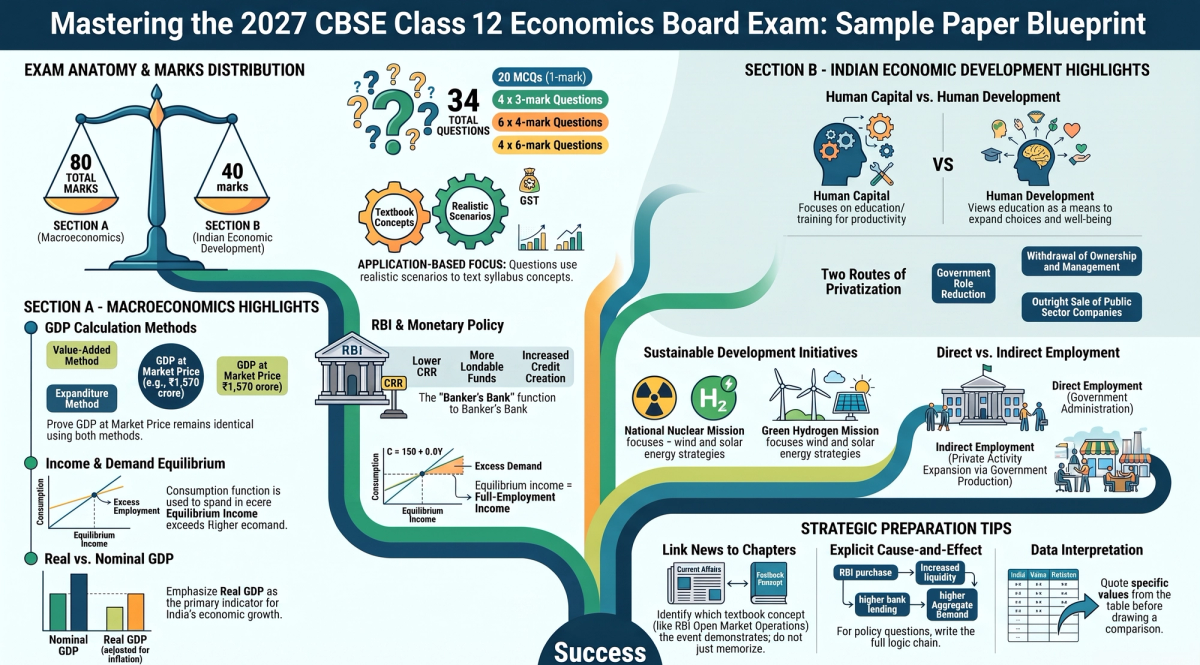
The paper carries 80 marks, divided into Section A (Macroeconomics) and Section B (Indian Economic Development). It contains 20 one-mark MCQs, four 3-mark questions, six 4-mark questions and four 6-mark questions.
The most important feature is the use of realistic economic situations: RBI policy, FDI, GDP, the Union Budget, employment, human capital and sustainable development all appear as contexts for textbook concepts.
Section A: Macroeconomics
The MCQs cover: government budget; money supply; foreign exchange; fiscal deficit; consumption and multiplier; Balance of Payments; functions of money. Even the one-mark questions often require a calculation or cause-and-effect sequence.
Question 11: GDP by two methods
Students are asked to show that GDP at Market Price gives the same result under Value-Added Method and Expenditure Method.
The marking scheme calculates: Value-Added Method: ₹1,900 crore – ₹330 crore = ₹1,570 crore; Expenditure Method: ₹500 + ₹400 + ₹600 + ₹70 = ₹1,570 crore.
This tests more than formulas — know which item belongs in which method and avoid double counting.
Question 12: GST
The paper uses a cartoon to ask students to analyse how GST improved efficiency in the taxation system and benefited the economy.
The marking scheme highlights: subsuming multiple indirect taxes; reducing cascading; reducing business/production costs; improving competitiveness; increasing transparency; improving ease of doing business — a good example of converting a cartoon into economic analysis.
Question 13: RBI as Banker’s Bank or CRR
The first option asks students to identify the RBI function involved when banks need a mechanism for inter-bank transactions and support. The marking scheme identifies Banker’s Bank: RBI accepts bank deposits; advances loans when required; maintains reserves; settles inter-bank claims; acts as lender of last resort.
The alternative asks students to define Cash Reserve Ratio and analyse the impact of a CRR reduction. Marking logic: lower CRR → more lendable funds → greater lending capacity → more credit creation.
Question 14: FDI and Balance of Payments
A hypothetical economy receives increased FDI after investing in human capital. Expected reasoning: FDI inflows increase the supply of foreign exchange and strengthen the Balance of Payments position.
The question also asks for the exchange-rate system when the authority does not intervene: a flexible exchange-rate system.
Question 15: Equilibrium income and excess demand
Given: C = 150 + 0.8Y; Autonomous Investment = 250; Full-employment income = 1,600. At equilibrium: Y = C + I → 0.2Y = 400 → Y = 2,000.
Because equilibrium income of 2,000 exceeds full-employment income of 1,600, the economy faces excess demand. The marking scheme states that excess demand raises the general price level without increasing output and employment beyond full employment.
Question 16: GDP and India’s growth — 6 marks
A passage on India’s economic growth asks students to define GDP; distinguish real GDP from nominal GDP in context; explain why real GDP is useful; comment on India’s economic position and the reasons for recent growth.
The marking scheme identifies the growth figure as Real GDP, since it is adjusted for inflation, and points to factors including: structural reforms; resilient domestic demand; moderating inflation; higher labour-force participation; revival of investment; investor confidence; deeper global integration.
Question 17: Consumption Function and RBI OMO — 6 marks
One option asks for autonomous consumption; induced consumption; rationale for RBI Open Market Operation purchases; effect on Aggregate Demand.
The marking scheme explains the chain: RBI purchases government securities → liquidity increases → banks have more funds to lend → Aggregate Demand may rise.
The alternative asks students to evaluate APC at break-even income, ex-ante saving and investment, and the relationship between Aggregate Demand and the Investment curve.
Section B: Indian Economic Development
The MCQs and short answers cover: employment; colonial economy; human capital; Indian planning; reforms; NABARD; land reforms; rural development.
Question 28: Privatisation
A passage describes government reducing its role in public-sector undertakings. The marking scheme identifies the policy as Privatisation, through two routes: withdrawal of ownership and management; outright sale of public-sector companies to the private sector.
Question 29: Livestock productivity or formal vs informal sector
The first option asks for initiatives to improve livestock productivity — improved breeds/modern technology and improved veterinary facilities. The alternative compares formal and informal employment through job security, regular income and social-security differences.
Question 30: Karve Committee and colonial trade
Combines two historical-development topics: the Karve Committee and village/small-scale industries; British monopoly over India’s foreign trade. The marking scheme links village and small-scale industries with labour intensity and employment generation.
Question 31: Government and employment
Students evaluate government’s direct and indirect role in employment generation. The marking scheme distinguishes: Direct employment — jobs in administration, public-sector industries and government organisations. Indirect employment — expansion of related private-sector activity as government production rises.
Question 32: Human capital formation — 4 marks
A case contrasts expenditure on health (yoga/fitness) with expenditure on information (job portals, counselling). The alternative distinguishes Human Development from Human Capital Formation: education that expands choices and well-being is Human Development; training aimed at productivity and output is Human Capital Formation.
Question 33: India-China comparison or China’s one-child policy
The first option uses a data table on human-development indicators for India, China and Pakistan: identify indicators, compare data, explain Special Economic Zones. The marking scheme notes, among other points, the difference in maternal mortality and access to drinking water between India and China.
The alternative asks about the one-child norm and challenges in the Great Leap Forward campaign.
Question 34: Sustainable development — 6 marks
A passage on India’s energy transition asks students to define global warming; identify two government initiatives; explain two strategies for sustainable development.
The marking scheme names National Nuclear Mission and Green Hydrogen Mission as initiatives, and wind and solar energy as strategies.
How to prepare from this sample paper
- Link current affairs to chapters — don’t memorise news, ask which textbook concept the event demonstrates.
- Show cause-and-effect. For RBI, fiscal policy, foreign exchange and aggregate demand questions, write the chain explicitly.
- Practise numericals separately. GDP, multiplier, equilibrium income and government-budget questions should become automatic.
- Use data carefully — if a question gives a table, quote the relevant values before drawing the comparison.
- Distinguish similar concepts: real vs nominal GDP, human capital vs human development, current vs capital transactions, direct vs indirect employment.
Keynesian Multiplier & Equilibrium Income Simulator
Explore equilibrium output, investment multiplier, and inflationary vs deflationary demand gaps with dynamic parameter adjustments.
Keynesian cross: equilibrium income
Equilibrium
At full employment
Planned spending is below full-employment output: deficient demand.
A positive planned-spending gap at Yf signals excess demand; the income gap and the spending gap are different quantities.
ChampionsPrep Next Step
After solving the official paper, classify each mistake as conceptual, numerical, interpretation or answer-structure related, then practise another question from the same category. Registration on ChampionsPrep is free and you only pay as you use it, so you can move from the official SQP concept into targeted questions, concept revision and AI Tutor support instead of stopping at an answer key.
Frequently Asked Questions
How is the Class 12 Economics sample paper divided? +
It has two sections: Macroeconomics and Indian Economic Development.
How many 6-mark questions are there? +
The paper contains four 6-mark long-answer questions.
Does the sample paper include current affairs? +
It uses recent economic and policy contexts such as RBI action, the Union Budget, GDP growth and energy transition to test syllabus concepts.
Should I memorise exact current-affairs figures? +
Use the figures given in the question. More important is understanding the economic mechanism the figure illustrates.
How is the Class 12 Economics paper divided between Macro and Indian Economy? +
The paper carries 80 marks split equally: 40 marks for Introductory Macroeconomics (Section A) and 40 marks for Indian Economic Development (Section B).
Keep practising Economics
AI-powered feedback and structured revision for Economics — free to start, at your own pace.
AI-powered practice — free to start