

The CBSE Class 12 Accountancy Sample Question Paper for 2026-27 is a useful blueprint for the 2027 Board exam because it shows exactly how concepts are tested across Partnership Firms, Companies and Financial Statement Analysis or Computerised Accounting.
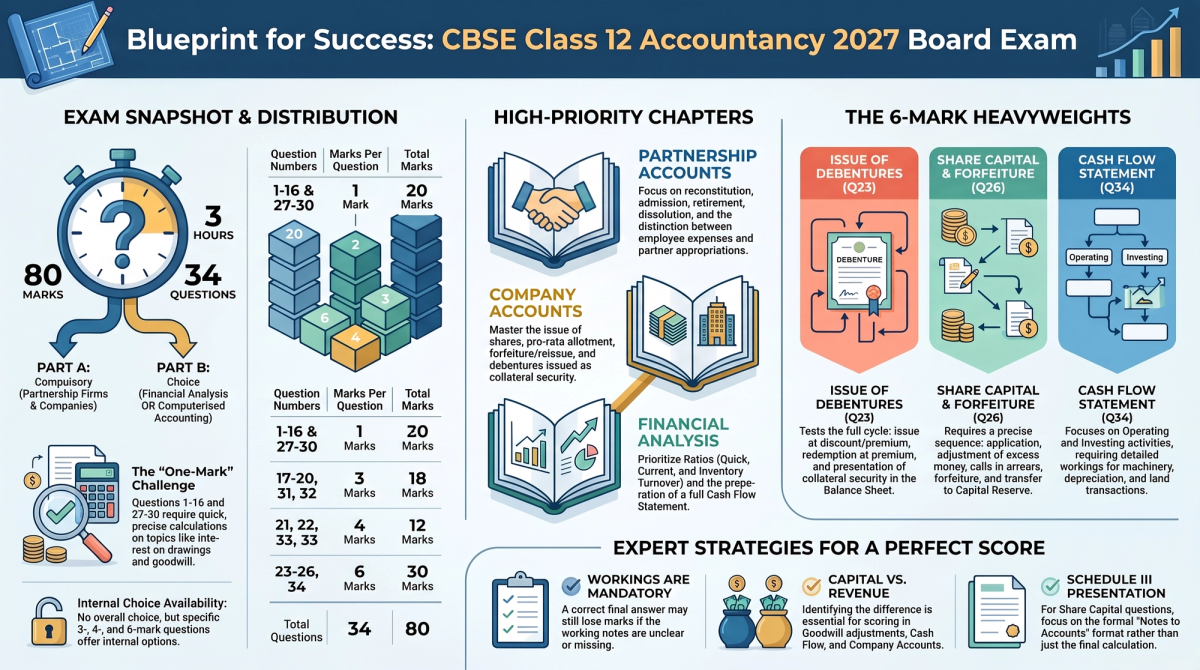
The paper carries 80 marks over three hours, with 34 questions. Part A is compulsory; Part B offers a choice between Analysis of Financial Statements and Computerised Accounting.
The biggest lesson: preparation cannot rest on memorising formats alone — CBSE repeatedly combines concepts, calculations and presentation.
CBSE Class 12 Accountancy Paper Pattern
Questions 1-16 and 27-30 carry 1 mark each. Questions 17-20, 31 and 32 carry 3 marks each. Questions 21, 22 and 33 carry 4 marks each. Questions 23-26 and 34 carry 6 marks each.
There is no overall choice, though selected 3-, 4- and 6-mark questions offer internal choice.
What Chapters Dominate the Paper?
Partnership Accounts: change in profit-sharing ratio; interest on drawings; partner loans; guarantee of profit; goodwill; admission; retirement; dissolution; revaluation; partner salary and commission; executor’s account.
Company Accounts: issue of shares; pro-rata allotment; securities premium; forfeiture and reissue; debentures; purchase consideration; collateral security.
Financial Statement Analysis: comparative and common-size statements; classification of items; current and quick ratio; inventory turnover; cash flow.
Important One-mark Questions: Do Not Underestimate Them
The MCQs are not simple memory checks — the paper works through interest on drawings, goodwill payable on death of a partner, guarantee of minimum profit, capital adjustment, share forfeiture/reissue, and purchase consideration.
A student can lose marks here despite "knowing the chapter" if the calculation isn’t quick and precise. Practise one-mark numerical MCQs separately, under a time limit.
Question 17: Dissolution of partnership
The question requires journal entries after assets and liabilities have already been transferred to the Realisation Account.
The marking scheme records:
Bank A/c Dr. ₹56,000 To Realisation A/c ₹56,000Realisation A/c Dr. ₹25,000 To Amit’s Loan A/c ₹25,000Realisation A/c Dr. ₹27,000 To Cash A/c ₹27,000What CBSE is testing: identifying what has already been transferred; treatment of realised debtors; settlement involving a partner; payment of creditors; avoiding unnecessary entries.
Common mistake: passing entries for Provision for Doubtful Debts or creditors again even though the question states that outside liabilities and assets have already been transferred.
Question 18: Appropriation under profit, insufficient profit and loss
Partners are entitled to salaries of ₹24,000, ₹16,000 and ₹16,000, while an omitted employee salary also needs adjustment; the marking scheme first removes it from available profit.
Case 1 (sufficient profit): profit after employee salary = ₹62,000; total salary = ₹56,000; balance ₹6,000 shared equally, so each partner gets salary plus ₹2,000.
Case 2 (insufficient profit): profit after employee salary = ₹35,000, below the ₹56,000 entitlement, so it is split 3:2:2, giving ₹15,000, ₹10,000 and ₹10,000.
Case 3 (loss): adjusted loss = ₹30,000; no partner salary is allowed and the loss is shared equally at ₹10,000 each.
Exam lesson: always distinguish an employee expense from a partner appropriation.
Question 20: Goodwill by average profit
The marking scheme adjusts abnormal and non-recurring items before finding average profit: adjusted profits total ₹83,00,000; average profit = ₹16,60,000; goodwill at three years' purchase = ₹49,80,000. What CBSE is testing: identifying abnormal loss; insurance claim treatment; removing capital/non-operating receipts; correcting a doubly-recorded expense; applying the years'-purchase formula.
Question 21: Share Capital presentation
The question asks for the Share Capital head and Notes to Accounts after pro-rata allotment, non-payment and forfeiture. The marking scheme shows subscribed and fully paid-up equity share capital of ₹9,00,000 plus forfeited shares of ₹26,000, giving ₹9,26,000 under Share Capital — a presentation question, not only a calculation one. Practise Schedule III-style classification and note format.
Question 23: Issue of debentures — 6 marks
One of the most important questions in the paper. It tests issue at discount; redemption at premium; issue at premium; loss on issue; collateral security; journal entries; Balance Sheet extract.
For collateral security, the marking scheme records a ₹4,00,000 bank loan and ₹5,00,000 of 9% debentures issued as collateral through Debenture Suspense; the bank loan appears under long-term borrowings, netted against Debenture Suspense.
What to revise: issue price; redemption value; discount/premium treatment; loss on issue; collateral-security entries; presentation.
Question 24: Change in profit-sharing ratio
This 6-mark case combines goodwill, sacrifice/gain, revaluation, reserves and capital adjustment: A sacrifices 1/10; B sacrifices 1/10; C gains 1/5; goodwill compensation = ₹30,000; net gain on revaluation = ₹25,000; reserves distributed in the old ratio; C’s adjusted capital = ₹2,22,500 — an integrated Partnership question typical of this paper.
Question 25: Admission or retirement
The admission option requires journal entries and a Balance Sheet after reconstitution: goodwill brought partly through machinery and furniture; insolvency of a debtor; revised provision for doubtful debts; patents becoming valueless; stock overvaluation; an unforeseen liability; incoming partner’s capital.
The marking scheme computes adjusted capitals of X and Y at ₹1,44,000 and ₹2,88,000, with Z bringing ₹1,08,000. The alternative asks students to reconstruct the Revaluation Account and Partners' Capital Accounts after retirement from the post-retirement Balance Sheet.
Question 26: Share issue, pro-rata allotment, forfeiture and reissue
A must-practise 6-mark question. Sequence: application money; excess application money adjustment after pro-rata allotment; allotment due; first and final call; calls in arrears; forfeiture; reissue; transfer to Capital Reserve.
The marking scheme records calls in arrears of ₹3,600 and a transfer of ₹9,600 to Capital Reserve after reissue.
Common mistake: losing track of the premium component at forfeiture.
Question 33: Ratios
The paper asks students either to explain the effect of transactions on the Quick Ratio, or to calculate Current Ratio and Inventory Turnover Ratio. The marking scheme gives Current Ratio = 1.47:1 and Inventory Turnover Ratio = 44 times — ratio preparation should include transaction-effect questions, not only formula substitution.
Question 34: Cash Flow Statement — 6 marks
The Financial Statement Analysis option ends with a full Cash Flow problem: Net Cash Flow from Operating Activities = ₹63,750; Net Cash used in Investing Activities = ₹1,24,000, requiring workings for machinery, accumulated depreciation, profit before tax and land purchased/sold during the year.
How to Score Better in Accountancy
- Write workings clearly — a correct final number with unclear workings can still lose marks.
- Separate capital and revenue items, essential in goodwill, cash flow and company accounts.
- Learn the order of journal entries; in share capital and debentures, sequence matters.
- Recheck ratios and signs — many errors come from using closing instead of average inventory, or reversing increases/decreases.
- Practise complete 6-mark questions on a blank sheet, not just chapter notes.
ChampionsPrep Next Step
Use this paper diagnostically: mark every concept that caused hesitation, then practise similar questions rather than rereading the same solution. Registration on ChampionsPrep is free and you only pay as you use it, so you can move from a difficult question into targeted practice, concept revision and AI Tutor support until the process becomes automatic.
Frequently Asked Questions
How many 6-mark questions are in the Accountancy sample paper? +
Questions 23-26 and 34 carry 6 marks, with internal choice available in selected questions.
Which chapters should I prioritise for the 2027 Boards? +
Based on the official SQP: Partnership reconstitution, admission/retirement, Share Capital, Debentures, ratios and Cash Flow.
Is the marking scheme enough for preparation? +
It is excellent for understanding expected treatment and marks, but should be combined with additional practice, since the Board exam will not repeat the same numbers and situations.
How many total questions are in the Class 12 Accountancy sample paper? +
The paper contains 34 compulsory questions across two parts: Part A (Accounting for Partnership Firms and Companies, 60 marks) and Part B (Analysis of Financial Statements, 20 marks).
Are calculations shown in working notes awarded marks by CBSE? +
Yes, CBSE marking schemes explicitly allocate partial marks for correct working notes in multi-step numericals like forfeiture, partnership, and cash flow statements.
Keep practising Accountancy
AI-powered feedback and structured revision for Accountancy — free to start, at your own pace.
AI-powered practice — free to start