

The official CBSE Class 12 Accountancy Sample Paper 2026-27 makes Partnership Accounts one of the strongest high-weightage areas for the 2027 Boards.
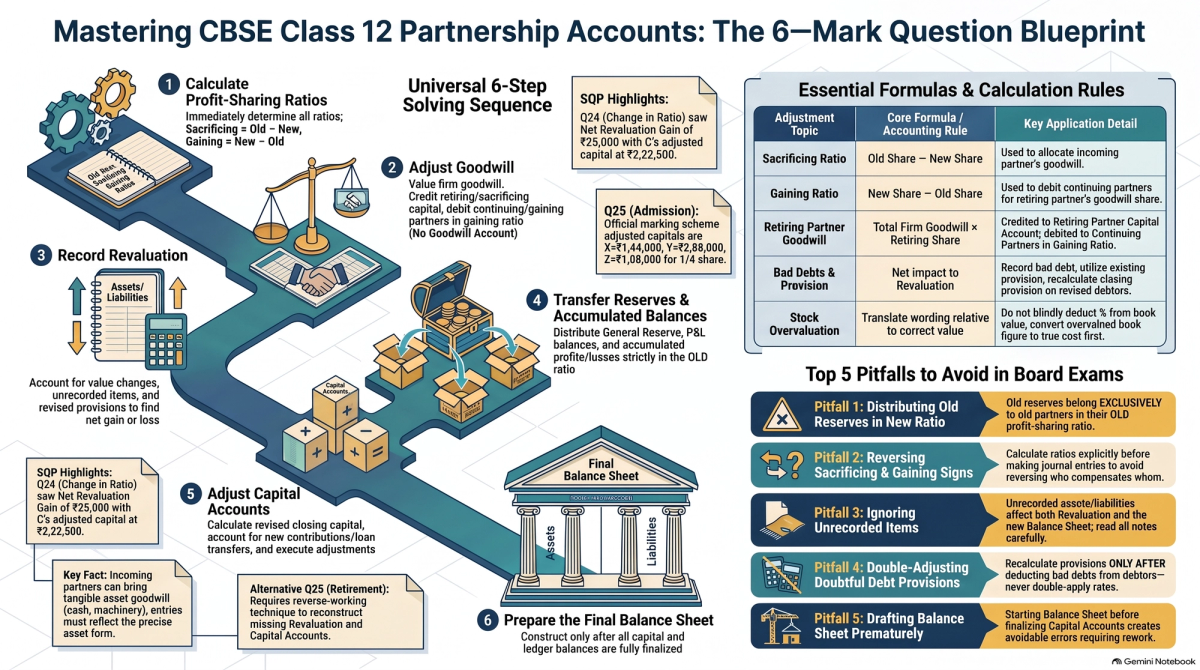
The important point is not simply that Partnership appears often. CBSE combines goodwill, revaluation, reserves, capital adjustments and profit-sharing changes within the same question, so a single missed step can cost marks across the rest of the answer.
Quick Reference: the Solving Sequence
Whichever reconstitution event you are asked about — change in ratio, admission, retirement or death — the sequence is the same: find the ratios (old, new, sacrificing/gaining) → adjust goodwill → record revaluation → transfer reserves and accumulated profits/losses in the old ratio → settle capital → prepare the new Balance Sheet. Memorising this order is what transfers across different Board questions.
Question 24: Change in Profit-Sharing Ratio
Old ratio: 4:3:3
New ratio: 3:2:5
The marking scheme concludes: A sacrifices 1/10; B sacrifices 1/10; C gains 1/5.
The question then brings in: goodwill valuation; revaluation of Land & Building; provision for doubtful debts; an unrecorded liability; General Reserve; Profit & Loss Account balance; adjusted partner capital.
Important answers from the marking scheme:
Goodwill compensation = ₹30,000
Net gain on revaluation = ₹25,000
Reserve and P&L balance distribution = old ratio
C’s final adjusted capital = ₹2,22,500
How to Solve Reconstitution Questions
Use this order: Calculate old and new ratio. Find sacrificing/gaining ratio. Adjust goodwill. Record revaluation. Transfer reserves and accumulated profits/losses. Recalculate capital balances.
Sequence matters. If you change capitals before distributing old reserves, later figures can go wrong, because the reserve distribution is meant to reach partners in their old ratio, before any new partner or new ratio applies.
Question 25: Admission of a Partner
X and Y admit Z for a 1/4 share.
Adjustments include: goodwill; machinery and furniture brought by the incoming partner; bad debts; revised provision for doubtful debts; patents becoming valueless; stock overvaluation; unforeseen liability; reserve and accumulated loss; capital contribution by Z.
The marking scheme arrives at:
Adjusted capital of X = ₹1,44,000
Adjusted capital of Y = ₹2,88,000
Z’s capital = ₹1,08,000
The admission question tests whether you can move from journal entries to the final Balance Sheet without losing an adjustment, which is exactly why examiners award marks step by step rather than only for the final figure.
Goodwill in This Question
Z’s share of goodwill is settled partly through assets brought into the business.
That means students need to understand the economic substance rather than assuming goodwill must always be brought in cash — an incoming partner’s contribution can take the form of tangible assets, cash, or a combination of both, and the journal entries must reflect whichever form the question describes.
Bad Debts and Provision
A debtor becomes partly irrecoverable and the provision for doubtful debts is also revised.
The correct approach is: record the bad debt; use the existing provision where appropriate; recalculate the required closing provision on revised debtors; take the net impact to Revaluation Account.
Stock Overvaluation
If stock is overvalued by 20%, do not simply deduct 20% from the book value without checking what "overvalued by 20%" means relative to the correct value. Translate the wording carefully before making the adjustment — 20% overvaluation on the book figure is not the same as a 20% reduction needed to reach the correct figure, and mixing the two is a common source of a wrong revaluation loss.
Alternative Q25: Retirement
The alternative gives the pre-retirement and post-retirement Balance Sheets but omits the Revaluation Account and Partners' Capital Accounts.
Students must reconstruct the missing accounts.
This is a reverse-working question.
It tests: goodwill adjustment; reserves; revaluation; retirement settlement; loan transfer; capital balances.
Common Mistakes in Partnership 6-mark Questions
Mistake 1
Using new ratio for old reserves.
Old reserves and accumulated balances belong to partners in the old ratio, because they were earned before the reconstitution — distributing them in the new ratio transfers value the incoming or gaining partner has not earned.
Mistake 2
Confusing sacrificing and gaining ratios.
Calculate them explicitly. Sacrificing ratio = old share minus new share; gaining ratio = new share minus old share. Getting the sign wrong reverses who compensates whom for goodwill.
Mistake 3
Missing unrecorded assets/liabilities.
These affect Revaluation Account and the new Balance Sheet, and examiners frequently plant them in a single line of the question to test whether students read the full adjustment list before starting the workings.
Mistake 4
Adjusting provision for doubtful debts twice.
Recalculate only after considering bad debts and the revised debtor balance — do not apply the old provision rate to the old debtor figure and then separately apply the new rate again.
Mistake 5
Starting the Balance Sheet too early.
Finish all capital and revaluation workings first; a Balance Sheet started before the Partners' Capital Accounts are finalised almost always needs to be redone once the correct closing capitals are known.
Practice It Yourself
Practice Question 1
P and Q share profits in the ratio 3:2. They admit R for a 1/5 share, and R acquires this share equally from P and Q. Calculate the new profit-sharing ratio of P, Q and R.
Approach & Solution: R’s share = 1/5, acquired equally, so 1/10 comes from each of P and Q. New share of P = 3/5 − 1/10 = 5/10. New share of Q = 2/5 − 1/10 = 3/10. R’s share = 1/5 = 2/10. New ratio P : Q : R = 5 : 3 : 2.
Practice Question 2
A firm’s goodwill is valued at ₹60,000 at the time of a partner’s retirement. The retiring partner’s share of profit was 1/4. Calculate the amount to be compensated to the retiring partner for goodwill, and state which accounts record this adjustment.
Approach & Solution: Retiring partner’s share of goodwill = 1/4 × ₹60,000 = ₹15,000. This amount is credited to the retiring partner’s Capital Account and debited to the continuing partners' Capital Accounts in their gaining ratio, since no Goodwill Account is opened in the books under the prevailing accounting treatment.
What to Practise Before Boards
Change in profit-sharing ratio; goodwill without opening Goodwill Account; revaluation with unrecorded items; admission with capital adjustment; retirement with loan settlement; death and executor account; reserves and accumulated losses; reconstructed accounts from a final Balance Sheet.
ChampionsPrep Next Step
Practise one reconstitution question every day for a week, but vary the adjustment set each time. Registration on ChampionsPrep is free and you only pay as you use it, so once the solving sequence above feels automatic, you can keep testing it against fresh combinations of goodwill, revaluation and capital adjustments at no upfront cost.
Frequently Asked Questions
Are admission and retirement usually 6-mark topics? +
They are represented as 6-mark alternatives in the official sample paper and should be treated as high-priority long-answer practice.
What is the best solving order for a reconstitution question? +
Ratios, then goodwill, then revaluation, then reserves, then capital adjustment, then the Balance Sheet.
Should I prepare both journal entries and ledger accounts for Partnership? +
Yes. The sample paper tests both formats, so practise moving between journal entries, Revaluation Account, Partners' Capital Accounts and the Balance Sheet.
How is a retiring or deceased partner compensated for goodwill? +
The retiring or deceased partner’s share of goodwill is credited to their Capital Account and debited to the continuing partners' Capital Accounts in their gaining ratio.
How is hidden goodwill calculated during partner admission? +
Hidden goodwill = (New partner's capital × Reciprocal of new partner's share) − Total actual combined capital of all partners including the new partner.
Keep practising Accountancy
AI-powered feedback and structured revision for Accountancy — free to start, at your own pace.
AI-powered practice — free to start