
What Is Partnership? Meaning, Features & Partnership Deed Explained
When a business outgrows what one person can manage alone, entrepreneurs often join hands to pool capital, share responsibilities, and spread risk. This arrangement is called a partnership, and it’s one of the first topics in CBSE Class 12 Accountancy under “Accounting for Partnership: Basic Concepts.” Before preparing any ledger account for a partnership firm, you need to understand what legally makes an arrangement a partnership, and how a partnership deed governs the relationship between partners.
Meaning of Partnership
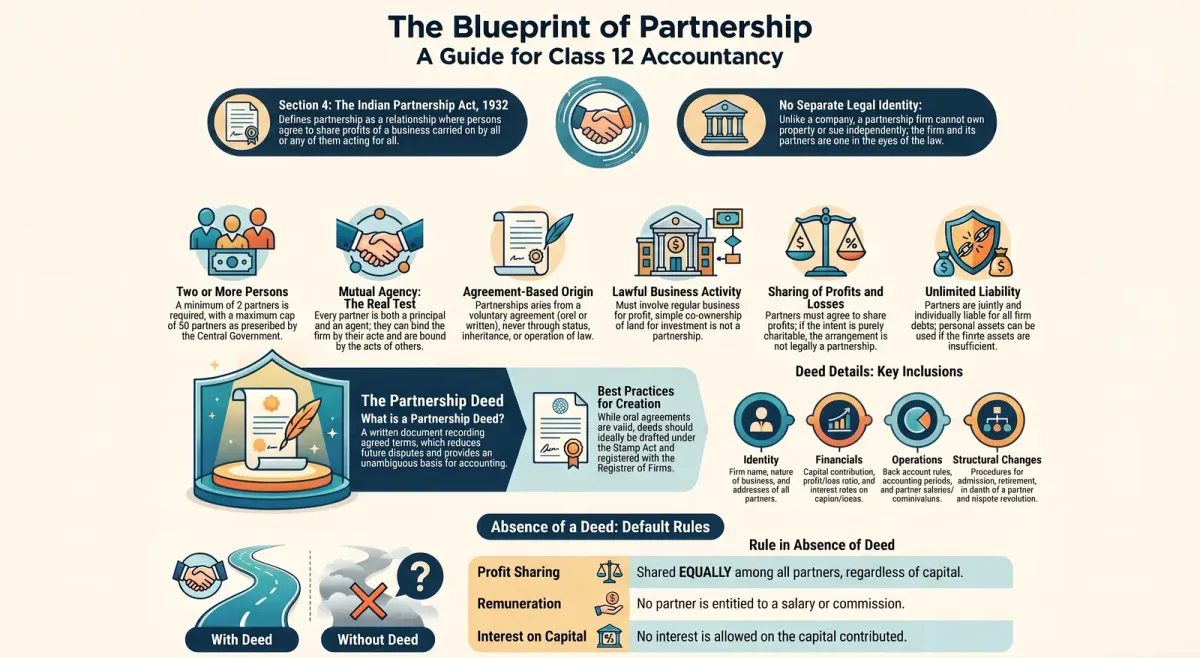
Section 4 of the Indian Partnership Act, 1932 defines partnership as the relationship between persons who have agreed to share the profits of a business carried on by all of them, or by any of them acting for all. In simpler terms, when two or more people contribute capital or skill and agree to run a business and split its profits, they become partners, and together they form a firm, operating under a firm’s name. Importantly, a partnership firm has no separate legal identity apart from its partners — unlike a company, it cannot own property or sue independently of the people who make it up.
Essential Features of Partnership
To qualify as a partnership under the law, an arrangement must satisfy several conditions simultaneously.
1. Two or More Persons
A partnership needs at least two people. The Central Government, using powers under Section 464 of the Companies Act, 2013, has capped the maximum number of partners in a firm at 50 (the Act permits a ceiling of up to 100).
2. An Agreement
Partnership arises only out of an agreement — it can never be created by status, inheritance, or operation of law. This agreement can be oral or written, though a written one is strongly recommended.
3. Carrying On a Business
The agreement must be to carry on a lawful business activity. Simply owning an asset jointly does not make people partners. If two friends jointly buy a plot of land purely as an investment, they are co-owners, not partners. But if they buy and sell land regularly to earn profit, that qualifies as a business, and they become partners.
4. Mutual Agency
This is often called the real test of partnership. Every partner is both a principal and an agent for the other partners — each can bind the firm through acts done in the ordinary course of business, and is equally bound by acts of fellow partners. Without mutual agency, an arrangement cannot legally be called a partnership, even if profits are shared.
5. Sharing of Profits and Losses
The partners must agree to share the profits of the business. While the legal definition emphasises profit-sharing, the sharing of losses is understood to be implied. If people join together purely for a charitable purpose with no intention of sharing profits, it will not be treated as a partnership.
6. Unlimited Liability
Each partner is liable, jointly with the others and also individually, for all the debts and obligations of the firm incurred while they were a partner. This liability is unlimited — if the firm’s assets fall short, a partner’s personal assets can be used to settle the firm’s dues.
What Is a Partnership Deed?
A partnership deed is a written document that records the terms agreed upon by the partners. While the law does not compel partners to put their agreement in writing, doing so is considered good practice because it creates clarity and reduces the scope for future disputes. Ideally, the deed should be drafted in line with the Stamp Act and registered with the Registrar of Firms.
What Does a Partnership Deed Usually Contain?
A well-drafted partnership deed typically covers:
-
Name and address of the firm and the nature of its business
-
Names and addresses of all partners
-
Amount of capital contributed by each partner
-
The firm’s accounting period and date of commencement
-
Rules for operating bank accounts
-
The agreed profit and loss sharing ratio
-
Rate of interest on capital, drawings, and partners’ loans
-
Provisions for partners’ salary or commission, if any
-
Rights, duties, and liabilities of each partner
-
Procedure for admission, retirement, or death of a partner
-
Method for resolving disputes among partners
Why a Written Deed Really Matters
Here’s the practical accounting angle: if the deed is silent on an issue, the Indian Partnership Act, 1932’s default rules step in automatically — and these may not reflect what the partners actually intended. For instance, without a deed, no partner can claim a salary or interest on capital, and profits are shared equally regardless of capital contributed. A clear, written deed lets partners customise these terms and gives the accountant an unambiguous basis for preparing the books.
Key Takeaways
-
Partnership is defined by agreement, shared business activity, mutual agency, and profit-sharing.
-
A firm has no separate legal identity from its partners; liability is unlimited.
-
A partnership deed is not compulsory but is essential for smooth accounting and dispute-free operations.
-
In the absence of a deed, the Indian Partnership Act 1932’s default provisions apply.
Ready to Test Your Understanding?
Reading about partnership is one thing — applying it in exam-style questions is another. Head over to championsprep.in to practice pay-per-use question sets on Partnership Basic Concepts, designed specifically for CBSE and State Board Commerce students preparing for board exams and entrance tests like CUET.
Test Your Knowledge

What Is Partnership? Meaning, Features & Partnership Deed Explained (Class 12)
Frequently Asked Questions
What is the minimum and maximum number of partners allowed in a partnership firm? +
A partnership needs a minimum of two partners. The Central Government has prescribed a maximum of 50 partners under the Companies Act, 2013.
Is it compulsory to have a written partnership deed? +
No. The Indian Partnership Act, 1932 does not require the agreement to be in writing — an oral agreement is equally valid. However, a written, registered deed is strongly recommended to prevent disputes.
What happens if the partnership deed does not mention the profit-sharing ratio? +
If the deed is silent, profits and losses are shared equally among all partners, regardless of how much capital each one contributed.
What is meant by mutual agency in a partnership? +
Mutual agency means each partner acts as both a principal and an agent for the other partners — actions taken by one partner in the ordinary course of business are binding on the whole firm.
Can two people who jointly own a property be called partners? +
Not necessarily. Mere co-ownership of an asset is not partnership unless the owners are also carrying on a business with the intention of sharing its profits.
AI-powered practice — free to start