
What is Accounting? Meaning, Definition and Need – Class 11 Accountancy
Introduction: Why Accounting Matters More Than Ever
If you are a Class 11 Commerce student stepping into the world of Accountancy for the first time, you might wonder — what exactly is accounting, and why is it so important? The answer is simpler than you think. Every time a business buys goods, pays salaries, or earns revenue, that activity needs to be tracked, measured, and communicated. Accounting is the discipline that does exactly that.
Over centuries, accounting has evolved from simple record-keeping into a powerful information system. Today, accountants are not just number-crunchers — they work in forensic accounting, e-commerce payment systems, financial planning, and even environmental accounting. This transformation happened because decision-makers need accurate, timely financial data to run businesses effectively.
What is Accounting? – The Core Definition
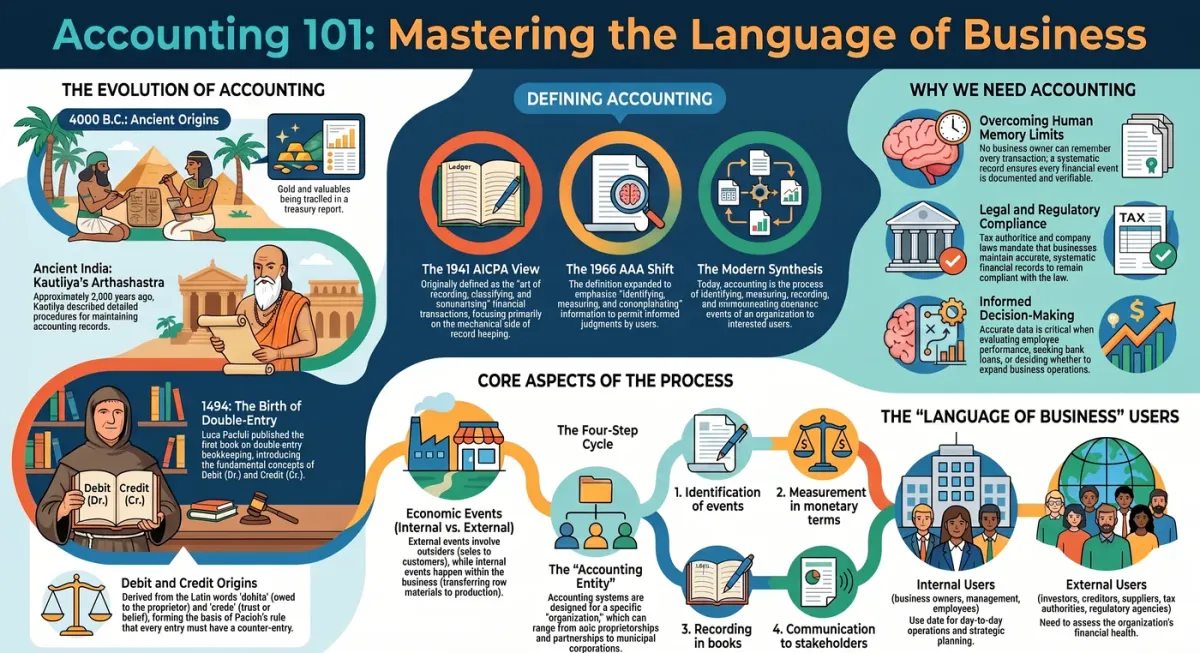
The AICPA Definition (1941)
The American Institute of Certified Public Accountants (AICPA) originally defined accounting as:
“The art of recording, classifying, and summarising in a significant manner and in terms of money, transactions and events which are, in part at least, of a financial character, and interpreting the results thereof.”
This early definition focused on the mechanical side — recording and classifying transactions.
The AAA Definition (1966)
As businesses grew more complex, the American Accounting Association (AAA) expanded the scope of accounting to:
“The process of identifying, measuring and communicating economic information to permit informed judgements and decisions by users of information.”
This shift was significant. Accounting was no longer just about maintaining records; it became about generating useful information for decision-making.
The Modern Definition
Synthesising these views, accounting today is best defined as:
The process of identifying, measuring, recording, and communicating the required information relating to the economic events of an organisation to the interested users of such information.
This definition captures four critical stages — identification, measurement, recording, and communication — all directed toward one purpose: helping users make informed decisions.
The Need for Accounting
1. Memory Has Limits
No business owner, however brilliant, can accurately remember every purchase, sale, payment, or receipt that takes place. A properly maintained accounting system ensures that every financial event is documented, verifiable, and retrievable whenever needed.
2. Legal and Regulatory Compliance
Businesses are required by law to maintain accurate financial records. Tax authorities, regulatory agencies, and company law requirements mandate systematic accounting.
3. Informed Decision-Making
Whether it’s deciding to expand operations, seek a bank loan, or evaluate employee performance, decision-makers at every level rely on accounting data.
4. Communicating Financial Health
Investors, creditors, suppliers, and customers need to know how a business is performing. Accounting provides that communication through financial statements.
A Brief History of Accounting
Accounting is as old as civilisation itself. The earliest records of accounting date to around 4000 B.C. in Babylonia and Egypt, where transactions were recorded on clay tablets. Egyptians kept records of gold and valuables in treasuries, with daily reports sent up the chain of command.
In ancient India, the connection to accounting goes back about 2,300 years. Kautilya, a minister in Chandragupta’s kingdom, wrote Arthashastra, which described detailed procedures for maintaining accounting records.
The landmark moment in accounting history came in 1494, when Luca Pacioli, an Italian friar, published Summa de Arithmetica — considered the first book on double-entry bookkeeping. Pacioli introduced the concepts of Debit (Dr.) and Credit (Cr.), derived from the Latin words debita (owed to the proprietor) and credo (trust or belief). His rule — “All entries have to be double entries; if you make one creditor, you must make some debtor” — remains the foundation of modern accounting.
Four Key Aspects of the Accounting Definition
Understanding the modern definition requires unpacking four core aspects:
1. Economic Events
An economic event is any happening that affects the financial position of a business and can be measured in monetary terms. For example, purchasing a machine involves multiple transactions — buying it, transporting it, installing it, and running trial operations. All these form a single economic event.
Economic events can be external (between the business and an outsider, such as a sale to a customer or purchase from a supplier) or internal (within the organisation, such as transferring raw materials from the stores to the production department).
2. Organisation
The term “organisation” in accounting refers to any business enterprise — whether for profit or not — including sole proprietorships, partnership firms, cooperative societies, companies, local authorities, and municipal corporations. Every accounting system is designed for a specific organisation, also called an accounting entity.
3. Identification, Measurement, Recording and Communication
These four steps form the accounting process itself. (Explored in detail in our next blog — link below.)
4. Interested Users of Information
Accounting serves a wide range of users who rely on financial information to make decisions. These users include owners, managers, investors, creditors, tax authorities, employees, and regulatory agencies. Accounting is often called the “language of business” because it communicates financial information across all these groups.
Accounting as an Information System
The modern view positions accounting as a definite information system. It collects economic data, processes it, and communicates it to a wide range of users whose decisions are linked to the performance of the organisation. This shift in perspective — from simple record-keeping to an information system — explains why accounting has become central to modern business management.
Related Reading on ChampionsPrep
-
Read Next: Economic Events, Identification & Measurement in Accounting – Class 11
-
Also Explore: Objectives and Role of Accounting – Class 11 Chapter 1
-
Practice Questions: Basic Accounting Terms for Class 11
Prepare Smarter with ChampionsPrep
Struggling to grasp accounting concepts? ChampionsPrep offers an AI-powered doubt resolution engine designed specifically for Class 11 and 12 Commerce students. Get instant answers to your Accountancy doubts, practice chapter-wise questions, and build a strong foundation for your board exams and competitive entrance tests like CUET, IPMAT, and JIPMAT.
👉 Visit app.championsprep.in and start learning smarter today — pay only for what you use.

What is Accounting? Meaning, Definition and Need for Class 11
Frequently Asked Questions
What is the simplest definition of accounting? +
Accounting is the process of identifying, measuring, recording, and communicating financial information about an organisation to help users make informed decisions.
Who gave the first modern definition of accounting? +
The American Accounting Association (AAA) gave the widely accepted modern definition in 1966, describing accounting as the process of identifying, measuring, and communicating economic information.
Why is accounting called the language of business? +
Accounting communicates financial information to various stakeholders — owners, investors, creditors, and regulators — in a standardised way, much like a language enables communication between people.
What is the difference between bookkeeping and accounting? +
Bookkeeping refers to the systematic recording of financial transactions, while accounting is broader — it includes recording, classifying, summarising, and interpreting financial data to support decision-making.
Who are the users of accounting information? +
Users include internal parties (management, employees) and external parties (investors, creditors, tax authorities, regulatory agencies, customers, and trade associations).
AI-powered practice — free to start