
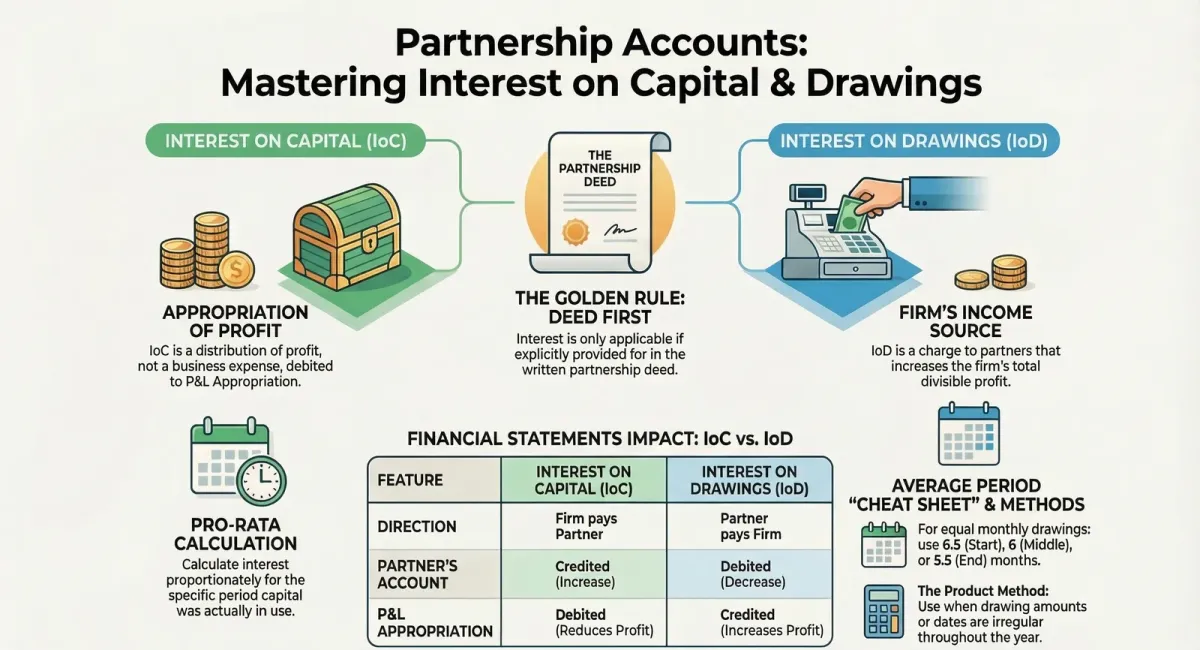
You can understand every concept in the Partnership chapter and still lose marks in the exam — through misidentifying the method, skipping working notes, or making preventable errors in account formats. This post is about closing that gap: a clean exam strategy, a checklist of mistakes to stop making, and a practice plan that builds both accuracy and speed.
What This Chapter Is Worth
CBSE Class 12 Board Exams
Partnership typically carries 6–8 marks and appears as:
-
A full capital account preparation problem (4–6 marks)
-
A short question on concepts or journal entries (2 marks)
With proper presentation and working notes, full marks are achievable consistently.
CA Foundation
Partnership forms the base for all advanced partnership topics — admission, retirement, dissolution. Speed and accuracy are both tested. Target: any standard partnership problem solved in 10–15 minutes.
The 5-Step Approach to Any Partnership Problem
Before writing a single number, work through these steps:
Step 1: Identify the Method
Read for the keywords:
-
“Capital Account” + “Current Account” mentioned → Fixed Capital Method
-
Only “Capital Account” mentioned → Fluctuating Capital Method
This determines which account every single transaction goes into. Getting this wrong wastes the entire question.
Step 2: Check the Deed Provisions
Scan the question for what the deed allows:
-
Is interest on capital mentioned? At what rate?
-
Is interest on drawings mentioned?
-
Are salaries or commissions payable?
-
Is there a guarantee provision?
Mark these clearly before you start computing. Anything not mentioned in the deed does not apply.
Step 3: Set Up the P&L Appropriation Account
This account distributes profit among partners. Build it before the capital/current accounts so you know the final figures.
Debits (appropriations):
-
Interest on capital
-
Partners’ salaries and commission
-
Transfer to reserves (if any)
Credits:
-
Net profit from P&L Account
-
Interest on drawings
The balance is the divisible profit — shared in PSR.
Step 4: Prepare the Capital/Current Accounts
Use columnar format (all partners side by side) for neatness and speed.
Fixed Capital Method: Prepare Capital Account first (usually a single entry), then prepare the Current Account with all adjustments.
Fluctuating Capital Method: Prepare one Capital Account per partner with all adjustments.
Step 5: Cross-Check Your Balances
-
Debits = Credits on both sides of every account
-
Interest on capital (total) matches the P&L Appropriation debit
-
Interest on drawings (total) matches the P&L Appropriation credit
-
Profit shares distributed = divisible profit from P&L Appropriation
Common Mistakes — and How to Stop Making Them
Mistake 1: Confusing the Method
What happens: You record profit in the Capital Account under Fixed method, or create a Current Account under Fluctuating method. Fix: Identify the method in Step 1 before writing anything. Underline the key phrase in the question.
Mistake 2: Applying Interest Without Deed Authority
What happens: You calculate interest on capital or drawings even though the deed doesn’t mention it. Fix: Check the deed in Step 2. If not mentioned, it does not exist.
Mistake 3: Wrong Account for Interest Entries
What happens: Interest on capital is debited to P&L Account (not P&L Appropriation Account). Fix: Interest on capital is an appropriation of profit — it always goes to the P&L Appropriation Account, not the trading P&L Account.
Mistake 4: Treating Drawings as an Expense
What happens: Drawings appear as a debit in the P&L Account. Fix: Drawings are a reduction in the partner’s capital/current account — they never touch the P&L Account.
Mistake 5: Mishandling the Guarantee
What happens: The partner receiving the guarantee gets correct treatment, but the shortfall is not deducted from the right partners. Fix:
-
Calculate the guaranteed partner’s actual profit share
-
If it is less than the guaranteed amount, the shortfall = guaranteed amount − actual share
-
Deduct the shortfall from the other partners in their agreed ratio or PSR
Example:
Partner A is guaranteed ₹50,000. Actual share = ₹40,000. Shortfall = ₹10,000.
If B and C share the shortfall equally: B bears ₹5,000, C bears ₹5,000.
A still receives ₹50,000. B and C receive their profit share minus ₹5,000 each.
Board Exam Presentation Tips
These earn marks independent of whether your numbers are correct:
1. Show all working notes Label them clearly: “Working Note 1: Interest on Capital”, etc. Examiners award method marks even if the final figure is wrong.
2. Use columnar format for capital accounts Place all partners side by side — it is faster to write and easier for the examiner to follow.
3. Label accounts precisely “Partner A’s Current Account” not just “Current Account.” This shows you know which method you’re using.
4. Write the account title at the top Every T-account must be titled. Untitled accounts lose the format mark.
5. Balance both sides Always write “Balance c/d” and carry it forward as “Balance b/d.” An unbalanced account is an automatic deduction.
Quick Recall: CA Foundation Shortcuts
| Situation | Rule |
|---|---|
| Question mentions Capital A/c and Current A/c | Fixed Capital Method |
| Question mentions only Capital A/c with multiple adjustments | Fluctuating Capital Method |
| PSR not mentioned in deed | Equal sharing |
| No deed exists | Partnership Act provisions apply |
| Interest not mentioned in deed | No interest charged or allowed |
| Partner guaranteed minimum profit | Shortfall borne by other partners |
Your Practice Plan
For CBSE Class 12 (6–8 marks target)
-
10 problems on Fixed Capital Method — focus on neat columnar format
-
10 problems on Fluctuating Capital Method — focus on correct debit/credit treatment
-
5 mixed problems — identify the method from the question, then solve
-
5 problems on time-based interest calculations
-
Past 3 years’ board exam questions — practise under timed conditions (aim: 15 minutes per full question)
For CA Foundation (speed + accuracy target)
-
20 problems across both methods — aim for 10 minutes per problem initially, then push to 7
-
10 problems on guarantee — these are high-frequency in CA Foundation papers
-
Full mock problems combining P&L Appropriation, capital accounts, and journal entries
Series Recap: What We’ve Covered
| Post | Topic |
|---|---|
| Part 1 | Partnership definition, features, partnership deed, PSR, and guarantee |
| Part 2 | Fixed Capital vs Fluctuating Capital — what gets recorded where, and how to identify the method |
| Part 3 | Interest on Capital and Drawings — product method, average method, time-based calculation |
| Part 4 | This post — exam strategy, common mistakes, and practice plan |
Master these four areas and the Partnership chapter becomes one of your most reliable sources of marks — both in CBSE boards and CA Foundation.
💡 Interactive Worked Example: See how adjustments ripple through the Trading Account, P&L, and Balance Sheet in real time in our Final Accounts Adjustments Studio .
AI-powered practice — free to start