
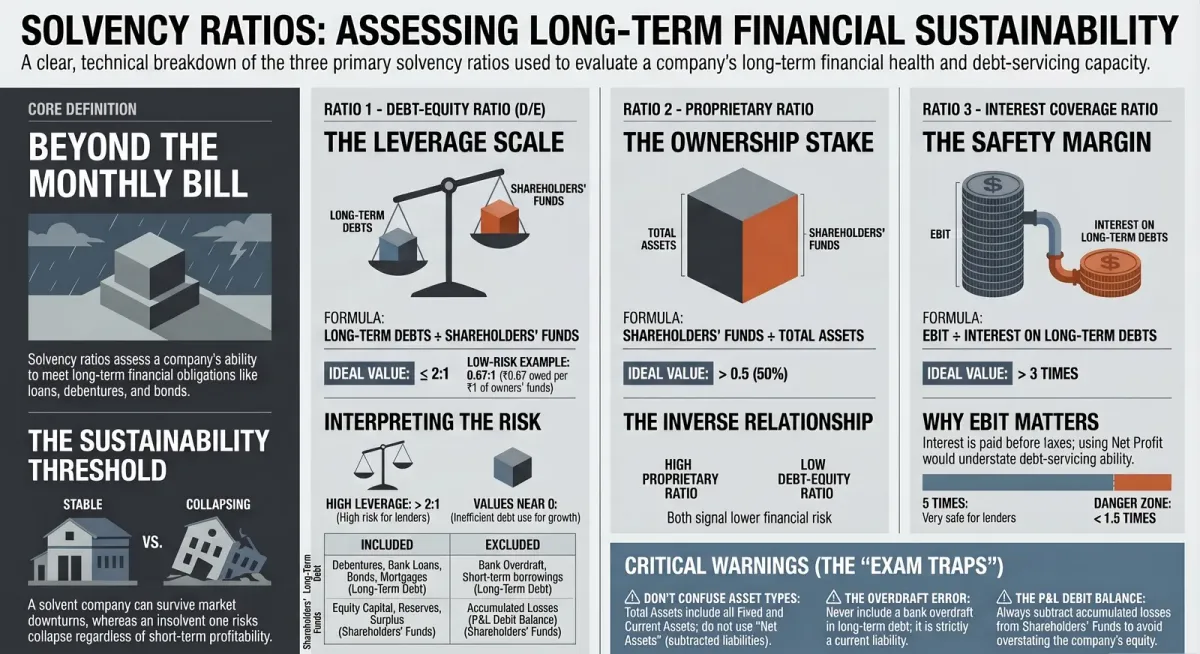
While liquidity ratios ask “Can the company pay its bills this month?”, solvency ratios ask a bigger question: “Is this company financially sustainable for the long term?”
These ratios matter most to long-term lenders and investors — and they matter to you because they carry significant marks in both CBSE board exams and CA Foundation. This post covers all three solvency ratios you need to know, with full worked examples and the interpretation language examiners reward.
What Solvency Ratios Measure
Solvency ratios assess a company’s ability to:
-
Meet its long-term financial obligations (loans, debentures, bonds)
-
Maintain a healthy balance between debt and equity
-
Sustain operations without being overburdened by interest payments
A solvent company can survive economic downturns; an insolvent one cannot, regardless of how profitable it appears in the short term.
Ratio 1: Debt-Equity Ratio
Ideal value: ≤ 2:1
Components
Long-term Debts include:
-
Debentures
-
Long-term bank loans
-
Bonds payable
-
Mortgage loans
Do not include bank overdraft or short-term borrowings — these are current liabilities.
Shareholders’ Funds include:
Exam trap: Students often forget to subtract accumulated losses (debit balance in Profit & Loss Account) when calculating Shareholders’ Funds. Always check.
Worked Example
Long-term Debts = ₹4,00,000 | Shareholders’ Funds = ₹6,00,000
Interpretation: For every ₹1 of owners’ funds, the company owes only ₹0.67 to long-term lenders. This is well within the ideal threshold — the company has a low-risk capital structure.
Reading the Ratio
| D/E Ratio | What It Signals |
|---|---|
| < 1:1 | Conservative — equity-heavy, low financial risk |
| 1–2:1 | Balanced — acceptable leverage |
| > 2:1 | High leverage — greater risk for lenders and shareholders |
| Very low (near 0) | May indicate underutilisation of debt financing |
Key insight: A lower ratio is generally safer for creditors. But an extremely low ratio may suggest the company is not using debt financing efficiently to grow.
Ratio 2: Proprietary Ratio
Ideal value: > 0.5 (or > 50%)
What It Shows
This ratio reveals what proportion of total assets is financed by the owners themselves, as opposed to borrowed funds. The higher the ratio, the less dependent the company is on external creditors.
Components
Total Assets = All fixed assets + All current assets (i.e., everything on the assets side of the balance sheet)
Shareholders’ Funds = Same as in Debt-Equity Ratio above.
Worked Example
Shareholders’ Funds = ₹6,00,000 | Total Assets = ₹10,00,000
Interpretation: 60% of total assets are financed by the owners — a strong financial position that indicates low dependence on external debt.
Relationship with Debt-Equity Ratio
The Proprietary Ratio and Debt-Equity Ratio tell the same story from opposite angles:
-
High Proprietary Ratio → Low Debt-Equity Ratio → Lower financial risk
-
Low Proprietary Ratio → High Debt-Equity Ratio → Higher financial risk
If you’ve calculated one correctly, use it as a sense-check for the other.
Ratio 3: Interest Coverage Ratio
Where EBIT = Earnings Before Interest and Tax (also called Operating Profit)
Ideal value: > 3 times
What It Shows
This ratio tells lenders how comfortably the company can service its interest obligations from its operating profit. A ratio of 5, for example, means the company earns enough operating profit to pay its interest bill five times over — giving lenders significant confidence.
Why EBIT (Not Net Profit)?
Interest is paid before tax is calculated — so the relevant earnings figure is profit before both interest and tax are deducted. Using net profit (after interest and tax) would understate the company’s true ability to cover interest.
Worked Example
EBIT = ₹1,50,000 | Annual Interest on Long-term Debts = ₹30,000
Interpretation: The company earns 5 times its interest obligation from operating profit — very safe for lenders.
Reading the Ratio
| Interest Coverage | What It Signals |
|---|---|
| > 5 times | Excellent — very low default risk |
| 3–5 times | Comfortable — within ideal range |
| 1.5–3 times | Adequate but under watch |
| < 1.5 times | Danger — operating profit barely covers interest |
| < 1 time | Critical — company cannot cover interest from operations |
The Three Solvency Ratios at a Glance
| Ratio | Formula | Ideal | What It Measures |
|---|---|---|---|
| Debt-Equity | Long-term Debts ÷ Shareholders' Funds | ≤ 2:1 | Balance between borrowed and owned capital |
| Proprietary | Shareholders' Funds ÷ Total Assets | > 0.5 | Owner-financed proportion of total assets |
| Interest Coverage | EBIT ÷ Interest on LT Debts | > 3 times | Ability to service debt interest from operations |
Interactive Solvency & Debt-Equity Simulator
Adjust Long-Term Debt and Shareholder Funds below to observe how leverage and solvency benchmarks change dynamically.
Interactive Solvency & Leverage Studio
Experiment with debt levels to see when the Debt-Equity ratio crosses the safe 2:1 benchmark into the danger zone.
Profitability
Liquidity
Solvency & Activity
Syllabus Checkpoints & Exam Watch-Outs
- Debt-Equity = Long-Term Debt / Shareholder Funds. A ratio above 2:1 indicates excessive financial risk.
Common Mistakes in Solvency Ratios
| Mistake | Fix |
|---|---|
| Including bank overdraft in long-term debts | Bank overdraft is a current liability — exclude from D/E ratio |
| Forgetting to subtract accumulated losses from Shareholders' Funds | Debit balance in P&L A/c reduces Shareholders' Funds |
| Using net profit instead of EBIT for Interest Coverage | Always use EBIT — profit before interest and tax |
| Confusing Total Assets with Net Assets | Total Assets = Fixed + Current Assets (gross, before deducting liabilities) |
What’s Next?
In Part 3 , we move to Activity (Turnover) Ratios and Profitability Ratios — including Inventory Turnover, Receivables Turnover, Gross Profit Ratio, Net Profit Ratio, and Return on Investment — with the key rules on when to use averages, and how to interpret each ratio correctly.
💡 Interactive Studio: Want to see how liquidity and profitability move dynamically with inventory and debt changes? Try our interactive Ratio Analysis Simulator .
AI-powered practice — free to start