
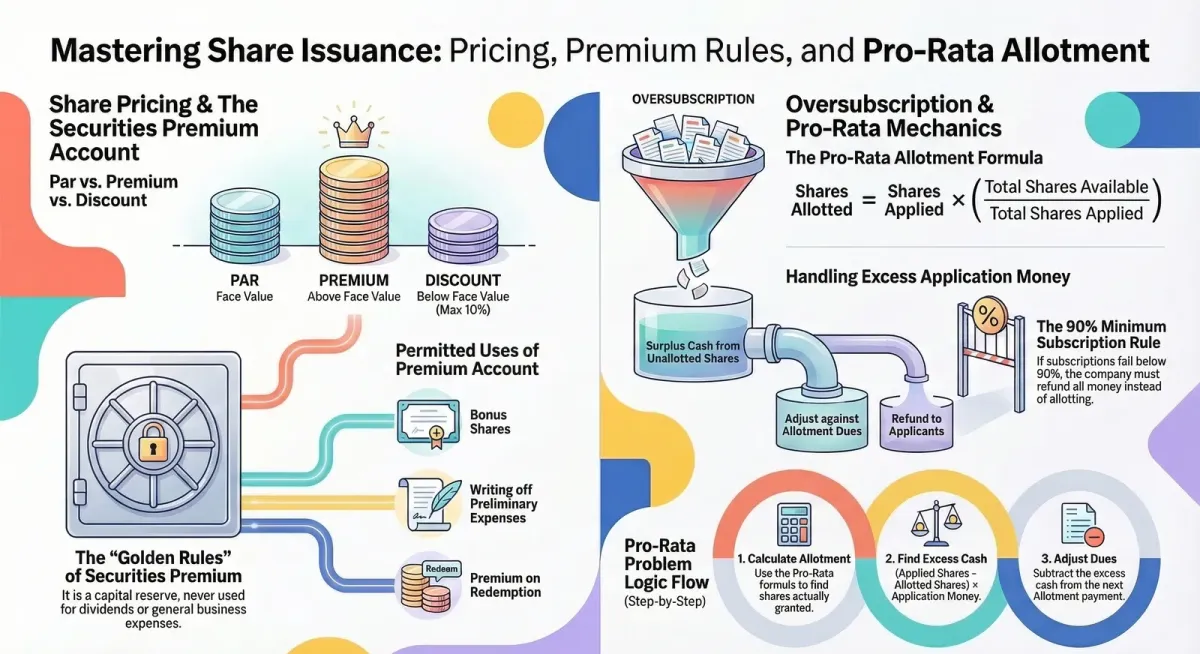
Once a company decides how much capital to raise, it must issue shares — and the price at which it does so, and how it handles excess demand, determine the accounting treatment. This post covers every scenario you’ll encounter in CBSE Class 12 and CA Foundation.
Issue Price: Three Scenarios
1. Issue at Par
-
Issue price = Face value
-
The simplest case: no premium, no discount
-
Full amount credited to Share Capital Account
Journal Entry (on allotment at par):
Share Allotment A/c          Dr.   ₹X,XXX
    To Share Capital A/c              ₹X,XXX
(Allotment money due)

Bank A/c                    Dr.   ₹X,XXX
    To Share Allotment A/c           ₹X,XXX
(Allotment money received)
2. Issue at Premium
-
Issue price > Face value
-
The excess over face value is credited to the Securities Premium Account — not to Share Capital
Example: 1,000 shares of ₹10 each issued at ₹12
| Component | Amount per share | Account Credited |
|---|---|---|
| Face value | ₹10 | Share Capital A/c |
| Premium | ₹2 | Securities Premium A/c |
| Total received | ₹12 |
Journal Entry:
Bank A/c                    Dr.   ₹12,000
    To Share Capital A/c              ₹10,000
    To Securities Premium A/c          ₹2,000
Important: Premium is typically collected on allotment, not on application. Always check when the question says premium is due.
3. Issue at Discount
-
Issue price < Face value
-
Maximum discount permitted: 10% of face value
-
Requires prior approval and specific conditions
-
Rare in practice, but tested in exams
Journal Entry:
Bank A/c                    Dr.   ₹9,000   (₹9 × 1,000)
Discount on Issue of Shares A/c Dr. ₹1,000
    To Share Capital A/c             ₹10,000
The discount is a capital loss and must be written off against Securities Premium or Capital Reserve.
The Securities Premium Account: What You Can and Cannot Do
This is one of the most tested MCQ topics in CA Foundation. The Companies Act strictly controls how securities premium can be used.
Permitted Uses ✅
| Use | Notes |
|---|---|
| Writing off preliminary expenses | Formation costs of the company |
| Writing off discount on issue of shares or debentures | Capital losses only |
| Providing premium on redemption of preference shares/debentures | Capital payments |
| Issuing fully paid bonus shares | Capitalising reserves |
Prohibited Uses ❌
-
Payment of dividends to shareholders
-
Meeting working capital requirements
-
General business or revenue expenses
-
Any distribution to shareholders other than bonus shares
Memory rule: Securities premium is a capital reserve — it can only be used for capital purposes, never for revenue purposes or distributions.
Oversubscription: What Happens When Demand Exceeds Supply
When applications received exceed the shares available, the company has three options:
Option 1: Reject Excess Applications
-
Selected applicants receive full allotment
-
Excess applicants are rejected and their money is refunded in full
-
Clean and simple, but excludes many investors
Option 2: Pro-Rata Allotment
-
All applicants receive a proportionate share of the available shares
-
Excess application money is adjusted against allotment dues
-
Any remaining excess is refunded
-
Most commonly used — and most commonly examined
Option 3: Combination
-
Some applications are rejected outright (refund given)
-
Remaining applicants receive pro-rata allotment
Pro-Rata Allotment: The Formula
Example:
-
Shares available: 5,000
-
Total applications received: 10,000 shares
-
One applicant applied for 200 shares
Handling Excess Money Under Pro-Rata Allotment
When an applicant applied for 200 shares but receives 100:
-
They paid application money on 200 shares
-
They are allotted 100 shares
-
The excess application money (paid on the extra 100 shares) is adjusted against the allotment amount due
-
If any amount remains after this adjustment, it is refunded
Step-by-Step Approach
Step 1: Calculate shares allotted (pro-rata formula)
Step 2: Calculate excess application money
Step 3: Adjust excess against allotment dues
Step 4: If excess > allotment due, refund the balance
Worked Example: Oversubscription with Pro-Rata Allotment
Facts:
-
Company issues 10,000 shares of ₹10 each at ₹12 (₹2 premium)
-
Payable: ₹3 on application, ₹5 on allotment (including ₹2 premium), ₹4 on call
-
Applications received: 15,000 shares
-
Pro-rata allotment to all applicants
One applicant applies for 300 shares:
| Step | Calculation | Amount |
|---|---|---|
| Shares allotted | 300 × (10,000 ÷ 15,000) | 200 shares |
| Application money paid | 300 × ₹3 | ₹900 |
| Application money due on 200 shares | 200 × ₹3 | ₹600 |
| Excess application money | ₹900 − ₹600 | ₹300 |
| Allotment due on 200 shares | 200 × ₹5 | ₹1,000 |
| Net allotment to collect | ₹1,000 − ₹300 | ₹700 |
Board Exam Tips for This Section
-
Always state when premium is received — on application, allotment, or a specific call. It changes the journal entries.
-
Show your working note for pro-rata — even one line showing the ratio earns method marks
-
Label Securities Premium clearly — it is not part of Share Capital and should never be merged with it
-
Check the 90% rule — if the question describes a subscription level below 90%, the correct treatment is full refund, not allotment
What’s Next?
In Part 3 , we cover forfeiture of shares — what triggers it, the legal requirements, and the exact journal entries with a fully worked numerical example. This is where many students lose marks due to confusion over called-up vs paid-up amounts.
AI-powered practice — free to start