
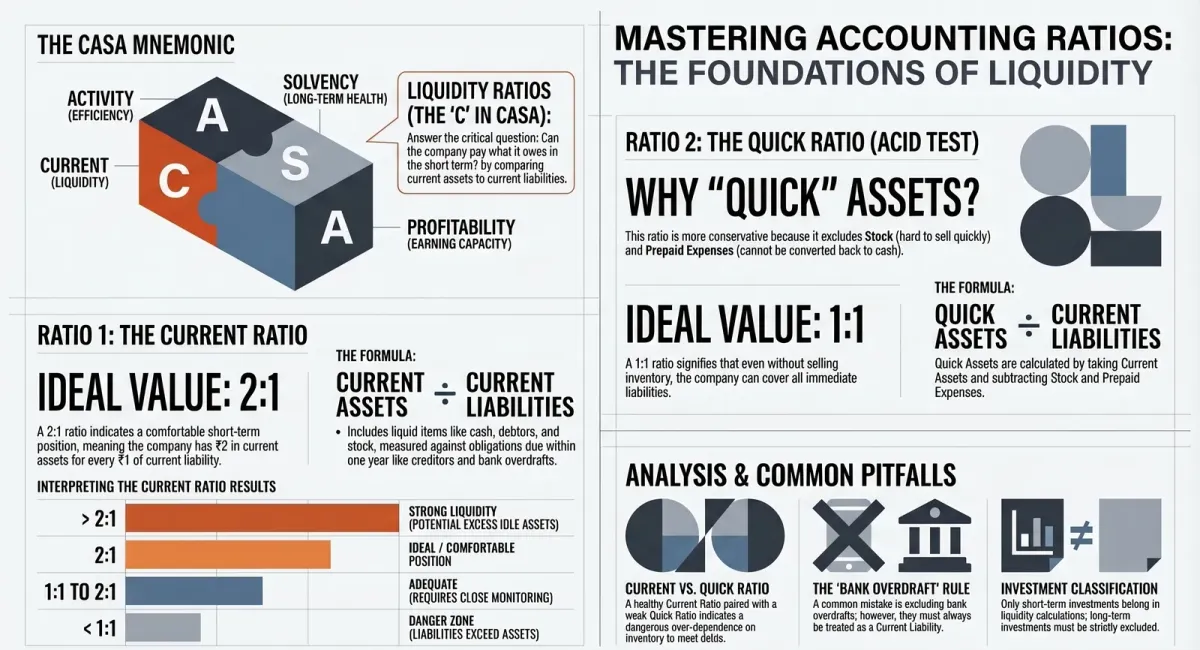
Accounting ratios carry 10–12 marks in CBSE Class 12 board exams and form the backbone of financial analysis in CA Foundation. Unlike most accountancy topics, ratios reward understanding over memorisation — once you know what a ratio measures and why, the formula becomes easy to recall.
This post covers the foundation: what ratios are, the four-category framework, and the two liquidity ratios you must know cold.
What Is an Accounting Ratio?
An accounting ratio is a mathematical relationship between two accounting figures, expressed as a proportion, a percentage, or a number of times.
Raw financial data — a balance sheet or income statement — tells you what the numbers are. Ratios tell you what those numbers mean. They transform data into insight.
Five Purposes of Ratio Analysis
| Purpose | Question It Answers |
|---|---|
| Assess profitability | Is the business generating sufficient profit? |
| Evaluate liquidity | Can it pay its short-term bills? |
| Analyse solvency | Will it survive in the long term? |
| Measure efficiency | How well are assets being used? |
| Compare performance | How does it stack up against competitors or past periods? |
The CASA Framework: Four Categories of Ratios
Use the mnemonic CASA to organise every ratio you study:
| Letter | Category | What It Measures |
|---|---|---|
| C | Current / Quick (Liquidity) | Ability to meet short-term obligations |
| A | Activity (Turnover) | Efficiency of asset utilisation |
| S | Solvency | Long-term financial health and stability |
| A | And Profitability | Earning capacity and return on investment |
Every ratio in the syllabus fits into one of these four buckets. When a question asks you to identify a ratio’s category, use CASA to locate it immediately.
Liquidity Ratios
Liquidity ratios answer the question: “Can the company pay what it owes in the short term?”
They compare current assets — things that can be converted to cash within a year — against current liabilities — obligations due within a year.
Ratio 1: Current Ratio
Ideal value: 2:1
Components
Current Assets include: Cash, bank balances, debtors (trade receivables), stock (inventory), short-term investments, prepaid expenses, advance payments
Current Liabilities include: Creditors (trade payables), bills payable, outstanding expenses, bank overdraft, short-term loans
Worked Example
Current Assets = ₹2,00,000 | Current Liabilities = ₹1,00,000
Interpretation: The company has ₹2 of current assets for every ₹1 of current liability. This matches the ideal ratio — the company is in a good liquidity position.
What the Ratio Tells You
| Current Ratio | Interpretation |
|---|---|
| > 2:1 | Strong liquidity; may indicate excess idle assets |
| = 2:1 | Ideal — comfortable short-term position |
| 1–2:1 | Adequate but watch closely |
| < 1:1 | Danger zone — current liabilities exceed current assets |
Ratio 2: Quick Ratio (Acid Test Ratio)
Ideal value: 1:1
Why Are Stock and Prepaid Excluded?
-
Stock takes time to sell and convert to cash — and in a crisis, it may not fetch its book value
-
Prepaid expenses cannot be converted to cash at all — they represent services already paid for
The Quick Ratio strips out these less liquid items to give a more conservative picture of short-term solvency.
Worked Example
Current Assets = ₹80,000 | Stock = ₹20,000 | Prepaid Expenses = ₹5,000 | Current Liabilities = ₹50,000
Interpretation: Even without selling any stock, the company can cover all its current liabilities — excellent short-term position.
Interactive Ratio Simulator: Watch Liquidity Move Live
Drag the sliders below for Revenue, COGS, Inventory, or Current Liabilities and watch how the Current Ratio and Quick Ratio update in real time with instant health benchmarks.
Interactive Liquidity & Profitability Studio
Change Inventory or Current Liabilities to see how the Quick Ratio strips out slow-moving stock while Current Ratio includes it.
Profitability
Liquidity
Solvency & Activity
Syllabus Checkpoints & Exam Watch-Outs
- Quick Ratio strictly excludes Inventory from Current Assets. Watch how increasing Inventory drops Quick Ratio while leaving Current Ratio higher.
- Gross Profit Ratio uses Gross Profit (Revenue − COGS), not Net Profit.
Current Ratio vs Quick Ratio: Side by Side
| Feature | Current Ratio | Quick Ratio |
|---|---|---|
| Numerator | All current assets | Current assets − Stock − Prepaid |
| Ideal value | 2:1 | 1:1 |
| What it tests | Broad short-term liquidity | Immediate, liquid-asset coverage |
| More conservative? | No | Yes |
A company can have a healthy Current Ratio but a weak Quick Ratio — which would indicate it is heavily dependent on stock to meet its short-term obligations. Both ratios together give a fuller picture.
Common Mistakes in Liquidity Ratios
| Mistake | Fix |
|---|---|
| Including long-term investments in current assets | Only short-term investments belong here |
| Excluding bank overdraft from current liabilities | Bank overdraft is always a current liability |
| Forgetting to subtract prepaid expenses from Quick Assets | Quick Assets = CA − Stock − Prepaid |
| Treating advance payments as current liabilities | Advance payments received are current liabilities; advance payments made are current assets |
What’s Next?
In Part 2 , we cover Solvency Ratios — Debt-Equity Ratio, Proprietary Ratio, and Interest Coverage Ratio — the ratios that tell long-term lenders and investors whether the company is built on solid financial foundations.
💡 Interactive Studio: Want to see how liquidity and profitability move dynamically with inventory and debt changes? Try our interactive Ratio Analysis Simulator .
AI-powered practice — free to start