
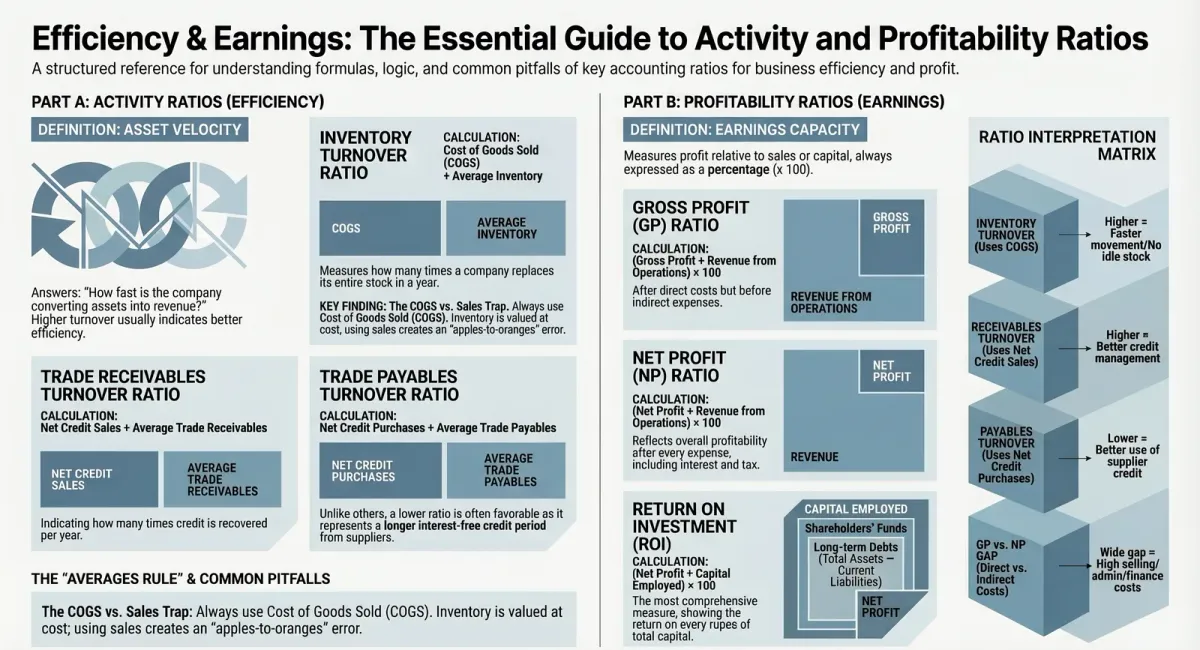
Activity ratios measure how efficiently a company uses its assets. Profitability ratios measure how much it earns from its operations. Together, they form the second half of the CASA framework and are essential for the financial analysis questions in CBSE Class 12 and CA Foundation.
Part A: Activity Ratios (Turnover Ratios)
Activity ratios answer: “How fast is the company converting assets into revenue?”
A higher turnover ratio generally means better efficiency — assets are being put to work rather than sitting idle.
The Averages Rule
For all turnover ratios, use average figures (opening + closing ÷ 2) in the denominator, not just the closing balance. This smooths out distortions from seasonal fluctuations or mid-year changes.
Exam trap: Using only the closing balance instead of the average is one of the most common errors in ratio questions. If the question gives both opening and closing figures, you are expected to average them.
Ratio 1: Inventory Turnover Ratio
Why Cost of Goods Sold — Not Sales?
Inventory is valued at cost, not at selling price. Using sales in the numerator would compare a cost-based figure with a revenue-based figure — an apples-to-oranges comparison. Always use COGS.
Worked Example
Cost of Goods Sold = ₹12,00,000 | Opening Stock = ₹1,50,000 | Closing Stock = ₹2,50,000
Interpretation: The company sells through and replaces its entire stock 6 times a year — efficient inventory management.
Days’ Inventory = 365 ÷ 6 = ~61 days (average time stock sits before being sold)
Ratio 2: Trade Receivables Turnover Ratio
Key Points
-
Use net credit sales only — cash sales do not create receivables
-
Bills receivable are included in trade receivables
-
A higher ratio means faster collection and better credit management
Worked Example
Net Credit Sales = ₹15,00,000 | Average Trade Receivables = ₹3,00,000
Interpretation: Credit is recovered 5 times per year.
Average Collection Period = 365 ÷ 5 = 73 days — the company takes about 73 days on average to collect from credit customers.
Ratio 3: Trade Payables Turnover Ratio
Interpretation (Reversed Logic)
Unlike the other turnover ratios, a lower Trade Payables Turnover is generally favourable for the company — it means the company is taking longer to pay its suppliers, effectively enjoying a longer interest-free credit period.
Average Payment Period = 365 ÷ Trade Payables Turnover
A longer payment period means better use of supplier credit. However, excessively slow payment can damage supplier relationships and creditworthiness.
Activity Ratios Side-by-Side
| Ratio | Formula | Higher = Better? |
|---|---|---|
| Inventory Turnover | COGS ÷ Avg Inventory | Yes — faster stock movement |
| Trade Receivables Turnover | Net Credit Sales ÷ Avg Receivables | Yes — faster collection |
| Trade Payables Turnover | Net Credit Purchases ÷ Avg Payables | No — lower = longer credit period enjoyed |
Part B: Profitability Ratios
Profitability ratios answer: “How much profit is the company making, relative to its sales or capital?”
All three ratios below are expressed as percentages — remember to multiply by 100.
Ratio 4: Gross Profit Ratio
Where: Gross Profit = Revenue from Operations − Cost of Goods Sold
What It Measures
The GP Ratio shows the profit margin after direct costs (materials, direct labour, manufacturing overhead) but before indirect expenses (selling costs, administration, finance costs). It reflects the efficiency of the production or trading process.
Worked Example
Gross Profit = ₹3,00,000 | Revenue from Operations = ₹10,00,000
Interpretation: The company retains 30 paise as gross profit on every rupee of sales. The remaining 70 paise covers direct costs.
Ratio 5: Net Profit Ratio
Where: Net Profit = Profit after all expenses, interest, and tax
What It Measures
The NP Ratio shows the overall profitability of the business after every single expense has been deducted. It reflects both operational efficiency and financial management.
Worked Example
Net Profit = ₹1,50,000 | Revenue from Operations = ₹10,00,000
Interpretation: The company earns ₹15 net profit on every ₹100 of sales.
GP vs NP: Reading the Gap
| Scenario | What It Suggests |
|---|---|
| GP Ratio much higher than NP Ratio | High indirect expenses (selling, admin, finance costs) |
| GP and NP Ratios close together | Tight control over indirect expenses |
| NP Ratio falling while GP Ratio is stable | Increasing non-operating costs or finance charges |
Ratio 6: Return on Investment (ROI)
(Alternative: Total Assets − Current Liabilities)
What It Measures
ROI shows the return generated on every rupee of total capital invested in the business — both owned (equity) and borrowed (long-term debt). It is the most comprehensive profitability measure because it considers all capital, not just sales.
Worked Example
Net Profit = ₹2,00,000 | Capital Employed = ₹10,00,000
Interpretation: The business generates a 20% return on the total capital invested — investors and lenders together earn 20 paise on every rupee deployed.
Profitability Ratios at a Glance
| Ratio | Formula | What It Measures |
|---|---|---|
| Gross Profit Ratio | (GP ÷ Revenue) × 100 | Margin after direct costs |
| Net Profit Ratio | (NP ÷ Revenue) × 100 | Overall profit margin |
| Return on Investment | (NP ÷ Capital Employed) × 100 | Return on all capital deployed |
Common Mistakes in Activity & Profitability Ratios
| Mistake | Fix |
|---|---|
| Using sales (not COGS) for Inventory Turnover | Always use Cost of Goods Sold in the numerator |
| Using closing figures instead of averages | Use (Opening + Closing) ÷ 2 for all turnover denominators |
| Forgetting to multiply by 100 for profitability ratios | GP, NP, and ROI are expressed as percentages |
| Using total sales instead of credit sales for receivables | Receivables Turnover uses net credit sales only |
What’s Next?
In Part 4 , get the complete exam strategy for ratio questions — the 5-step approach to 12-mark problems, a full formula reference card for all four categories, the most common errors and how to avoid them, and a targeted practice plan for CBSE Class 12 and CA Foundation.
💡 Interactive Studio: Want to see how liquidity and profitability move dynamically with inventory and debt changes? Try our interactive Ratio Analysis Simulator .
AI-powered practice — free to start