

The CBSE Class 12 Business Studies Sample Paper 2026-27 is more than a list of questions. It is a clear guide to how students appearing for the 2027 Boards should write, interpret and apply NCERT concepts.
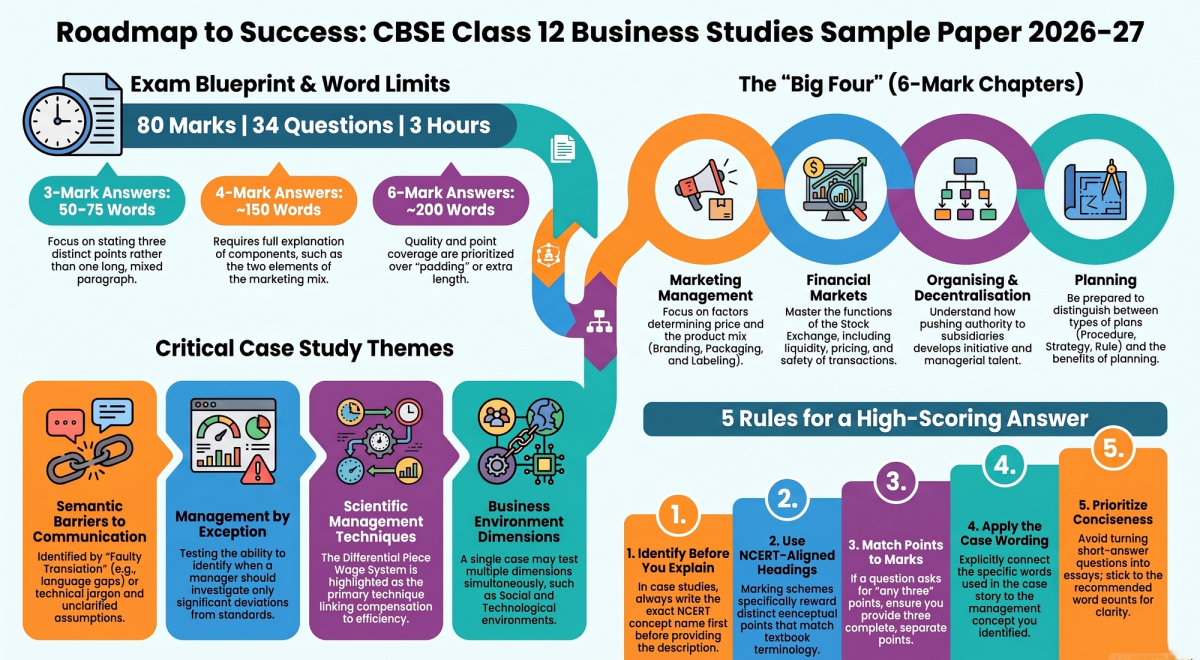
The paper carries 80 marks over three hours, with 34 questions. CBSE also gives useful guidance on answer length: 3-mark answers may be around 50-75 words, 4-mark answers about 150 words, and 6-mark answers about 200 words.
The strongest feature is the number of case-based questions, where students must read a business situation, identify the concept and explain it precisely.
What the Paper Is Really Testing
The paper covers all the familiar areas of Business Studies, but tests them through application: nature and significance of management; principles of management; business environment; planning; organising; staffing; directing; controlling; financial management; financial markets; marketing; consumer protection.
The one-mark section is not pure recall either — several questions use mini-cases or statement-based logic.
Important MCQ Patterns
Scientific management: the paper asks students to identify the Differential Piece Wage System as the technique linking worker efficiency with compensation.
Business environment: a failed restaurant case tests the importance of identifying threats and early warning signals.
Consumer protection: contemporary examples involving dark patterns, automatic subscription renewal and consumer rights.
Financial management: distinguishing fixed and working capital concepts and evaluating financing alternatives.
Planning: a case asks which stages of the planning process have not yet been completed.
These reward conceptual clarity, not memorised paragraphs.
Question 21: Selection process or training benefits
The first option asks for the first three steps in selecting the most suitable candidate. The marking scheme identifies: Preliminary Screening; Selection Tests; Employment Interview.
The alternative asks for any three benefits of training and development to the organisation.
A good 3-mark answer states three distinct points, not one long mixed paragraph.
Question 22: Semantic barriers to communication
A sales employee in France struggles because his command of French is weak. The marking scheme identifies the barrier as Faulty Translation, within semantic barriers.
Other semantic barriers: badly expressed message; symbols with different meanings; unclarified assumptions; technical jargon; body-language/gesture decoding.
Exam technique: identify the group first, then explain two additional barriers from the same group.
Question 23: Financing decision or fixed capital
The financing-decision option asks about control considerations and state of the capital market: issuing more equity can dilute control, while debt carries no such ownership implication; a rising stock market eases equity issuance, a depressed one hinders it.
The alternative tests choice of technique and growth prospects as factors affecting fixed-capital requirements.
Question 24: Sources of recruitment
The case describes close liaison with management institutes, private agencies and professional bodies, and a database of unsolicited applicants.
The expected sources: Campus Recruitment; Placement Agencies and Management Consultants; Casual Callers — a classic case where the wording gives clues rather than naming the concept.
Question 25: Principles of Management
The paper asks either about cause-and-effect relationship and universal applicability, or harmony-not-discord and science-not-rule-of-thumb. The marking scheme shows why headings matter: each principle must be clearly named and then explained.
Question 26: Physical distribution
The prompt refers to decisions about dealers, intermediaries, discounts and promotional support, then asks for two components of the related marketing-mix element: transportation; warehousing; inventory control; order processing. For a 4-mark answer, select two and explain them completely.
Question 27: Management by Exception
A company has clear cost and output standards. Most expenses stay within budget, but maintenance expenditure exceeds the permissible limit, and the chairman asks for investigation only of the significant deviation.
The marking scheme identifies the principle as Management by Exception, with the subsequent controlling step as Taking Corrective Action — identify each, then explain it, proof that the chapter name is never handed to you.
Question 28: Leadership or Maslow
The leadership option asks for a definition plus any two leadership styles based on use of authority: Autocratic/Authoritarian; Democratic/Participative; Laissez-faire/Free-rein.
The alternative asks for motivation and any two needs from Maslow’s hierarchy.
Question 29: Business environment and ethical fashion
A garment company observes changing Gen Z expectations around ethical fashion and collaborates on technology that turns plastic bottles into sustainable fabric. The marking scheme identifies Social Environment and Technological Environment — a good model for how one case may contain more than one dimension.
Question 30: Coordination
Production increases output, Sales lacks enough confirmed orders, Finance delays raw-material funding and department heads do not share information. The concept is Coordination.
The marking scheme allows characteristics such as: continuous process; all-pervasive function; integration of group efforts; unity of action; responsibility of all managers; deliberate function.
Question 31: Marketing — 6 marks
Students choose between: A. factors determining price (Product Cost, Utility and Demand, Marketing Methods Used); or B. Branding, Packaging and Labelling as elements of product mix. A priority revision question, since the marking scheme expects a heading and explanation for each element.
Question 32: Stock Exchange — 6 marks
A company issues shares and later participates in a market for buying and selling existing securities. The case mentions price discovery, legal framework, liquidity and productive use of savings — the institution is the Stock Exchange.
The marking scheme expects a definition plus functions: liquidity and marketability; pricing of securities; safety of transactions; contribution to economic growth. This question shows how CBSE converts a textbook list into a case.
Question 33: Decentralisation — 6 marks
An IT company facing AI disruption separates operations into product-line subsidiaries, pushing authority closer to the point of action.
The marking scheme asks for benefits including: develops initiative; develops managerial talent; quick decision-making; relief to top management; facilitates growth; better control. Identify decentralisation even when the word itself is absent from the case.
Question 34: Planning — 6 marks
The options test Procedure, Strategy and Rule as types of plans; or benefits of planning: facilitating decision-making, reducing uncertainty and establishing standards for controlling. A direct long-answer question, so structure is critical.
How to write a high-scoring Business Studies answer
- Identify before you explain — for case studies, write the exact concept first.
- Use NCERT-aligned headings, since marking schemes reward distinct conceptual points.
- Match the number of points to the marks — "any three" needs three complete points before extras.
- Apply the case — connect the case wording to the concept when asked to identify something.
- Keep answers concise; don’t turn a 3-mark question into a page-long essay.
ChampionsPrep Next Step
Practise Business Studies by identifying the concept before reading the answer, then compare your structure with the marking scheme. Registration on ChampionsPrep is free and you only pay as you use it, so you can turn each case into similar practice and learn to recognise the underlying concept even when the company, industry and wording change.
Frequently Asked Questions
How many questions are in the CBSE Class 12 Business Studies sample paper? +
The official 2026-27 sample paper contains 34 questions.
How long should a 6-mark Business Studies answer be? +
The paper guidance says answers to 6-mark questions may be about 200 words. Quality and point coverage matter more than padding.
Are case studies important for the 2027 Boards? +
Yes. The official SQP contains numerous case-based and application-based questions across multiple chapters.
Which 6-mark chapters appear in the sample paper? +
Marketing, Financial Markets/Stock Exchange, Organising/Decentralisation and Planning.
What is the proportion of case-study questions in Business Studies? +
Case-based questions make up approximately 60% of the paper, testing application of management principles, financial markets, and marketing concepts.
Keep practising Business Studies
AI-powered feedback and structured revision for Business Studies — free to start, at your own pace.
AI-powered practice — free to start