
Business Risk: Meaning, Nature, Types and Causes Explained
Every entrepreneur who has ever started a business has faced this uncomfortable truth: despite their best planning, efforts, and investment, things may still go wrong. A factory may catch fire. Consumer tastes may shift overnight. A flood may destroy an entire stock of raw materials. This ever-present possibility of loss is what we call business risk — and understanding it is a core part of CBSE Class 11 Business Studies Chapter 1. This guide covers the complete meaning, nature, types, and causes of business risk in exam-ready detail.
What is Business Risk?
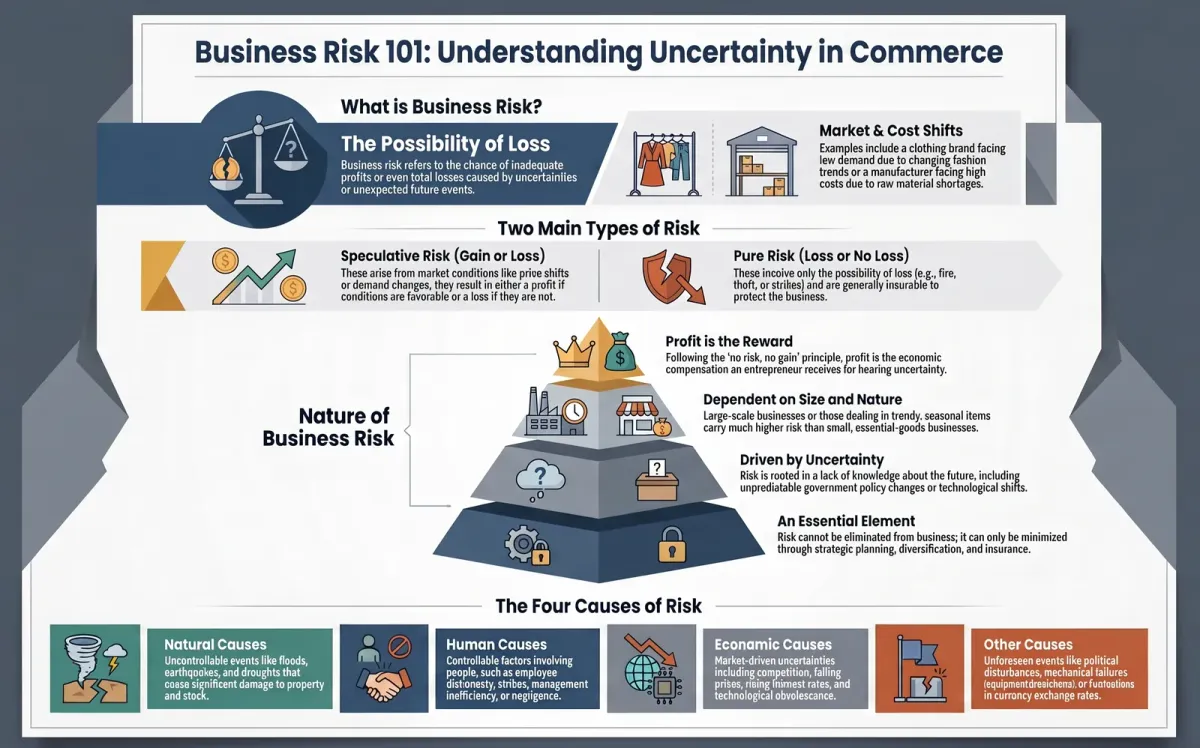
Business risk refers to the possibility of inadequate profits or even losses due to uncertainties or unexpected events in the course of conducting business.
Let’s look at two real-world examples:
-
A company manufacturing trendy clothing may see demand collapse if fashion trends change unexpectedly. Lower demand means lower sales and lower profits.
-
A biscuit manufacturer heavily dependent on wheat flour may face a sharp rise in raw material costs if a drought reduces wheat supply. Higher costs reduce profit margins.
In both cases, the business faces risk — a situation where outcomes are uncertain and the possibility of financial loss is real.
Types of Business Risk
Business enterprises constantly face two main types of risk: speculative risk and pure risk.
1. Speculative Risk
Speculative risks involve both the possibility of gain and the possibility of loss. They arise from changes in market conditions — fluctuations in demand and supply, price shifts, or changes in consumer fashion. Favourable conditions lead to gain; unfavourable ones lead to loss. Speculative risks are inherent to business and cannot be avoided — only managed through research and strategic planning.
2. Pure Risk
Pure risks involve only the possibility of loss — or no loss. There is no chance of gain. If the risky event occurs, the business suffers a loss; if it does not, the business simply avoids loss without gaining anything. Common pure risks include fire, theft, strikes, and natural disasters. Pure risks are generally insurable, allowing businesses to transfer the financial burden to an insurance company.
Nature (Characteristics) of Business Risks
Understanding the nature of business risks helps managers deal with them more effectively. Here are four key characteristics:
1. Risk is an Essential Part of Every Business
Every business, without exception, carries some degree of risk. No matter how carefully a business is planned or how efficiently it is managed, the future remains uncertain. Risk cannot be eliminated from business — it can only be minimised through careful planning, diversification, and insurance.
2. Business Risks Arise Due to Uncertainties
Uncertainty is the root cause of business risk. Uncertainty refers to a lack of knowledge about what will happen in the future. Factors that create uncertainty include:
-
Natural calamities (floods, droughts, earthquakes)
-
Changes in government policies and tax regulations
-
Shifts in consumer demand and technology
-
New competition entering the market
Because the outcomes of these future events are unknown, they create risks for businesses.
3. The Degree of Risk Depends on the Nature and Size of Business
Not all businesses carry equal risk. A business dealing in fashionable or seasonal items faces much higher risk than one dealing in everyday essentials, because fashion changes rapidly. Similarly, a large-scale business carries more risk than a small one due to greater capital exposure and operational complexity.
4. Profit is the Reward for Risk Taking
This principle — “no risk, no gain” — is one of the most fundamental in business. Greater the risk an entrepreneur takes, higher is the potential for profit. An entrepreneur who risked their savings to launch a new product — and succeeds — earns far more than someone who chose the safe path of employment.
Profit is therefore not just a measure of financial performance. It is the economic reward for bearing uncertainty and risk.
Causes of Business Risks
Business risks arise from a variety of sources. These causes are broadly classified into four categories:
1. Natural Causes
Human beings have very little control over nature. Floods, cyclones, earthquakes, lightning, droughts, and famine can cause significant damage to property, stock, and business income. Natural risks are largely unpredictable and uncontrollable — making insurance essential for businesses in disaster-prone areas or industries that depend on climate conditions.
2. Human Causes
Human causes include unexpected failures or negative actions by people both within and outside the organisation — employee dishonesty or fraud, carelessness and negligence, strikes and lockouts halting production, management inefficiency, riots, or power failures stopping operations. These risks are partially controllable through strong governance, HR practices, and a positive workplace culture.
3. Economic Causes
Economic causes relate to market and financial uncertainties. These include declining demand, new competition, falling prices, bad debts, technological obsolescence, rising interest rates, and higher taxes. Economic risks are among the most complex because they are driven by macro-level market forces often beyond a single business’s control.
4. Other Causes
Unforeseen events not covered above include political disturbances (government changes, policy shifts), mechanical failures (breakdown of critical equipment or boilers), and exchange rate fluctuations affecting import/export businesses. These causes are difficult to predict and plan for, reinforcing why risk management must be an ongoing business priority.
📚 Prepare for CBSE Exams with ChampionsPrep
Questions on business risk — including “Distinguish between speculative and pure risk” or “Explain any four causes of business risk” — are common in board exams. Get model answers, instant clarifications, and exam-ready notes through ChampionsPrep’s AI-powered doubt resolution platform.
👉 Visit ChampionsPrep.in — your Commerce exam partner!
Chapter Reference: CBSE Class 11 Business Studies – Chapter 1: Business, Trade and Commerce
Test Your Knowledge

Business Risk: Meaning, Nature, Types and Causes Explained | Class 11 Business Studies
Frequently Asked Questions
What is the meaning of business risk? +
Business risk refers to the possibility of inadequate profits or even losses due to uncertainties or unexpected events that affect the conduct of business.
What is the difference between speculative risk and pure risk? +
Speculative risk involves both the possibility of gain and loss (e.g., launching a new product). Pure risk involves only the possibility of loss or no loss — there is no upside (e.g., fire destroying a factory).
Can business risk be completely eliminated? +
No. Risk is an essential and unavoidable part of every business. It can be minimised through planning, insurance, and diversification, but it can never be completely eliminated.
What are the four causes of business risk? +
The four causes are: Natural causes (floods, droughts), Human causes (strikes, fraud, negligence), Economic causes (competition, demand changes, interest rates), and Other causes (political instability, mechanical failures, exchange rate fluctuations).
Why is profit considered the reward for risk taking? +
An entrepreneur bears uncertainty and the possibility of loss by investing in business. The profit they earn is the economic compensation for taking on this risk. Greater risk generally corresponds to a higher potential for profit.
AI-powered practice — free to start