
Business vs Profession vs Employment: 9 Key Differences Explained
Three friends finish their Class XII Commerce exams. One opens a clothing boutique. Another clears the CA exam and joins an accounting firm. The third signs an employment contract with a bank. All three are engaged in economic activities — but each belongs to a completely different category. Understanding the distinction between Business, Profession, and Employment is fundamental to CBSE Class 11 Business Studies and a common board exam topic.
What Are Economic Activities?
Economic activities are those human activities performed with the aim of earning money or securing a livelihood. They are distinct from non-economic activities (which are motivated by love, sympathy, or patriotism). Economic activities are classified into three broad types:
-
Business — Regular production and sale of goods or services for profit
-
Profession — Rendering specialised, expert services based on formal knowledge
-
Employment — Performing work for an employer under a service agreement in exchange for salary or wages
Each of these three types has unique features in terms of how they are set up, the qualifications required, the rewards earned, and the risks involved. Let’s explore each one.
What is Business?
Business is an economic activity involving the regular production and/or sale of goods and services with a view to earning profit. A businessperson decides to start a venture, invests capital, manages operations, bears risks, and earns profits (or incurs losses). Business can range from a small street vendor to a large manufacturing company.
Key features of business:
-
Started by the entrepreneur’s own decision
-
No minimum qualification required
-
Reward is profit (uncertain and irregular)
-
Capital investment is necessary
-
High degree of risk
-
Interest/ownership can be transferred with formalities
What is Profession?
A profession involves the rendering of personalised and expert services based on special knowledge and formal training. Entry into a profession requires membership of a professional body and a certificate of practice. Professionals follow a strict code of conduct set by their regulatory body.
Examples of professions: Doctor, lawyer, chartered accountant, architect, company secretary
Key features of profession:
-
Requires membership of a professional body and a certificate of practice
-
Prescribed qualifications and training are mandatory
-
Reward is a professional fee (generally regular and certain)
-
Limited capital needed for establishment
-
Some risk involved, but less than business
-
Interest cannot be transferred
What is Employment?
Employment occurs when a person works for an employer under a service agreement and receives a salary or wages in return. An employee follows the rules, norms, and instructions set by the employer. There is no capital investment required, and the risk to the employee is minimal.
Examples: A bank teller, a government officer, an HR executive in a company, a teacher in a school.
Key features of employment:
-
Begins with an appointment letter and service agreement
-
Qualification prescribed by the employer
-
Reward is a fixed salary or wages
-
No capital required
-
Little to no financial risk
-
Interest cannot be transferred
9 Key Differences: Business vs Profession vs Employment
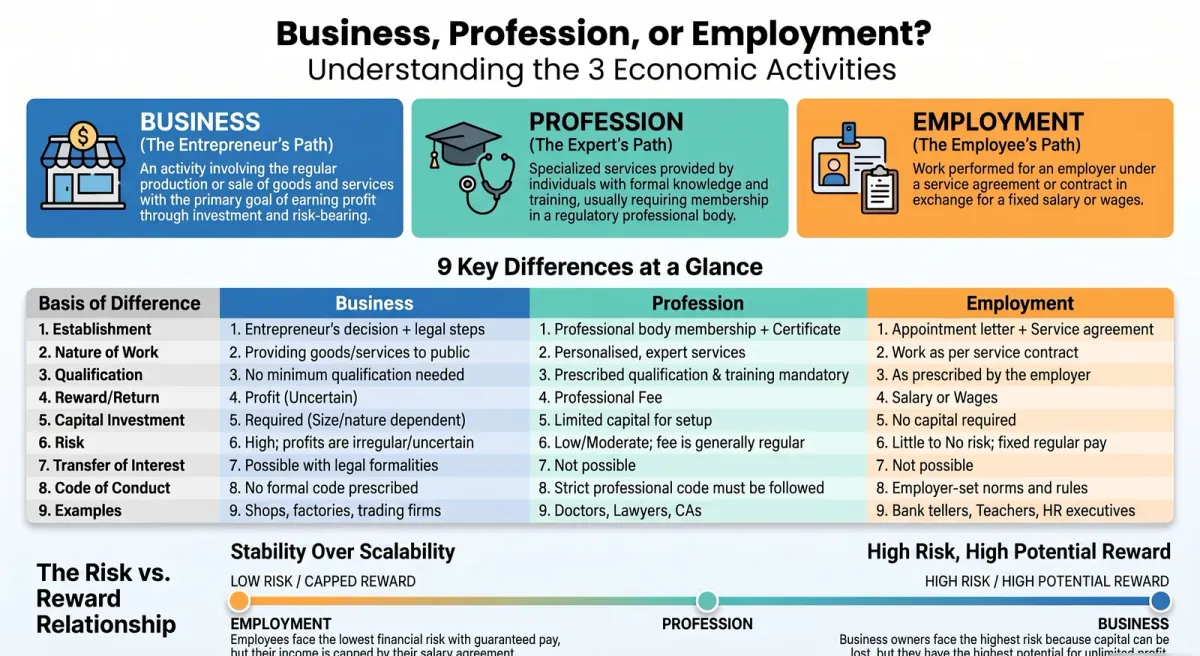
The table below summarises the major differences across nine important dimensions:
| Basis | Business | Profession | Employment |
|---|---|---|---|
| 1. Mode of Establishment | Entrepreneur's decision and legal formalities, if required | Membership of a professional body and certificate of practice | Appointment letter and service agreement |
| 2. Nature of Work | Provision of goods and services to the public | Rendering personalised, expert services | Performing work as per service contract |
| 3. Qualification | No minimum qualification necessary | Prescribed qualifications and training are compulsory | Qualification as prescribed by the employer |
| 4. Reward/Return | Profit earned | Professional fee | Salary or wages |
| 5. Capital Investment | Required as per the size and nature of business | Limited capital needed | No capital required |
| 6. Risk | Profits are uncertain and irregular; high risk | Fee is generally regular and certain; some risk | Fixed and regular pay; little or no risk |
| 7. Transfer of Interest | Transfer is possible with some legal formalities | Not possible | Not possible |
| 8. Code of Conduct | No formal code of conduct is prescribed | Professional code of conduct must be followed | Norms of behaviour set by the employer |
| 9. Example | Shop, factory, trading company | Legal, medical, chartered accountancy | Jobs in banks, insurance companies, government departments |
A Closer Look at Risk and Reward
The risk-reward relationship is one of the clearest distinctions between the three categories. A businessperson bears the highest risk — invested capital may be lost if the venture fails — but also has unlimited earning potential. A professional earns a relatively steady fee with moderate risk. An employee faces the least financial risk with a fixed salary, but also has a capped income. This risk-reward balance is a theme that recurs throughout your Business Studies course.
📚 Nail Your Business Studies Exams with ChampionsPrep
Comparison questions like “Distinguish between Business, Profession and Employment” are a staple of CBSE board exams. If you’re unsure how to structure your answers or need further clarification, ChampionsPrep is here to help. Our AI-powered doubt resolution is available 24/7 — ask any question, anytime.
👉 Visit ChampionsPrep.in and get your doubts cleared instantly!
Chapter Reference: CBSE Class 11 Business Studies – Chapter 1: Business, Trade and Commerce
Test Your Knowledge

Business vs Profession vs Employment: 9 Key Differences Explained | Class 11 Business Studies
Frequently Asked Questions
What is the main difference between business and profession? +
Business involves producing or selling goods/services for profit with no mandatory qualification, while profession requires formal qualifications, training, and membership of a regulatory professional body.
Is a freelancer a businessperson or a professional? +
A freelancer who provides expert, specialised services (like a freelance doctor or lawyer) may be considered a professional. However, if they run a business entity selling products or general services for profit, they may be classified as a businessperson.
Why is risk highest in business compared to profession and employment? +
In business, the entrepreneur invests their own capital and faces an unpredictable market. Profits are not guaranteed. Professionals earn a steady fee, and employees earn a fixed salary — both more predictable than business income.
Can a businessperson transfer their interest to another person? +
Yes. A business owner can transfer their ownership or interest to another person through legal formalities such as the sale of the business, transfer of shares, or partnership agreements. This is not possible in profession or employment.
Why do professionals need a code of conduct but businesspeople do not? +
Professionals deal with sensitive areas like health, law, and finance where public trust is essential. Regulatory bodies therefore set strict ethical codes. Business activity is regulated by consumer law and market forces instead.
AI-powered practice — free to start