
Ask a shopkeeper, a school principal, and the CEO of a multinational company what they do all day, and you’ll get three very different answers. Yet all three are doing the same fundamental thing: managing. Whether it’s a global steel conglomerate coordinating operations across continents or a small entrepreneur running a candle-making business in rural Sikkim, every organisation — big or small, profit-seeking or not — depends on management to turn scattered effort into achieved goals.
This post breaks down the NCERT Class 11 Business Studies Chapter 1 concept of management: its meaning, how experts have defined it, and the seven characteristics that set it apart as a field of study. If you’re preparing for CBSE boards or entrance tests like CUET, this is foundational material.
Meaning of Management
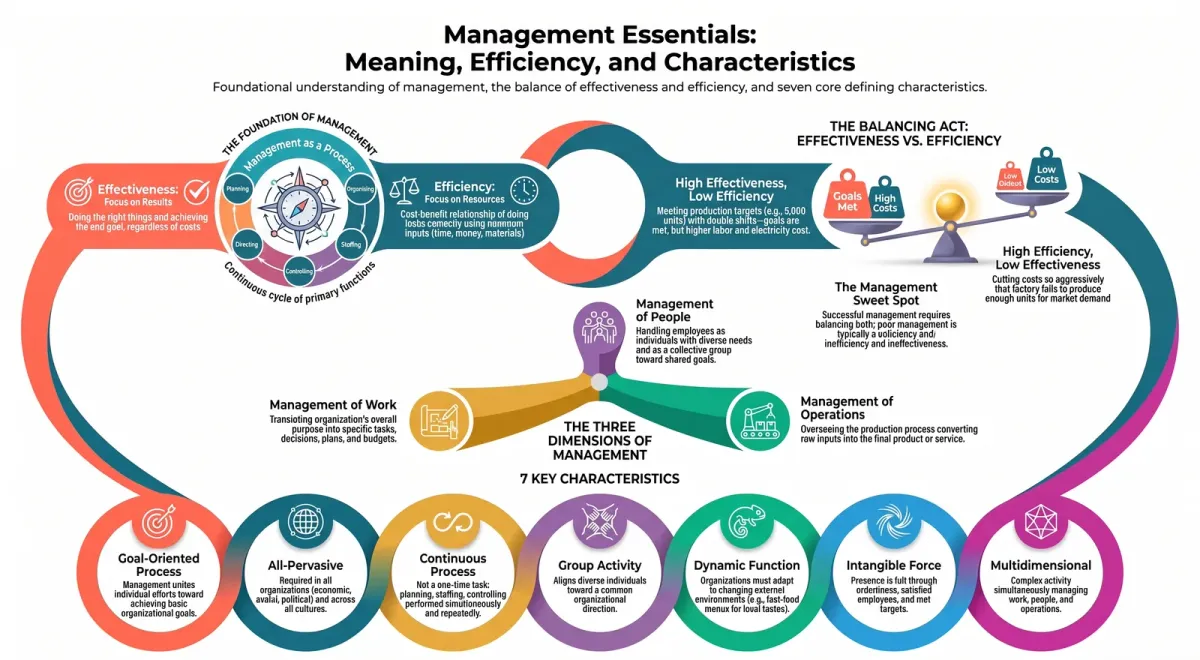
Management is generally understood as the process of getting things done with the aim of achieving goals effectively and efficiently. That one-line definition hides three important ideas that examiners love to test.
Process refers to the primary functions or activities that management performs to get things done — namely planning, organising, staffing, directing, and controlling. These functions are ongoing and interconnected, not one-off tasks.
Effectiveness is about completing the given task — doing the right things and achieving the end result, regardless of the cost involved.
Efficiency is about doing the task correctly, using the fewest possible resources for the maximum output. It is essentially a cost-benefit relationship between inputs (money, materials, people, time) and outputs.
Effectiveness vs Efficiency: Why the Difference Matters
These two terms are often used loosely in everyday conversation, but in management theory they describe two different — sometimes competing — priorities.
Consider a manager whose factory has a target production of 5,000 units a year. If power cuts force double shifts to hit that number, the target is met (effectiveness), but at a much higher labour and electricity cost (poor efficiency). Flip the scenario: a manager who cuts costs aggressively but fails to produce enough units to meet market demand is efficient but not effective, since the goods never reach customers.
Good management rarely means choosing one over the other. The real skill lies in balancing effectiveness and efficiency. Poor management, by contrast, tends to show up as a combination of both inefficiency and ineffectiveness.
How Management Scholars Have Defined It
Several well-known definitions appear repeatedly in Business Studies textbooks and exams.
Harold Koontz and Heinz Weihrich describe management as the process of designing and maintaining an environment in which people, working together in groups, efficiently accomplish selected goals. Robert L. Trewelly and M. Gene Newport frame it as the process of planning, organising, actuating, and controlling an organisation’s operations to achieve coordinated, effective, and efficient use of resources. Kreitner calls it the process of working with and through others to achieve organisational objectives, using limited resources efficiently in a changing environment.
Notice the common threads: a process, involving people, aimed at goals, achieved effectively and efficiently. These are exactly what the seven characteristics below expand on.
Characteristics of Management
1. Management Is a Goal-Oriented Process
Every organisation exists for a reason — a set of basic goals that justify its existence. A retail store may aim to increase sales; an NGO working with children with special needs aims to provide education. Management exists to unite individual efforts toward these shared goals.
2. Management Is All-Pervasive
The activities involved in managing are common to every kind of organisation — economic, social, or political. A petrol pump needs to be managed just as much as a hospital or a school. What differs across countries and cultures is how management is practised, not whether it is needed.
3. Management Is Multidimensional
Management operates across three interconnected dimensions:
-
Management of work — translating organisational purpose into actual tasks, decisions, plans, and budgets.
-
Management of people — treating employees both as individuals with diverse needs and as a group working toward shared goals.
-
Management of operations — running the production process that converts inputs into the product or service the organisation exists to deliver.
4. Management Is a Continuous Process
Planning, organising, staffing, directing, and controlling are performed by managers simultaneously and repeatedly, not in a single sitting. A manager might spend one day planning a festive product launch and the very next sorting out a staffing issue.
5. Management Is a Group Activity
An organisation brings together individuals with different backgrounds and personal motivations. Management’s job is to align these diverse efforts toward the common organisational goal, while still helping individual members grow.
6. Management Is a Dynamic Function
Organisations operate inside a changing external environment. Successful management adapts goals and strategies to that environment, the way global fast-food chains revise their menus to suit local tastes.
7. Management Is an Intangible Force
You cannot see management directly, but you can feel its presence — targets met on schedule, satisfied employees, and order rather than chaos.
Why This Chapter Matters for Your Exams
Nature and Significance of Management opens the Class 11 syllabus for a reason: nearly every later chapter builds directly on the definitions and characteristics covered here. Board papers frequently ask students to identify a characteristic from a short case, so understanding these ideas conceptually, rather than memorising them, pays off.
Ready to Master This Chapter?
Understanding definitions is only the first step — scoring well means practising application-based questions too. ChampionsPrep’s AI-powered platform gives CBSE and Maharashtra Board Class 11 and 12 Commerce students unlimited chapter-wise practice for just ₹10 a session, along with prep support for CUET, IPMAT, JIPMAT, NPAT, and SET. Visit app.championsprep.in to start practising Nature and Significance of Management today.
Test Your Knowledge

What Is Management? Meaning, Definition and Characteristics
Frequently Asked Questions
What is the simplest definition of management for exam purposes? +
Management is the process of getting things done with the aim of achieving an organisation's goals, effectively and efficiently, through the functions of planning, organising, staffing, directing, and controlling.
What is the difference between effectiveness and efficiency? +
Effectiveness means completing the task and achieving the goal — the end result — while efficiency means completing that task using the minimum possible resources and cost. A good manager aims to balance both.
How many characteristics of management are there according to the NCERT syllabus? +
Seven: goal-oriented process, all-pervasive, multidimensional, continuous process, group activity, dynamic function, and intangible force.
What does "management is multidimensional" mean? +
It means management simultaneously handles three dimensions — the work of the organisation, its people, and its operations — and these three are interlinked rather than separate.
Why is management called an intangible force? +
Because management itself cannot be seen or touched, but its effects are visible in how smoothly an organisation functions — through orderliness, employee satisfaction, and goals achieved on schedule.
AI-powered practice — free to start