
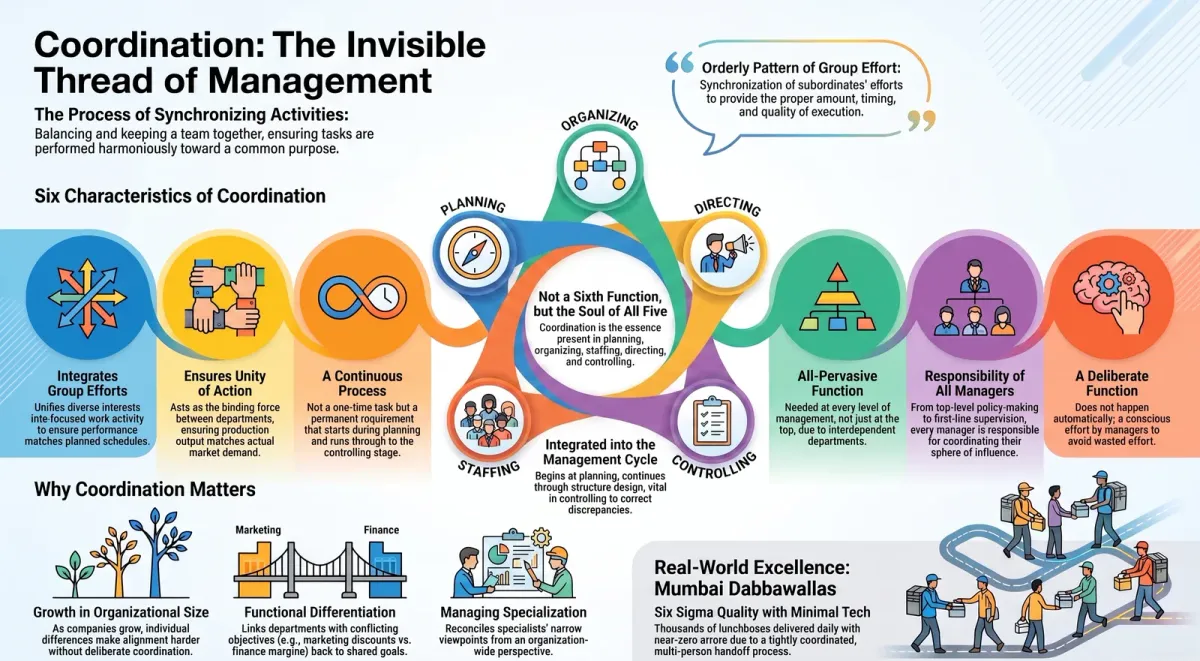
If planning, organising, staffing, directing, and controlling are the five functions of management, coordination is the invisible thread that holds them all together. NCERT Class 11 Business Studies Chapter 1 closes with this idea for good reason: without coordination, even a team of individually excellent managers can end up working against each other rather than toward a shared goal.
What Coordination Actually Means
A manager performs five interrelated functions while managing an organisation — a system made up of interlinked, interdependent subsystems such as purchase, production, sales, and finance. Coordination is the process by which a manager synchronises the activities of these departments so they work in harmony rather than at cross-purposes.
Well-known definitions capture this idea. E.F.L. Brech describes coordination as balancing and keeping together a team by ensuring suitable allocation of tasks among members and seeing that tasks are performed harmoniously. McFarland defines it as the process whereby an executive develops an orderly pattern of group effort among subordinates and secures unity of action in pursuit of a common purpose. Theo Haimann describes it as the orderly synchronising of subordinates’ efforts to provide the proper amount, timing, and quality of execution, so their combined efforts lead to the organisation’s stated objectives.
Why Coordination Is Called the “Essence” of Management, Not a Separate Function
This is a subtle but important distinction that exam papers frequently test. Coordination is sometimes treated as though it were a sixth function, alongside planning, organising, staffing, directing, and controlling. NCERT is explicit that this framing is misleading: coordination is the essence of management, not a separate function performed at a distinct stage.
Every one of the five functions contributes to coordination — it is implicit in each, beginning at the planning stage and continuing through controlling. Top management plans for the entire organisation; the structure is staffed accordingly; directing ensures plans are executed; and controlling corrects discrepancies between what was planned and what happened. Coordination is the thread running through all of it, ensuring orderly individual and group effort toward common objectives.
Characteristics of Coordination
Coordination Integrates Group Efforts
It unifies unrelated or diverse interests into purposeful, focused work activity, ensuring group performance stays aligned with what was planned and scheduled.
Coordination Ensures Unity of Action
Its purpose is to secure unity of action in pursuit of a shared goal. It acts as the binding force between departments, for instance ensuring that a business’s production and sales departments work together so that output actually matches market demand.
Coordination Is a Continuous Process
It is not a one-time task performed at a single stage. It begins during planning and runs all the way through the controlling stage, requiring constant monitoring and adjustment along the way.
Coordination Is an All-Pervasive Function
Because activities across departments are interdependent, coordination is needed at every level of management, not just at the top. Purchase, production, and sales efforts, for example, all have to be coordinated for an organisation to function harmoniously — poor-quality raw materials from the purchase department will eventually show up as declining sales, however well the sales team performs.
Coordination Is the Responsibility of All Managers
Every manager in the organisation, at every level, is responsible for coordination. Top managers coordinate with their subordinates to ensure overall policies are carried out; middle managers coordinate between top-level direction and first-line execution; supervisors coordinate the activities of the workers they directly oversee.
Coordination Is a Deliberate Function
A manager has to coordinate different people’s efforts consciously and deliberately — it does not happen automatically, even when team members are willingly cooperative. In fact, cooperation without coordination can lead to wasted effort, and coordination without cooperation can lead to employee dissatisfaction. The two need to work together.
Why Coordination Matters: The Underlying Reasons
Coordination becomes necessary largely because departments and individuals within an organisation are fundamentally interdependent — they rely on each other for information and resources. Three factors make this especially important.
Growth in size — As organisations grow, individual differences in work habits, background, and approach make it progressively harder to keep everyone aligned toward common goals without deliberate coordination.
Functional differentiation — Departments like finance, production, and marketing often develop their own objectives that can conflict — a marketing team offering discounts to boost sales might clash with a finance team protecting margins. Coordination links these separate activities back to shared goals.
Specialisation — Modern organisations rely on specialists who often believe only they are qualified to judge matters in their own area, creating friction with the rest of the organisation. This requires coordination from an organisation-wide perspective to reconcile differences.
A Real-World Example: Mumbai’s Dabbawallas
The Mumbai dabbawallas are a widely cited case study of coordination in action. Every day, thousands of dabbawallas collect home-cooked lunches from kitchens across the city, sort them at railway stations by destination, transport them by train, and deliver them precisely to offices, with an error rate famously benchmarked at Six Sigma quality, despite using almost no technology. Each dabbawalla handles just one link in a long, tightly coordinated chain, proof that coordination, done well, can produce near-flawless results even with limited resources.
Complete Your Chapter 1 Revision
Coordination questions frequently appear as “do you agree” or reasoning-based long-answer questions in board exams. ChampionsPrep’s AI-powered platform helps CBSE and Maharashtra Board Class 11 and 12 Commerce students practise this kind of reasoning for ₹10 a session, alongside dedicated preparation for CUET, IPMAT, JIPMAT, NPAT, and SET. Visit https://app.championsprep.in to complete your revision of Nature and Significance of Management.
Test Your Knowledge

Coordination: The Essence of Management — Meaning, Characteristics and Importance
Frequently Asked Questions
Is coordination a separate function of management? +
No. NCERT explicitly describes coordination as the essence of management rather than a separate function — it is implicit and present in each of the five functions (planning, organising, staffing, directing, controlling), not a distinct sixth step.
What are the characteristics of coordination? +
Coordination integrates group efforts, ensures unity of action, is a continuous process, is an all-pervasive function, is the responsibility of all managers, and is a deliberate function.
Why does organisational growth make coordination more important? +
As an organisation grows, more people with different work habits and approaches are employed, making it progressively harder to keep everyone aligned toward common goals without deliberate coordination efforts.
How does specialisation create a need for coordination? +
Specialists often believe they alone are qualified to judge issues in their own area, which can create conflict with other specialists or departments. Coordination reconciles these differing viewpoints toward the organisation's shared objectives.
What is a well-known real-world example of effective coordination? +
The Mumbai dabbawalla system, which coordinates the delivery of thousands of home-cooked lunches daily with a Six Sigma-level error rate, using minimal technology and a tightly synchronised, multi-person handoff process.
AI-powered practice — free to start