
How to Start a Business: 8 Essential Factors Every Entrepreneur Must Know
Starting a business sounds exciting — and it is. But it is also one of the most important decisions a person can make, and one that requires careful, systematic thinking. Not every business idea becomes a successful enterprise. Many ventures fail simply because founders did not think through the critical factors before launching. CBSE Class 11 Business Studies Chapter 1 dedicates an entire section to this: Starting a Business — Basic Factors. This guide walks you through all eight factors with clear explanations and real-world context.
What is Entrepreneurship?
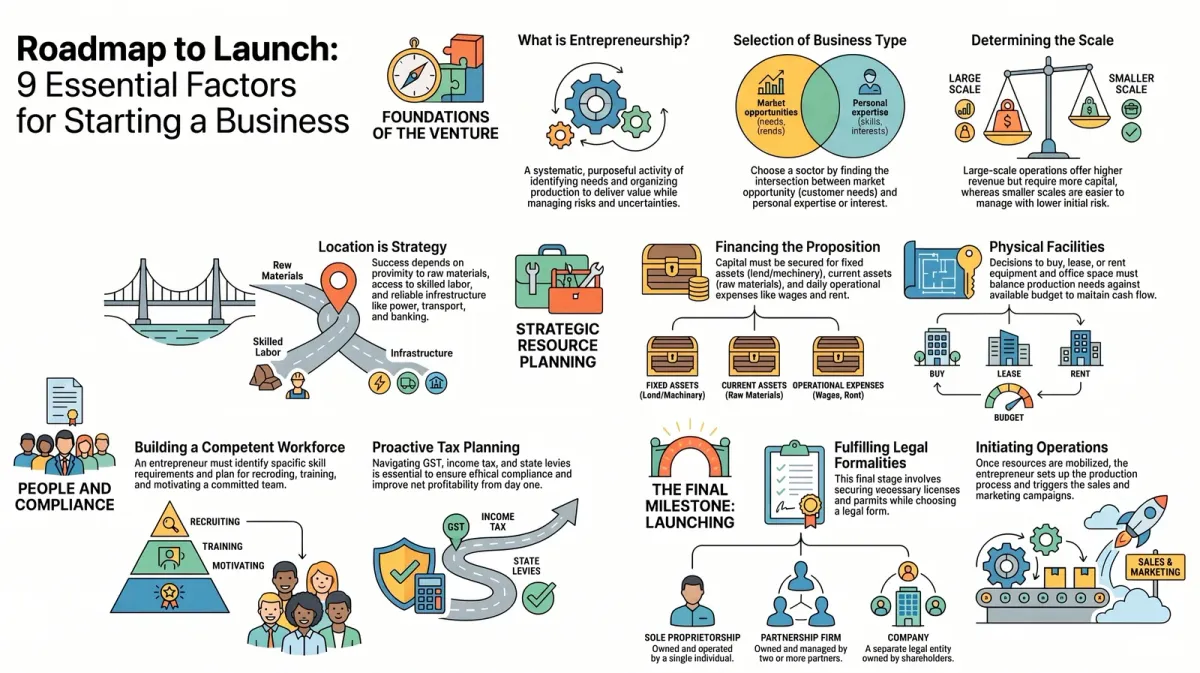
Before diving into the factors, let us understand the broader concept. The process of setting up one’s own business is called entrepreneurship. The person who sets up a business is called an entrepreneur, and the business unit created is called a business enterprise.
Entrepreneurship is defined as:
“A systematic, purposeful and creative activity of identifying a need, mobilising resources and organising production with a view to delivering value to customers, returns for investors and profits for the self, in accordance with the risks and uncertainties associated with business.”
This definition is important: it tells us that entrepreneurship is not spontaneous or random. It is a deliberate, planned process that interacts with both personal ambition and the surrounding business environment.
When you choose entrepreneurship, you become a job-provider rather than a job-seeker. Entrepreneurship also creates and expands opportunities for others — in employment and professional roles — making it crucial for a nation’s economic development.
8 Key Factors for Starting a Business
1. Selection of Type of Business
The first decision is: what kind of business to start? The best choice sits at the intersection of market opportunity and personal expertise. What do customers need? What does the entrepreneur know well and find engaging? Which sector offers realistic profitability? Aligning personal knowledge and interest with market demand is the foundation of a well-chosen business type.
2. Size of Business
The entrepreneur must determine the scale of operations — small, medium, or large. A larger scale offers greater revenue potential but demands more capital, staff, and management bandwidth. A smaller scale limits growth but is easier to manage and carries lower risk. The right scale depends on expected demand, available capital, and whether the business targets the MSME sector or large-scale markets.
3. Location of Business Enterprise
Location has long-term consequences. A wrong choice can result in high production costs, difficulty attracting workers, or poor market access. Key factors: proximity to raw materials, availability of skilled labour, reliable power and infrastructure, and access to banking, transport, communication, and warehousing services. A manufacturing unit producing perishables must be close to both its raw material source and its end consumers.
4. Financing the Proposition
Capital is the lifeblood of any new business. Financing involves identifying total capital needs and determining sources — entrepreneur’s savings, bank loans, family investment, venture capital, or government MSME schemes. Capital is needed for fixed assets (land, machinery, building), current assets (raw materials, finished goods), and day-to-day expenses (wages, rent, utilities). A clear financial plan before launch prevents running out of funds mid-operation.
5. Physical Facilities
The availability of adequate physical facilities — machines, equipment, office space, and support services — is an important pre-launch consideration. Decisions about what to acquire (and whether to buy, lease, or rent) depend on the nature and size of the business, available budget, and production process involved. Over-investing early can strain cash flow; under-investing can limit output quality.
6. Competent and Committed Workforce
No entrepreneur can do everything alone. Every business needs people — and the right people make all the difference. Building a competent and committed workforce requires the entrepreneur to identify skill requirements, plan the mix of skilled, unskilled, and managerial staff, and make upfront decisions about how employees will be recruited, trained, and motivated to give their best performance.
7. Tax Planning
Starting a business in modern India means navigating a complex landscape of tax laws — GST, income tax, TDS, and state-level levies — that directly affect financial viability. The entrepreneur must assess all applicable tax obligations before launch. Efficient, ethical tax planning reduces costs and improves net profitability from day one.
8. Launching the Enterprise
After all the above decisions have been made and resources mobilised, the entrepreneur is ready for the actual launch. This involves:
-
Fulfilling all necessary legal formalities (registration, licences, permits)
-
Setting up the production process
-
Initiating the sales and marketing campaign
-
Making decisions about the legal form of business — whether to operate as a sole proprietorship, partnership firm, or company
The launch also requires a clear financial plan that determines:
-
The total capital requirement
-
Sources from which capital will be raised
-
The best ways to deploy and utilise that capital in the business
📚 Future Entrepreneurs — Start Here with ChampionsPrep
Whether you are studying entrepreneurship for your CBSE board exams or genuinely considering starting a business someday, ChampionsPrep helps you build strong conceptual clarity in Commerce. Ask any question, get instant answers, and study on your terms.
👉 Visit ChampionsPrep.in — your AI study partner for Commerce!
Chapter Reference: CBSE Class 11 Business Studies – Chapter 1: Business, Trade and Commerce
Test Your Knowledge

How to Start a Business: 8 Essential Factors Every Entrepreneur Must Know | Class 11 Business Studies
Frequently Asked Questions
What is entrepreneurship as defined in CBSE Class 11 Business Studies? +
Entrepreneurship is a systematic, purposeful and creative activity of identifying a need, mobilising resources, and organising production to deliver value to customers, returns for investors, and profits for the entrepreneur — in accordance with business risks and uncertainties.
What are the eight basic factors to consider when starting a business? +
The eight factors are: (1) Selection of type of business, (2) Size of business, (3) Location of business, (4) Financing the proposition, (5) Physical facilities, (6) Competent and committed workforce, (7) Tax planning, (8) Launching the enterprise.
Why is location an important factor when starting a business? +
Location affects the cost of production, access to raw materials and labour, proximity to markets, and availability of infrastructure. A poor location can increase costs significantly and reduce the competitiveness of the business.
What types of capital does a new business need? +
A new business needs capital for fixed assets (land, machinery), current assets (raw materials, finished goods stock), and day-to-day operational expenses (wages, utilities, rent).
What legal forms can a business enterprise take at the time of launch? +
A business enterprise can be launched as a sole proprietorship (owned and run by one person), a partnership firm (owned by two or more partners), or a company (a separate legal entity with shareholders).
AI-powered practice — free to start