
Types of Industries in Business: Primary, Secondary and Tertiary Explained
Every product you use has passed through multiple types of industrial activity before reaching you. A farmer grew the wheat (primary industry), a mill processed it into flour (secondary industry), and a logistics company delivered it to your store (tertiary industry). Understanding industry classification is a key topic in CBSE Class 11 Business Studies Chapter 1.
What is Industry?
Industry refers to economic activities connected with the conversion of resources into useful goods. The term is typically used for activities in which mechanical appliances and technical skills are involved. These include activities related to:
-
Producing or processing goods
-
Breeding and raising animals
-
Constructing infrastructure
The term industry is also used to describe groups of firms producing similar or related goods. For example, the cotton textile industry refers to all manufacturing units producing goods from cotton. Similarly, we speak of the banking industry, insurance industry, and so on.
Industries are broadly divided into three main categories: Primary, Secondary, and Tertiary.
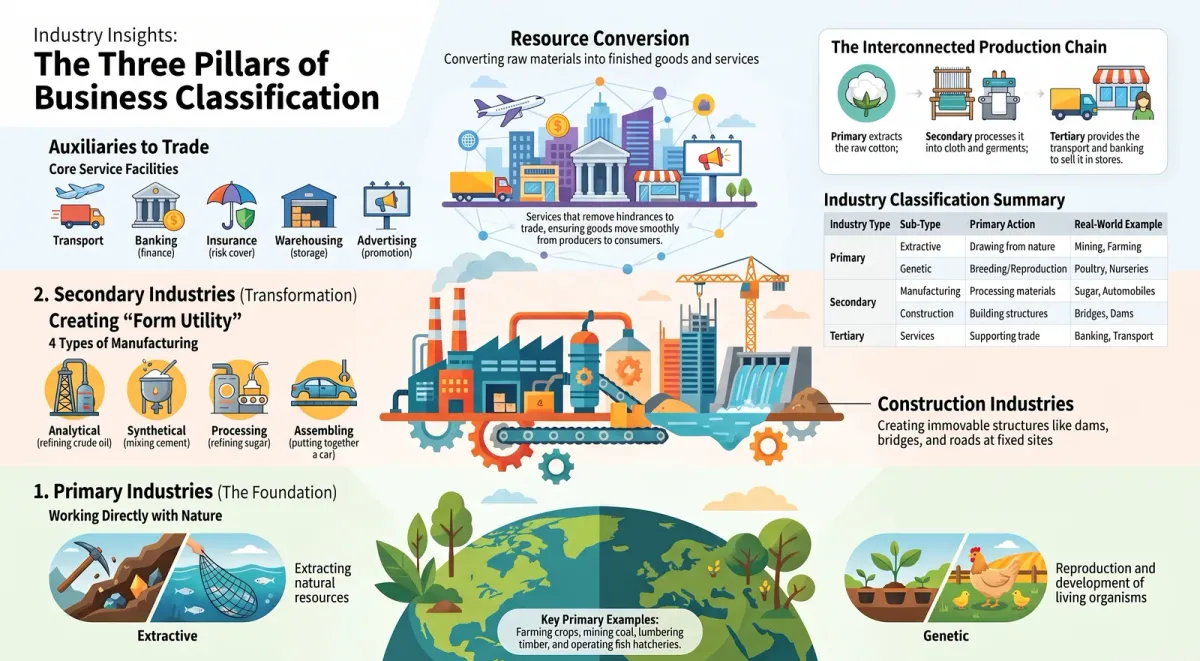
1. Primary Industries
Primary industries include all activities concerned with the extraction and production of natural resources, as well as the reproduction and development of living organisms and plants. These industries work directly with nature.
Primary industries are further divided into two sub-types:
(a) Extractive Industries
Extractive industries extract or draw products from natural sources. They work with the geographical and natural environment to obtain raw materials that are later transformed into finished goods by manufacturing units.
Key examples of extractive industries:
-
Farming — growing crops like wheat, rice, and cotton
-
Mining — extracting coal, iron ore, gold, and other minerals
-
Lumbering — cutting and processing timber from forests
-
Fishing — catching fish from rivers, lakes, and seas
-
Hunting — obtaining animal products
Extractive industries provide the basic raw materials that form the foundation of the entire industrial chain.
(b) Genetic Industries
Genetic industries are engaged in breeding plants and animals for their use in further reproduction. These industries help replenish and multiply living resources.
Key examples of genetic industries:
-
Seeds and nursery companies (breeding plant varieties for agriculture)
-
Cattle breeding farms
-
Poultry farms
-
Fish hatcheries
The critical difference between extractive and genetic industries is that extractive industries take from nature, while genetic industries reproduce and multiply living organisms for continued use.
2. Secondary Industries
Secondary industries are concerned with processing materials that have already been extracted at the primary level. They transform raw materials into finished goods suitable for final consumption or for further industrial processing.
For example: mining iron ore is a primary industry, but manufacturing steel from that iron ore is a secondary industry.
Secondary industries are divided into two sub-types:
(a) Manufacturing Industries
Manufacturing industries produce finished goods by processing raw or semi-finished materials, thereby creating form utility — transforming something into a more useful or valuable state. These industries bring out the diverse finished products we consume or use daily.
Manufacturing industries are further classified into four types based on their method of operation:
-
Analytical industry — Analyses and separates different elements from the same material. Example: Oil refinery (crude oil → petrol, diesel, kerosene)
-
Synthetical industry — Combines various ingredients into a new product. Example: Cement manufacturing (limestone + clay + heat → cement)
-
Processing industry — Involves successive stages to manufacture finished products. Example: Sugar manufacturing (sugarcane → juice → crystals → refined sugar); Paper manufacturing
-
Assembling industry — Assembles different component parts to make a complete product. Example: Television, car, computer assembly
(b) Construction Industries
Construction industries are involved in the construction of:
-
Buildings (residential, commercial)
-
Dams and canals
-
Bridges and roads
-
Tunnels and railways
Unlike manufacturing industries, construction industries create immovable structures at a fixed site. They require significant engineering and architectural skills. Output from construction industries cannot be transported — they are built in situ.
3. Tertiary Industries
Tertiary industries are concerned with providing support services to primary and secondary industries, as well as activities relating to trade. Instead of producing tangible goods, they provide service facilities that facilitate the movement, exchange, and distribution of goods.
Tertiary industries are closely linked to commerce and serve as auxiliaries to trade. They remove the various hindrances that prevent goods from reaching consumers smoothly.
Industries included in the tertiary sector:
-
Transport — moving goods and people from one place to another
-
Banking — providing financial services to businesses and individuals
-
Insurance — covering risks associated with goods in transit or storage
-
Warehousing — providing storage facilities for goods
-
Communication — postal, telephone, and digital communication services
-
Packaging — protecting goods during storage and transit
-
Advertising — promoting goods and services to consumers
How the Three Industry Types Work Together
The three types form an interconnected production chain: Primary industries extract raw materials (e.g., cotton), Secondary industries transform them into finished products (e.g., cotton → cloth → garments), and Tertiary industries ensure those products reach consumers through transport, banking, and warehousing. No stage can function effectively without the others.
Quick Recap: Classification at a Glance
| Type | Sub-Type | Key Activity | Example |
|---|---|---|---|
| Primary | Extractive | Drawing from nature | Mining, farming |
| Primary | Genetic | Breeding organisms | Poultry farms, nurseries |
| Secondary | Manufacturing | Processing raw materials | Sugar, cement, automobiles |
| Secondary | Construction | Building structures | Dams, roads, buildings |
| Tertiary | Services | Supporting trade | Banking, transport, advertising |
📚 Confused About Industry Types? Ask ChampionsPrep!
Questions on industry classification appear in almost every CBSE Business Studies exam. If the sub-types of manufacturing industries or the distinction between extractive and genetic industries ever trips you up, ChampionsPrep gives you instant, AI-powered answers — whenever you need them.
👉 Visit app.championsprep.in — your on-demand Commerce tutor!
Chapter Reference: CBSE Class 11 Business Studies – Chapter 1: Business, Trade and Commerce
Test Your Knowledge
Types of Industries in Business: Primary, Secondary and Tertiary Explained | Class 11 Business Studies
Frequently Asked Questions
What is the difference between extractive and genetic industries? +
Extractive industries draw or extract products from natural sources (e.g., mining, farming), while genetic industries breed and multiply living organisms for reproduction purposes (e.g., poultry farms, fish hatcheries).
What are the four types of manufacturing industries? +
The four types are: Analytical (e.g., oil refinery), Synthetical (e.g., cement), Processing (e.g., sugar, paper), and Assembling (e.g., cars, computers).
Why are construction industries classified as secondary and not tertiary? +
Construction industries process raw materials (brick, steel, cement) to create structures. Since they involve physical transformation of materials, they are secondary industries. Tertiary industries provide services, not physical goods.
What are two examples of tertiary industries? +
Banking and warehousing are two examples of tertiary industries that support trade and commerce.
What type of industry is a fish hatchery? +
A fish hatchery is a genetic industry, as it involves breeding and multiplying fish for further reproduction and use.
AI-powered practice — free to start