
What is Business? Meaning, Definition and 7 Key Characteristics
When a shopkeeper sells groceries every morning, we call it business. But when a housewife cooks those same groceries for her family at home, we do not. The difference lies not in what is done, but in why and how it is done. Understanding this distinction is the cornerstone of CBSE Class 11 Business Studies Chapter 1.
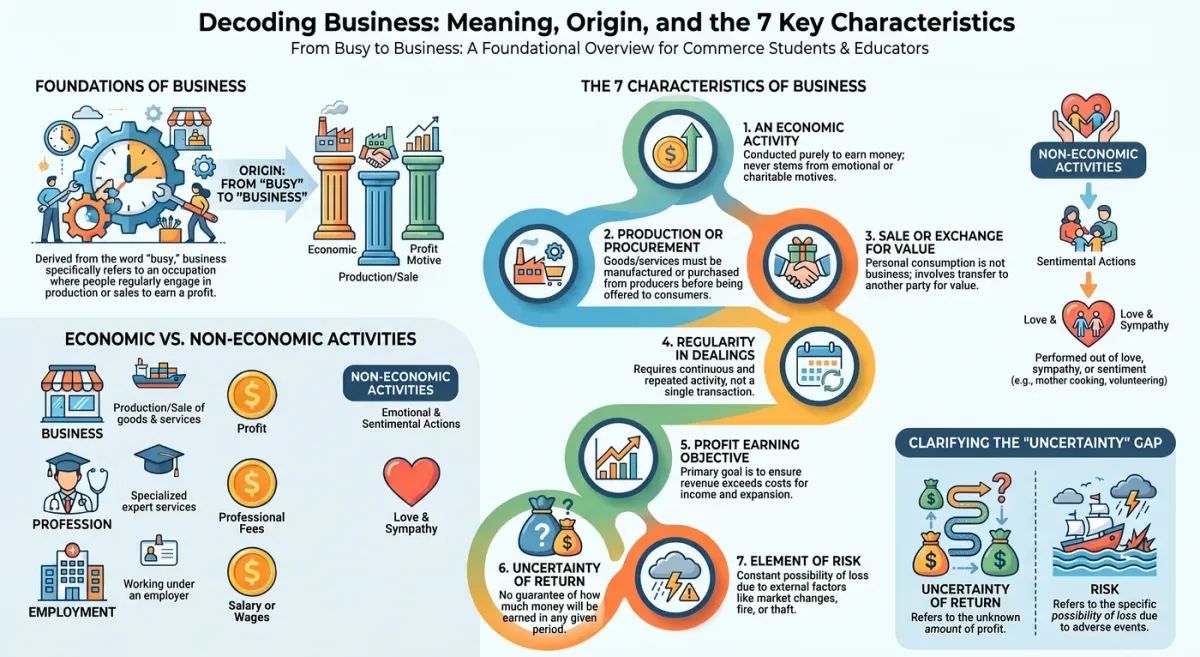
Economic vs Non-Economic Activities
All human activities can be broadly classified into two categories: economic activities and non-economic activities.
Economic activities are those performed to earn money or secure a livelihood. Examples include:
-
A factory worker operating machines in exchange for wages
-
A doctor treating patients to earn consultation fees
-
A teacher delivering lessons to earn a salary
Non-economic activities, by contrast, are performed out of love, affection, sympathy, patriotism, or sentiment — not for money. Examples include:
-
A mother cooking food for her family out of love
-
A student helping a classmate understand a difficult topic out of friendship
-
A volunteer distributing food during a disaster out of empathy
Economic activities are further divided into three major types:
-
Business — production and sale of goods or services for profit
-
Profession — rendering specialised, expert services (e.g., doctors, lawyers, CAs)
-
Employment — performing work for an employer in exchange for a salary or wages
What is Business? The Formal Definition
Business is an economic activity involving the production and sale of goods and services, undertaken with a motive of earning profit by satisfying human needs in society.
This definition packs three essential requirements into one sentence:
-
The activity must be economic in nature (not charitable or emotional)
-
It must involve the production or sale of goods and services
-
It must be carried out with the clear intent of earning profit
Business is central to everyday life. While schools, hospitals, and religious bodies also shape society, business has the most direct and widespread impact on how people live, work, and consume.
7 Key Characteristics of Business Activities
Not every money-generating activity qualifies as business. Here are the seven defining characteristics that make something a business:
1. Business is an Economic Activity
Business is always performed with the objective of earning money or securing a livelihood — never out of love, affection, or sympathy. This distinguishes business from activities like charity or volunteering. Whether the enterprise is small (a local kirana store) or large (a corporation), the economic motive remains constant.
2. Production or Procurement of Goods and Services
Before goods reach consumers, they must either be produced or procured. A manufacturing firm produces goods; a trading firm purchases goods from producers and resells them. Goods include consumable items of daily use (sugar, ghee, stationery) and capital goods (machinery, furniture). Services include banking, transportation, and power supply.
3. Sale or Exchange of Goods and Services
Business always involves a transfer or exchange of goods and services for value. If goods are produced purely for personal consumption, it is not business. Cooking food at home is not business. Cooking food and selling it to customers in a restaurant or a tiffin service is business. The act of sale or exchange is non-negotiable.
4. Dealings on a Regular Basis
A single, isolated transaction does not constitute business. If you sell your old textbooks for profit at the end of the year, that is not a business activity. But if you regularly buy and sell second-hand books, that is business. The key is regularity — continuous and repeated dealings in goods or services.
5. Profit Earning
Profit is one of the primary and essential goals of business. No business can survive long without earning profit. Profit is the excess of revenue over costs, and it serves multiple purposes: it provides income to the owner, finances future expansion, signals efficient operations, and reflects the market’s approval of the product or service.
6. Uncertainty of Return
Unlike a fixed salary from employment, business returns are uncertain. A business may earn high profits in one period and incur losses in another. This lack of predictability regarding future earnings is called the uncertainty of return and is an inherent feature of all business activity that cannot be eliminated.
7. Element of Risk
Risk is the uncertainty associated with exposure to loss — caused by unfavourable or undesirable events. Business risks arise from changes in consumer tastes, new competition, natural calamities, strikes, fire, theft, or technological changes. No business, however expertly managed, can eliminate risk entirely. It can only be minimised through careful planning, diversification, and insurance.
Why These Characteristics Matter for Your Exams
These seven characteristics are frequently tested in CBSE board exams, both as one-liners and in longer explanations. Understanding the why behind each — not just the label — is what earns full marks.
📚 Got Doubts in Business Studies? ChampionsPrep Has Answers.
Struggling to remember definitions and characteristics before your exam? ChampionsPrep provides AI-powered, on-demand doubt resolution for Class XI and XII Commerce students — instant, accurate, and affordable. No more waiting for the next class.
👉 Visit app.championsprep.in and ask your first doubt today!
Chapter Reference: CBSE Class 11 Business Studies – Chapter 1: Business, Trade and Commerce

What is Business? Meaning, Definition & 7 Key Characteristics
AI-powered practice — free to start