
Commerce, Trade and Auxiliaries to Trade: A Complete Guide for Class 11 Business Studies
Imagine a farmer in Punjab who grows excellent wheat but cannot get it to a customer in Chennai. Or a manufacturer in Surat who produces textiles but cannot store unsold stock safely. Or a trader who wants to import goods but has no protection if the cargo is lost at sea. These are real problems in the flow of goods and services — and commerce exists precisely to solve them. In this guide, we break down commerce, the types of trade, and the essential auxiliaries that keep the wheels of business turning.
What is Commerce?
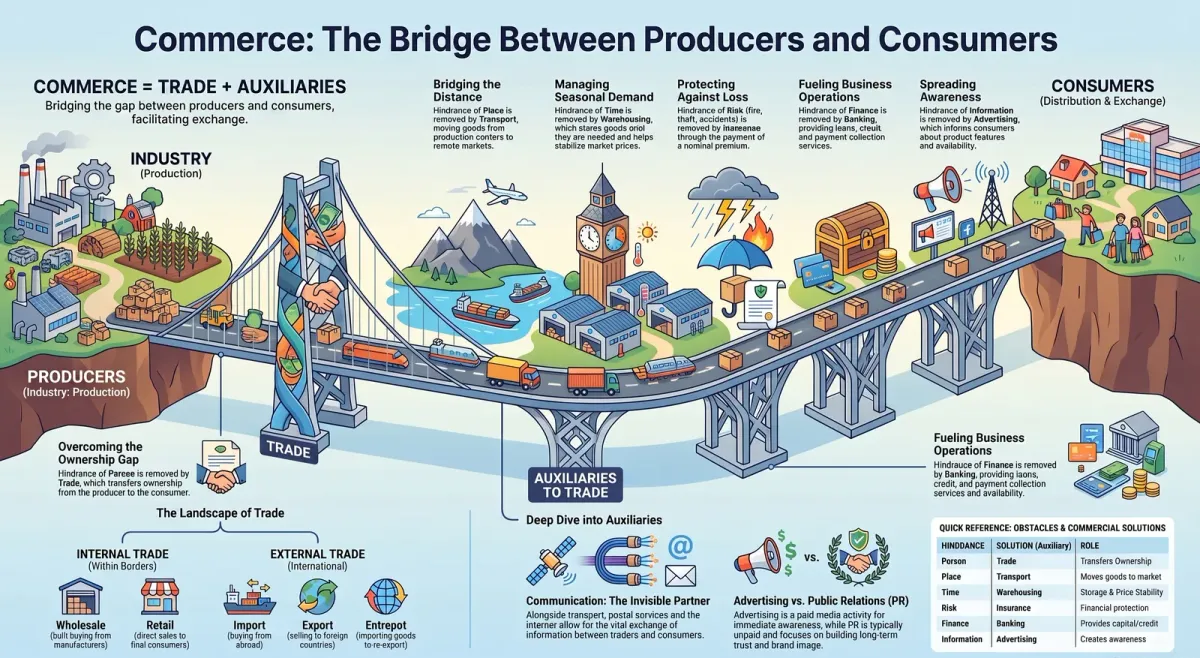
Business activities are broadly divided into two categories: Industry (which deals with production) and Commerce (which deals with distribution and exchange).
Commerce includes all those activities necessary for facilitating the exchange of goods and services. It consists of two main components:
-
Trade — the actual buying and selling of goods
-
Auxiliaries to Trade — services that support and facilitate trade
Commerce provides the essential link between producers and consumers. It embraces every activity necessary for maintaining a free and efficient flow of goods and services from those who make them to those who need them.
How Commerce Removes Hindrances
Commerce is often described as a system for removing hindrances that block the smooth exchange of goods. Here is how each hindrance is addressed:
| Hindrance | Removed by | How |
|---|---|---|
| Person (ownership gap) | Trade | Transfers ownership from producer to consumer |
| Place (distance) | Transport | Moves goods from production centres to markets |
| Time (seasonal demand) | Warehousing | Stores goods until they are needed |
| Risk (damage or loss) | Insurance | Provides financial protection against risks |
| Finance (capital shortage) | Banking | Provides funds for business operations |
| Information (lack of awareness) | Advertising | Informs consumers about available goods |
What is Trade?
Trade is the buying and selling of goods — either physical or virtual. It helps make the goods produced by industries available to consumers in different markets. Without trade, it would be impossible to produce goods on a large scale, since producers would have no efficient way to reach individual buyers.
Trade is classified into two broad types:
(a) Internal Trade
Internal trade refers to the buying and selling of goods within the same country. It is further divided into:
-
Wholesale trade: Goods are purchased in large quantities from manufacturers and sold to retailers. Wholesalers act as an important link between the manufacturer and the retailer.
-
Retail trade: Goods are sold directly to the final consumer in small quantities. Examples: supermarkets, kirana stores, online retail platforms.
(b) External Trade
External trade (also called foreign trade) refers to the buying and selling of goods between two or more countries. It is divided into:
-
Import trade: Buying goods from a foreign country for use in the home country
-
Export trade: Selling domestically produced goods to foreign countries
-
Entrepot trade: Importing goods from one country and re-exporting them to another country (the importer acts as an intermediary)
Auxiliaries to Trade
Activities that assist, support, and facilitate trade are known as auxiliaries to trade. These services support not just trade but also industry — making them an integral part of the entire business ecosystem.
1. Transport and Communication
Goods are produced in specific locations — tea in Assam, cotton in Gujarat, jute in West Bengal — but consumed across the country. Transport bridges this gap by moving raw materials to factories and finished goods to consumers through road, rail, and coastal shipping.
Alongside transport, communication facilities — postal services, telephone, and the internet — allow producers, traders, and consumers to exchange information efficiently. Together they remove the hindrance of place.
2. Banking and Finance
No business can function without capital. Banking removes the hindrance of finance by providing funds through loans, advances, overdraft facilities, and cash credit. Banks also facilitate cheque collection, fund remittances, bill discounting, and help exporters collect payments from foreign importers — enabling businesses to operate smoothly even when their own funds are insufficient.
3. Insurance
Business involves unavoidable risks — fire, theft, floods, accidents, and occupational hazards to employees. Insurance removes the hindrance of risk by providing financial protection against these uncertainties. On payment of a nominal premium, businesses can recover the value of a loss from the insurance company, allowing operations to continue with greater confidence.
4. Warehousing
Goods are rarely sold immediately after production. Warehousing removes the hindrance of time by providing proper storage facilities that ensure goods are available when and where needed. It also stabilises prices — storing surplus during periods of low demand and releasing stock during shortages prevents extreme price swings in the market.
5. Advertising and Public Relations
Even the best product is useless if consumers do not know it exists. Advertising removes the hindrance of information by communicating product availability, features, and price to potential customers. It is a paid activity — businesses purchase space in print, broadcast, or digital media.
Public Relations (PR) is typically unpaid — businesses build a positive public image through press releases, community involvement, and strategic communication. Advertising creates immediate awareness; PR builds long-term trust and brand reputation.
📚 Master Commerce Concepts with ChampionsPrep
Questions on auxiliaries to trade and their role in removing hindrances are a guaranteed part of CBSE board exams. If any concept here feels unclear, ChampionsPrep gives you instant, exam-focused answers through AI-powered doubt resolution — tailored for Class XI and XII Commerce students.
👉 Visit ChampionsPrep.in — clear doubts, score higher!
Chapter Reference: CBSE Class 11 Business Studies – Chapter 1: Business, Trade and Commerce
Test Your Knowledge

Commerce, Trade and Auxiliaries to Trade: Complete Guide for Class 11 Business Studies
Frequently Asked Questions
What is the difference between trade and commerce? +
Trade refers specifically to the buying and selling of goods, while commerce is a broader term that includes trade plus all the supporting services (auxiliaries) like transport, banking, insurance, warehousing, and advertising.
What are the five auxiliaries to trade? +
The five auxiliaries to trade are: Transport, Banking and Finance, Insurance, Warehousing, and Advertising and Public Relations.
What is entrepot trade? +
Entrepot trade involves importing goods from one country and re-exporting them to another country. The importing country acts as an intermediary or transit point.
How does warehousing help in price stabilisation? +
Warehousing stores surplus goods during periods of low demand and releases them during periods of high demand, ensuring a continuous supply in the market that prevents sharp price rises and falls.
What is the difference between advertising and public relations? +
Advertising is a paid activity where a business pays for promotional space in media. Public relations (PR) is typically unpaid and involves building a positive brand image through strategic communication such as press releases and community engagement.
AI-powered practice — free to start