
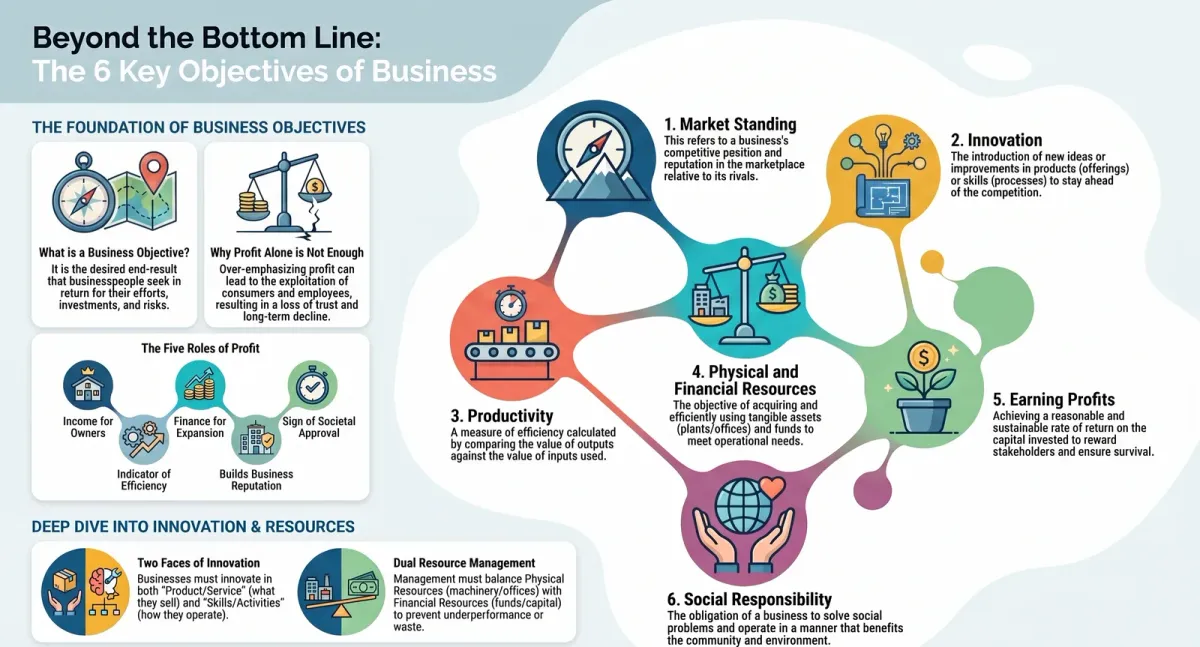
Objectives of Business: Why Profit Is Not the Only Goal
Ask anyone on the street why businesses exist, and most will say: “To make money.” And while that is certainly part of the answer, it is far from the complete picture. A business obsessed only with profit — ignoring its customers, employees, and community — often ends up failing far sooner than one that balances multiple goals. CBSE Class 11 Business Studies Chapter 1 introduces this important idea: business has multiple objectives, and understanding all of them is key to building something that lasts.
What is a Business Objective?
An objective is the starting point of business. It refers to what businesspeople want to achieve in return for their efforts, investments, and risks. Objectives provide direction, help allocate resources efficiently, and give a standard against which business performance can be measured.
Every business is directed towards achieving certain objectives. Since a business has to balance multiple needs — financial survival, customer satisfaction, employee welfare, innovation, and community contribution — it cannot follow only one objective and expect excellence.
The Role of Profit in Business
Profit is the most widely recognised objective of business — and rightfully so. Every business is an attempt to earn more from sales than it spends on costs. Profit is the excess of revenue over costs.
Profit is considered an essential objective for several important reasons:
-
It is the primary source of income for business owners and entrepreneurs
-
It serves as a source of finance for business expansion and growth
-
It indicates the efficient functioning of a business
-
It reflects society’s approval of the goods or services being offered
-
It helps build the reputation and credibility of a business enterprise
However, too much emphasis on profit — to the exclusion of every other goal — can be dangerous. Business managers obsessed with short-term profit may neglect responsibilities toward customers, employees, investors, and society. They may be tempted to engage in unethical practices, exploit consumers, or cut corners on quality. This results in loss of trust, customer backlash, and ultimately the decline of the business itself. Profit is a leading objective, but not the only one.
6 Key Objectives of Business
Business objectives span multiple areas — financial, operational, and social. Here are the six most important categories:
1. Market Standing
Market standing refers to a business’s competitive position relative to competitors — its goodwill, reputation, and distinct identity in the marketplace. A business must offer competitive products at reasonable prices, serve customers to their satisfaction, and reinforce why buyers should choose it over alternatives. Strong market standing helps a business survive economic downturns and competitive pressures.
2. Innovation
Innovation is central to the growth and competitiveness of any business. It is defined as the introduction of new ideas or methods — in the way a product is made, a service is delivered, or a process is managed.
Innovation does not necessarily mean inventing an entirely new product. Even a modification to an existing product to enhance its performance, usability, or appeal counts as innovation. There are two types of innovation in business:
-
Innovation in products or services (developing new or improved offerings)
-
Innovation in skills and activities (finding better, faster, cheaper ways of doing things)
No business can sustain long-term success without innovation. In today’s competitive markets, businesses that stop innovating are quickly overtaken by those that do.
3. Productivity
Productivity measures how efficiently a business uses its resources. It is calculated by comparing the value of output with the value of inputs. A more productive business generates more output from the same level of inputs — or the same output with fewer inputs.
Productivity is used as a direct measure of efficiency. Every business must aim at greater productivity through:
-
Better utilisation of machinery and equipment
-
Reduction of waste in materials and processes
-
Upskilling of employees
-
Adoption of improved technology
Higher productivity leads to lower costs, better quality products, and stronger profitability — creating a sustainable competitive advantage.
4. Physical and Financial Resources
Every business requires two types of resources to function:
-
Physical resources: Plants, machines, offices, equipment, and technology
-
Financial resources: Funds to invest in assets, purchase raw materials, and meet operational expenses
A key business objective is to acquire the right resources at the right time and use them efficiently. Inadequate resources lead to underperformance, while mismanaged resources lead to unnecessary costs. Smart resource acquisition and utilisation is therefore a distinct objective that requires continuous management attention.
5. Earning Profits
While profit has been discussed at length, it is formally listed here as one of the six objectives. Profitability — profit in relation to capital invested — must be reasonable and sustainable, not maximised at any cost. Every business must earn enough profit to survive, grow, and reward its stakeholders fairly.
6. Social Responsibility
Modern businesses are expected to contribute positively to society beyond just earning profit. Social responsibility is the obligation of business to contribute resources for solving social problems and to operate in a socially desirable manner — including avoiding environmental harm, providing fair wages, honest advertising, and supporting community welfare. Businesses that fulfil social responsibilities build deeper trust, which contributes to long-term success.
📚 Score Full Marks in Business Studies with ChampionsPrep
Exam questions on business objectives — especially “Explain why profit is not the sole objective of business” — require structured, multi-point answers. If you need help framing perfect exam responses, ChampionsPrep is your on-demand Commerce study partner for Class XI and XII.
👉 Visit ChampionsPrep.in — study smarter, score higher!
Chapter Reference: CBSE Class 11 Business Studies – Chapter 1: Business, Trade and Commerce
Test Your Knowledge

Objectives of Business: Why Profit Is Not the Only Goal | Class 11 Business Studies
Frequently Asked Questions
What are the six objectives of business as per CBSE Class 11? +
The six objectives are: Market Standing, Innovation, Productivity, Physical and Financial Resources, Earning Profits, and Social Responsibility.
Why is profit not the sole objective of business? +
Focusing only on profit can lead businesses to neglect customers, employees, and society. This results in loss of trust, declining reputation, and eventual business failure. Multiple balanced objectives ensure long-term sustainability.
What is meant by market standing as a business objective? +
Market standing refers to a business's competitive position in the market — its goodwill, reputation, and identity relative to competitors. A strong market standing helps attract and retain customers.
What are the two types of innovation in business? +
The two types are: (a) innovation in products or services, and (b) innovation in the skills and activities needed to supply products and services.
What is social responsibility in business? +
Social responsibility is the obligation of business to contribute resources for solving social problems and to operate in a manner beneficial to society — covering environmental care, fair labour practices, honest advertising, and community welfare.
AI-powered practice — free to start