
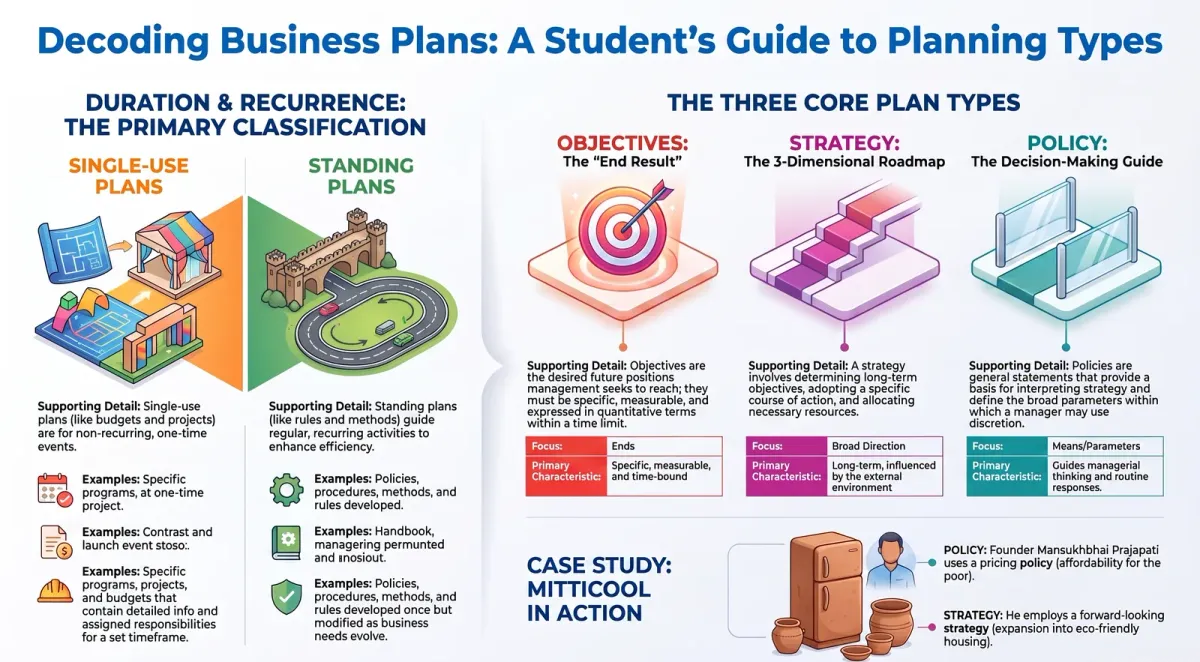
Not all plans in an organisation look the same. Some are drawn up for a one-time project, while others guide routine decisions for years. Chapter 4 of CBSE Class 12 Business Studies classifies plans in two ways — by duration/recurrence (single-use vs standing plans) and by what they seek to achieve (objectives, strategy, policy, procedure, method, rule, programme, budget). This post covers single-use vs standing plans and the first three plan types in detail, using the real-world Mitticool example from the NCERT textbook.
Single-Use Plans vs Standing Plans
Before a business makes any decision related to its operations or undertakes any project, it must prepare a plan. Plans can be classified based on how long they are used and how often they recur.
Single-Use Plans
A single-use plan is developed for a one-time event or project — a course of action that is unlikely to be repeated in the future, i.e., meant for non-recurring situations. Its duration depends on the type of project, ranging from a single day (like organising a seminar) to a week or a month. Single-use plans include budgets, programmes and projects, and they consist of detailed information, including the names of employees responsible for the work.
Standing Plans
A standing plan is used for activities that occur regularly over a period of time. It is designed to ensure that the internal operations of an organisation run smoothly, greatly enhancing efficiency in routine decision-making. Standing plans are usually developed once but modified from time to time as business needs require. They include policies, procedures, methods and rules.
Single-use and standing plans together form part of the operational planning process. However, some plans — like strategy — are not classified under either category, since they belong to strategic planning at the top-management level.
Objectives: The First and Most Basic Type of Plan
Objectives are the desired future position that management would like to reach. They are very basic to the organisation and are defined as the ends which management seeks to achieve through its operations. In simple terms, an objective is what you would like to achieve — the end result of activities.
For example, an organisation may have an objective of increasing sales by 10%, earning a reasonable rate of return on investment, or earning a 20% profit from the business. Objectives represent the end point of planning, and all other managerial activities are directed towards achieving them. They are usually set by top management, focus on broad and general issues, and must be expressed in specific, measurable, quantitative terms within a given time period.
Strategy: The Broad Contours of a Business
A strategy provides the broad contours of an organisation’s business, referring to future decisions that define the organisation’s direction and scope in the long run. A strategy is a comprehensive plan for accomplishing an organisation’s objectives, including three dimensions:
-
Determining long-term objectives
-
Adopting a particular course of action
-
Allocating resources necessary to achieve the objective
Whenever a strategy is formulated, the business environment — economic, political, social, legal and technological — must be taken into consideration, since changes in any of these dimensions will affect the organisation’s strategy. Major strategic decisions include whether the organisation should continue in the same line of business, combine new lines of activity with the existing business, or seek to acquire a dominant market position. A company’s marketing strategy, for instance, must address who the customers are, what the demand for the product is, which distribution channel to use, and what the pricing policy should be.
Policy: Guiding Managerial Decisions
Policies are general statements that guide thinking or channelise energies towards a particular direction. They provide a basis for interpreting strategy, which is usually stated in more general terms, and act as guides to managerial action and decisions in implementing that strategy. A policy is, in essence, the general response to a particular problem or situation.
There are policies at all levels and departments of an organisation, ranging from major company policies (known to customers, clients and competitors) to minor policies (applicable only to insiders). Policies define the broad parameters within which a manager may function, and the manager may use discretion to interpret and apply them. For example, a company’s Purchase Policy would guide decisions on whether to manufacture or buy packaging, how vendors are selected, and how many suppliers to engage.
Real-World Example: Mitticool’s Objective, Strategy and Policy
The NCERT textbook illustrates these three plan types through Mansukhbhai Prajapati’s company, Mitticool. After the 2001 Kutch earthquake, Mansukhbhai innovated a clay-based refrigerator that requires no electricity — the Mitticool fridge, launched in 2005. The company’s policy has been to keep all its products affordably priced for the poor. Its strategy and future objectives include starting a new factory with support from the National Innovation Foundation and building an eco-friendly Mitticool house powered entirely by renewable energy.
Confused Between Objectives, Strategy and Policy?
These terms are easy to mix up in exams. ChampionsPrep’s AI-powered platform gives Class 12 Commerce students unlimited practice MCQs and instant explanations distinguishing every type of plan, for just ₹10 per session. Visit https://app.championsprep.in and turn confusion into confidence.
Test Your Knowledge
Types of Plans Part 1: Objectives, Strategy & Policy (Class 12)
Frequently Asked Questions
What is the difference between single-use plans and standing plans? +
Single-use plans are developed for a one-time, non-recurring event or project (like budgets and programmes), while standing plans guide activities that occur regularly over time (like policies, procedures and rules), and are modified from time to time as needed.
What are objectives in Business Studies? +
Objectives are the desired future position that management would like to reach — the end results of an organisation's activities, usually set by top management and expressed in specific, measurable, quantitative terms.
What are the three dimensions of a strategy? +
Determining long-term objectives, adopting a particular course of action, and allocating the resources necessary to achieve the objective.
How is a policy different from a strategy? +
A strategy provides the broad direction and scope of the business in the long run, while a policy provides the basis for interpreting that strategy — it is the general response to a particular recurring problem or situation, guiding day-to-day managerial decisions.
What does the Mitticool example teach us about types of plans? +
It shows how a single company applies multiple plan types together — a pricing policy of affordability for the poor, and a forward-looking strategy/objective of factory expansion and a renewable-energy-powered eco-house.
AI-powered practice — free to start