
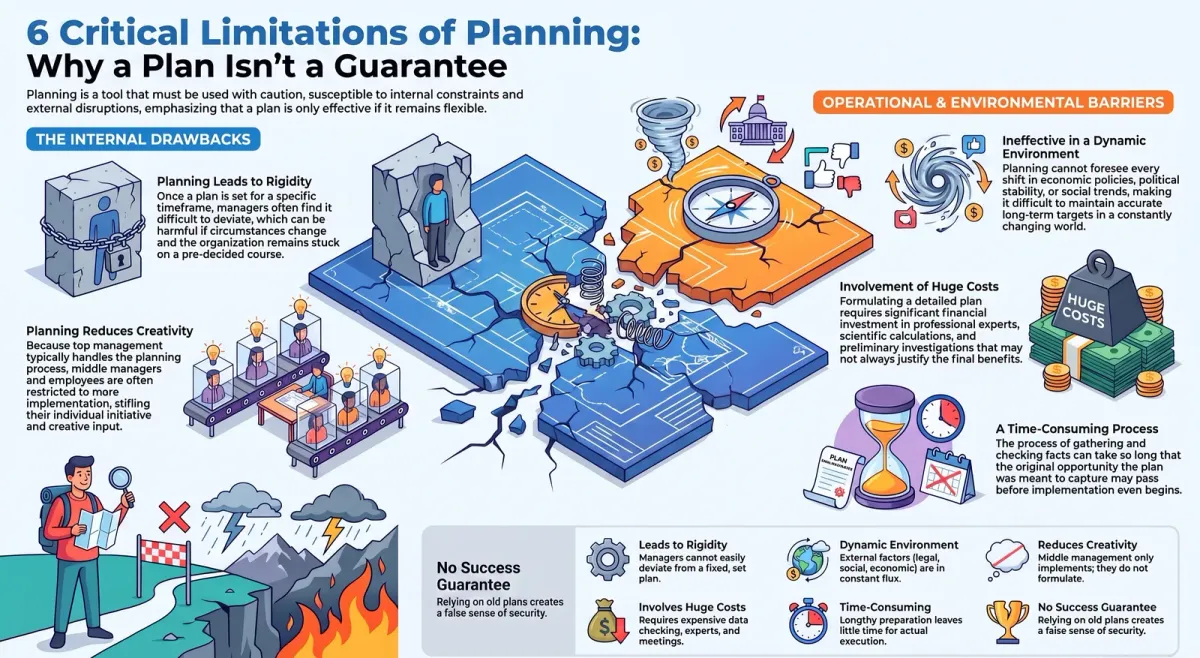
Planning is essential for every business organisation — but it is not perfect. Things do not always go according to plan: unforeseen events, rising costs, government interventions, and legal regulations can all disrupt even the most carefully drawn-up plans. This post covers the 6 limitations of planning from Chapter 4 of CBSE Class 12 Business Studies, a favourite topic for short-answer and critical-comment questions in board exams.
Why Study the Limitations of Planning?
If plans often need to be modified, students sometimes ask: why plan at all? The NCERT textbook addresses this directly — despite its limitations, planning is not a useless exercise. It is a tool to be used with caution, providing a base for analysing future courses of action, even though it is not a solution to every business problem.
6 Limitations of Planning Explained
1. Planning Leads to Rigidity
In an organisation, a well-defined plan is drawn up with specific goals to be achieved within a specific time frame. Once set, these plans decide the future course of action, and managers may not be in a position to change them easily. This rigidity can create difficulty — following a pre-decided plan when circumstances have genuinely changed may not actually serve the organisation’s best interest. Managers therefore need some flexibility to cope with changed conditions.
2. Planning May Not Work in a Dynamic Environment
The business environment is dynamic — nothing about it is constant. It consists of economic, political, physical, legal and social dimensions, and an organisation must constantly adapt to changes in all of them. It becomes difficult to accurately assess future trends if economic policies shift, political conditions become unstable, or a natural calamity occurs. Competition can also upset financial plans, forcing sales targets and cash budgets to be revised. Planning simply cannot foresee everything.
3. Planning Reduces Creativity
Planning is typically carried out by top management, while the rest of the organisation’s members mostly implement these plans. As a consequence, middle management and other decision-makers are often neither allowed to deviate from the plan nor permitted to act on their own initiative. Much of the creativity inherent in employees can get lost or reduced, since most people simply carry out orders rather than attempting to formulate plans of their own.
4. Planning Involves Huge Costs
When plans are drawn up, significant costs are involved in their formulation — in terms of both time and money. Checking the accuracy of facts, for instance, can take considerable time, and detailed plans often require scientific calculations to ascertain facts and figures. There are also incidental costs, such as expenses on boardroom meetings, discussions with professional experts, and preliminary investigations into a plan’s viability. Sometimes these costs may not even justify the benefits eventually derived from the plan.
5. Planning Is a Time-Consuming Process
Sometimes, the process of drawing up plans takes so much time that very little time is left for actually implementing them. In fast-moving business situations, this delay can mean that by the time a plan is ready, the opportunity it was designed to capture has already passed.
6. Planning Does Not Guarantee Success
The success of an enterprise is possible only when plans are properly drawn up and implemented — any plan that is not translated into action becomes meaningless. Managers often tend to rely on previously tried and tested plans, assuming that a plan which worked before will work again. This is not always true, since there are many unknown factors to consider, and this complacency or false sense of security can actually lead to failure instead of success.
Balancing the Limitations with the Importance of Planning
It is important to note that CBSE frequently pairs this topic with the importance of planning in “critically comment” style questions — for example, asking students to discuss both how planning promotes innovative ideas and how planning reduces creativity. A well-rounded answer acknowledges both perspectives rather than presenting planning as either entirely beneficial or entirely flawed.
Quick Recap Table
| Limitation | Key Reason |
|---|---|
| Leads to rigidity | Managers can't easily deviate from a set plan |
| Dynamic environment | Economic, political, legal factors keep changing |
| Reduces creativity | Only top management plans; others just implement |
| Involves huge costs | Time, money, and incidental expenses |
| Time-consuming | Little time left for implementation |
| No guarantee of success | Past success doesn't ensure future results |
Practice “Critically Comment” Questions with ChampionsPrep
Limitation-based case studies are common in board exams, and they require balanced, well-structured answers. ChampionsPrep’s AI-powered platform gives Class 12 Commerce students unlimited MCQs and long-answer practice for Chapter 4, with instant feedback for just ₹10 per session. Visit https://app.championsprep.in and build exam-ready answers today.
Test Your Knowledge

Limitations of Planning: 6 Drawbacks Explained (Class 12 Business Studies)
Frequently Asked Questions
What are the 6 limitations of planning in Class 12 Business Studies? +
Planning leads to rigidity, may not work in a dynamic environment, reduces creativity, involves huge costs, is a time-consuming process, and does not guarantee success.
Does planning guarantee the success of a business? +
No. Success depends on plans being properly implemented, and managers relying too heavily on previously successful plans can create a false sense of security that may actually lead to failure.
Why does planning sometimes lead to rigidity? +
Because a well-defined plan sets a fixed future course of action within a specific time frame, and managers may be unable to change it even when circumstances have genuinely changed, unless they are given some flexibility.
How does planning reduce creativity in an organisation? +
Since planning is typically done by top management, middle management and employees are often only permitted to implement it rather than deviate from it, which can reduce their initiative and creative input.
If planning does not work in a dynamic environment, is it still important? +
Yes. Despite its limitations, planning is not a useless exercise — it provides a base for analysing future courses of action, even though it cannot foresee every possible change and is not a solution to all problems.
AI-powered practice — free to start