
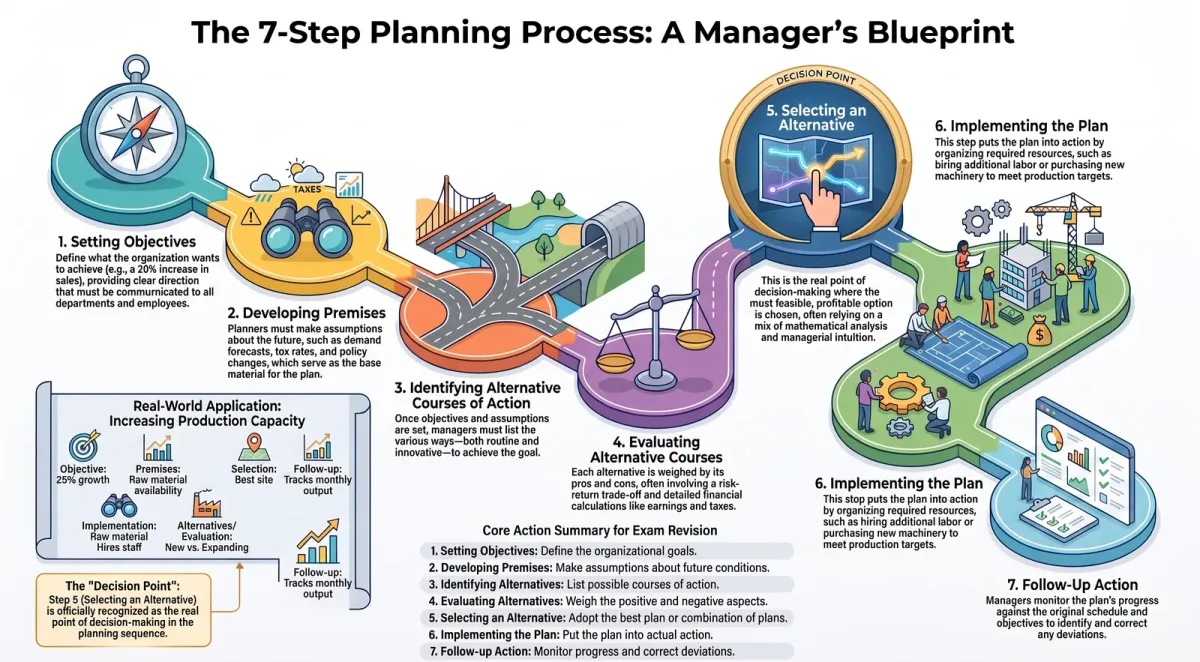
Planning is not a single, instant decision — it is a structured process of decision-making that every manager follows through a series of logical steps. This post walks through all 7 steps of the planning process from Chapter 4 of CBSE Class 12 Business Studies, a high-weightage topic that regularly appears as both a long-answer question and a case-based application question in board exams.
What Is the Planning Process?
Planning, as we already know, is deciding in advance what to do and how to do it — essentially a process of decision-making. Since planning is an activity, there are certain logical steps that every manager follows, moving from a broad objective all the way to a fully implemented and monitored plan.
The 7 Steps of the Planning Process
Step 1: Setting Objectives
The first and foremost step is setting objectives. Every organisation must have objectives, set for the entire organisation as well as for each department or unit within it. Objectives specify what the organisation wants to achieve — for instance, an increase in sales by 20% could be the objective of the entire organisation. They must be stated clearly for all departments and employees, since they give direction and must percolate down to every level.
Step 2: Developing Premises
Planning is concerned with the future, which is inherently uncertain, so every planner must make assumptions about what might happen. These assumptions are called premises — the base material upon which plans are drawn, coming from forecasts, existing plans, or past policy information. All managers involved in planning should use the same premises, gathered through forecasting demand, policy changes, interest rates, and tax rates.
Step 3: Identifying Alternative Courses of Action
Once objectives are set and assumptions made, the next step is to identify the different ways of acting to achieve those objectives. There may be many possible courses of action — some routine, some innovative. If a project is particularly important, more alternatives should be generated and thoroughly discussed among the organisation’s members before moving forward.
Step 4: Evaluating Alternative Courses
The next step is to weigh the pros and cons of each alternative, evaluating the positive and negative aspects of each proposal against the objective to be achieved. In financial plans, the risk-return trade-off is common — the riskier the investment, the higher the potential return — with detailed calculations of earnings, interest and taxes made before a decision is taken.
Step 5: Selecting an Alternative
This is the real point of decision-making in the entire planning process. The best plan must be adopted and implemented — ideally the most feasible and profitable option with the least negative consequences. Since most plans cannot always be subjected to purely mathematical analysis, subjectivity, managerial experience, judgement, and even intuition often play an important role. Sometimes a combination of plans is selected instead of a single best course of action.
Step 6: Implementing the Plan
This is the step where other managerial functions come into play. It is concerned with putting the plan into actual action — doing what is required. For example, if there is a plan to increase production, more labour and machinery will be required, which means this step also involves organising for labour and purchasing machinery.
Step 7: Follow-Up Action
To see whether plans are being implemented and activities are performed according to schedule is also part of the planning process. Monitoring the plan is equally important to ensure that the original objectives are actually achieved — without this final step, deviations from the plan might go unnoticed and uncorrected.
Worked Example: Applying the Planning Process
Imagine a company decides to increase its production capacity. First, it sets a clear objective — say, a 25% increase within one year. It develops premises based on demand forecasts and raw material availability, then identifies alternatives such as expanding the existing factory versus setting up a new unit. It evaluates both, selects the most feasible option, implements it through machinery purchase and hiring, and finally monitors output against the target.
Why This Topic Matters for Board Exams
CBSE frequently presents a business scenario and asks students to identify which specific step of the planning process is being illustrated — for example, a sales manager preparing a report on options like entering new markets or offering discounts is performing the “identifying alternative courses of action” step. Being able to match a scenario to the correct step, with justification, is essential for scoring full marks in case-based questions.
Quick Recap Table
| Step | Core Action |
|---|---|
| 1. Setting objectives | Define what the organisation wants to achieve |
| 2. Developing premises | Make assumptions about the future |
| 3. Identifying alternatives | List possible courses of action |
| 4. Evaluating alternatives | Weigh pros and cons of each |
| 5. Selecting an alternative | Make the final decision |
| 6. Implementing the plan | Put the plan into action |
| 7. Follow-up action | Monitor progress against objectives |
Master Case-Based Planning Process Questions
Identifying the correct step in a business scenario takes practice, not just memorisation. ChampionsPrep’s AI-powered platform offers unlimited chapter-wise MCQs and case-study practice for Chapter 4, with instant explanations for just ₹10 per session. Visit https://app.championsprep.in to sharpen your application skills before your boards.
Test Your Knowledge

The Planning Process: 7 Steps Explained with Examples (Class 12)
Frequently Asked Questions
What are the 7 steps of the planning process in Class 12 Business Studies? +
Setting objectives, developing premises, identifying alternative courses of action, evaluating alternative courses, selecting an alternative, implementing the plan, and follow-up action.
What is the difference between "developing premises" and "identifying alternative courses of action"? +
Developing premises involves making assumptions about future conditions like demand, prices and policy changes, while identifying alternatives involves listing the different possible courses of action to achieve the objectives, once those assumptions are set.
Which step of the planning process is considered the "real point of decision making"? +
Selecting an alternative — this is where the manager adopts the single best (or a combination of) plan(s) after evaluating all alternatives.
Why is follow-up action necessary if a plan has already been implemented? +
Because monitoring whether activities are being performed according to schedule ensures that any deviations from the plan can be identified and corrected, so that the original objectives are actually achieved.
Can the planning process skip developing premises and go straight to selecting an alternative? +
No. Premises form the base material — forecasts and assumptions about the future — on which every alternative is built and evaluated; skipping this step would make the evaluation of alternatives unreliable.
AI-powered practice — free to start