
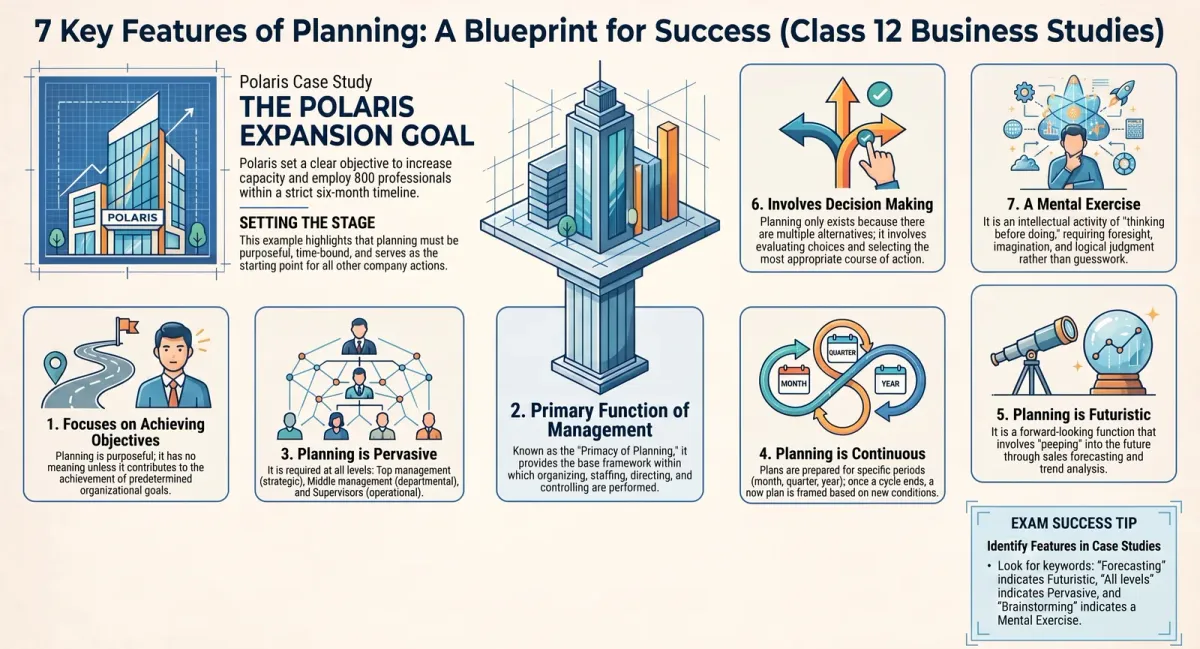
Once you understand what planning means, the next logical step in Chapter 4 of CBSE Class 12 Business Studies is understanding its features — the special characteristics that define its nature and scope. The NCERT textbook illustrates these features using the example of Polaris, a company planning to expand its capacity and employ 800 more professionals within six months. This post covers all 7 features of planning in detail, exactly as expected in your board exam answers.
The Polaris Example: Setting the Stage
In the chapter’s example, Polaris has clear plans of expansion. Its objective is to increase capacity so it can employ 800 more professionals, with a target time of six months. The current year’s objective has also been clearly stated: increasing capacity by 1500–2000 more professionals. Since planning is the primary function of management, Polaris set its objectives first — and this simple example reflects several of the features discussed below.
7 Features of Planning Explained
1. Planning Focuses on Achieving Objectives
Organisations are set up with a general purpose in view, and specific goals are set out in plans along with the activities needed to achieve them. Planning is therefore purposeful — it has no meaning unless it contributes to the achievement of predetermined organisational goals.
2. Planning Is a Primary Function of Management
Planning lays down the base for every other function of management. All other managerial functions — organising, staffing, directing and controlling — are performed within the framework of the plans already drawn up. This is referred to as the primacy of planning. While all functions of management are interrelated and equally important, planning provides the basis for all of them.
3. Planning Is Pervasive
Planning is required at all levels of management and in all departments of an organisation. It is not the exclusive function of top management or of any single department. However, the scope of planning differs across levels: top management undertakes planning for the organisation as a whole, middle management handles departmental planning, and supervisors at the lowest level manage day-to-day operational planning.
4. Planning Is Continuous
Plans are prepared for a specific period — a month, a quarter, or a year. At the end of that period, a new plan must be drawn up based on new requirements and future conditions. This continuous cycle is known as the planning cycle: a plan is framed, implemented, and then followed by another plan, and so on.
5. Planning Is Futuristic
Planning essentially involves looking ahead and preparing for the future. It implies peeping into the future, analysing it, and predicting it — which is why planning is regarded as a forward-looking function based on forecasting. For example, sales forecasting forms the basis on which a firm prepares its annual production and sales plan.
6. Planning Involves Decision Making
Planning essentially involves a choice from among various alternatives and activities. If there is only one possible goal or course of action, there is no need for planning, because there is no choice to make. The need for planning arises only when alternatives exist — planning therefore involves thoroughly examining and evaluating each alternative before choosing the most appropriate one.
7. Planning Is a Mental Exercise
Planning requires application of the mind — involving foresight, intelligent imagination, and sound judgement. It is basically an intellectual activity of thinking rather than doing, because planning determines the action to be taken. However, planning requires logical and systematic thinking based on facts and forecasts, rather than guesswork or wishful thinking.
Why These Features Matter for Your Board Exam
CBSE frequently asks case-based questions where you must identify which feature of planning is being illustrated — such as a company forming a cross-level team to brainstorm strategy (illustrating that planning is pervasive and a mental exercise), or a firm preparing next year’s sales plan based on this year’s forecast (illustrating that planning is futuristic). Memorising the feature names alone is not enough — you must be able to match real-world scenarios to the correct feature, along with a one-line justification from the textbook definition.
Quick Recap Table
| Feature | Core Idea |
|---|---|
| Focuses on objectives | Purposeful; no meaning without goals |
| Primary function | Base for all other managerial functions |
| Pervasive | Required at all levels and departments |
| Continuous | Followed by a new plan after each cycle |
| Futuristic | Forward-looking, based on forecasting |
| Involves decision making | Choice among alternatives |
| Mental exercise | Intellectual activity of thinking |
Practise Every Feature with Instant Feedback
Reading the features is one thing — applying them to case-based questions under exam pressure is another. ChampionsPrep’s AI-powered platform gives you unlimited chapter-wise MCQs and case-study practice for Chapter 4, with instant explanations for just ₹10 per session. Visit https://app.championsprep.in to strengthen your Business Studies score today.
Test Your Knowledge

Features of Planning: 7 Key Characteristics (Class 12 Business Studies)
Frequently Asked Questions
What are the 7 features of planning in Class 12 Business Studies? +
Planning focuses on achieving objectives, is a primary function of management, is pervasive, is continuous, is futuristic, involves decision making, and is a mental exercise.
What does "primacy of planning" mean? +
It means planning lays the base for all other managerial functions, since organising, staffing, directing and controlling are all performed within the framework of the plans already drawn up.
Why is planning called pervasive? +
Because it is required at all levels of management and in every department, though the scope of planning differs — top management plans for the whole organisation, middle management plans departmentally, and supervisors handle daily operational planning.
How is planning both futuristic and a mental exercise at the same time? +
Planning is futuristic because it involves forecasting and preparing for the future, and it is a mental exercise because this forecasting requires foresight, imagination and sound judgement — an intellectual activity rather than physical action.
What does the Polaris example illustrate about the features of planning? +
It illustrates that planning focuses on achieving objectives (increasing capacity), is futuristic (six-month target), and reflects the primacy of planning, since Polaris set its objectives before undertaking any other managerial action.
AI-powered practice — free to start