
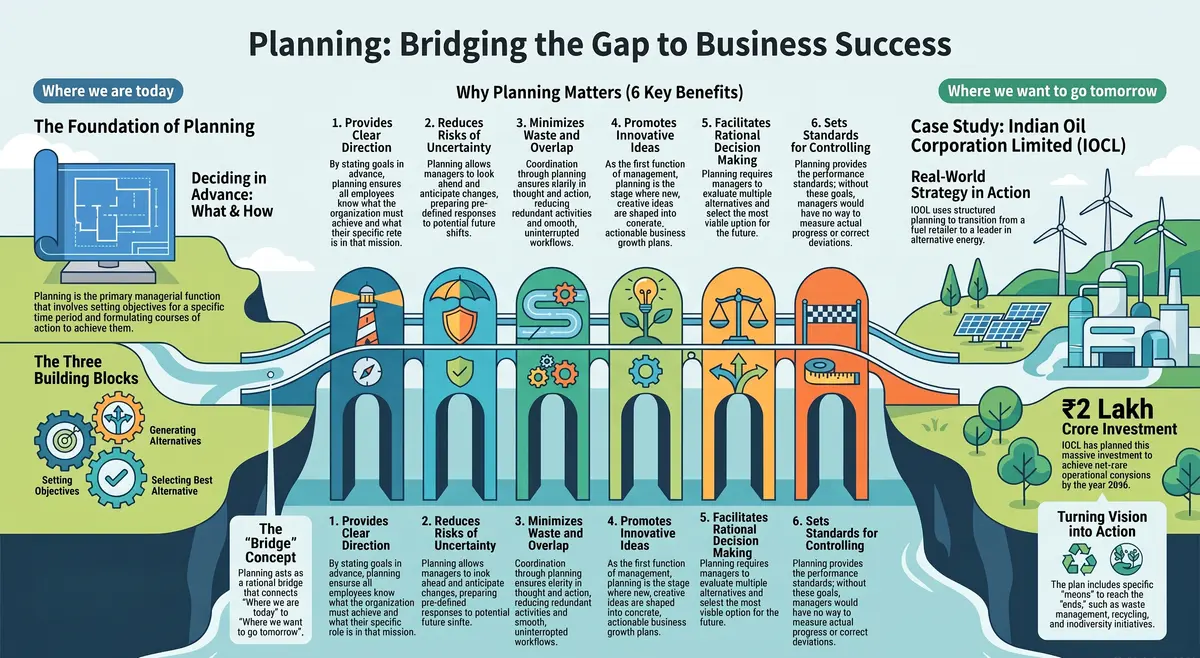
Of all the functions of management — organizing, staffing, directing, controlling — one always comes first. Planning is the foundation upon which every other management activity is built. Without it, an organization is, as the saying goes, a ship without a compass: moving, but directionless.
For CBSE Class 12 students, planning carries 14 marks and is one of the most conceptually rich chapters in the Business Studies syllabus. For anyone interested in management, it’s the starting point for understanding how organizations achieve their goals.
What Is Planning? (Definition)
Planning is the process of setting objectives and developing strategies to achieve them. It involves deciding in advance:
-
What to do
-
How to do it
-
When to do it
-
Who will do it
Planning bridges the gap between where an organization currently is and where it wants to be.
Simple Analogy: Think of planning as creating a roadmap for a journey. Before you start, you decide your destination (objectives), choose your route (strategy), prepare for possible obstacles (contingencies), and allocate your resources (budget, time). Skip the map, and you’re guessing your way through.
8 Key Features of Planning
1. Primary Function of Management
Planning is the first function of management. All other functions — organizing, staffing, directing, and controlling — depend on it. You cannot organize resources until you know what plan they need to serve.
2. Focuses on Objectives
Planning always begins with setting objectives. Without clear goals, planning is purposeless. Objectives give direction and meaning to all organizational activity.
3. Pervasive Function
Planning happens at every level of management — not just at the top:
-
Top Management → Strategic planning (long-term, overall direction)
-
Middle Management → Tactical planning (medium-term, departmental)
-
Lower Management → Operational planning (short-term, day-to-day)
4. Continuous Process
Planning never truly ends. Once one plan is implemented, the next is already being developed. Because the business environment is constantly shifting, planning must be ongoing.
5. Futuristic in Nature
Planning is inherently forward-looking. It requires forecasting future conditions, anticipating potential problems, and preparing for emerging opportunities — essentially, peering into the future and getting ready for it.
6. Involves Decision Making
Every plan involves choosing between alternatives. Planning requires deciding what to do and what not to do, which path to pursue and which to reject.
7. Mental Exercise
Planning is an intellectual process. It demands careful thinking, rigorous analysis, and creative problem-solving — not just paperwork and routine.
8. Flexibility
Plans must be stable enough to provide direction, but flexible enough to accommodate environmental changes. Rigid plans become obsolete quickly in dynamic markets.
Why Is Planning Called the “Primary” Function?
Planning earns its title as the primary function because every other management function depends on it:
| Management Function | How It Depends on Planning |
|---|---|
| Organizing | You can't allocate resources until plans exist |
| Staffing | Workforce needs are determined by plans |
| Directing | Employees need planned targets to work toward |
| Controlling | Performance is measured against planned standards |
Remove planning, and the entire management structure loses its foundation.
Planning in Real Life
Planning isn’t abstract — it shows up everywhere:
-
Career planning: Deciding which courses to take, which skills to build, which jobs to target
-
Business launches: Mapping out product development, marketing, and distribution before launch day
-
Event management: Organizing conferences, festivals, or sports events requires detailed advance planning
-
Project management: Construction, software development, and research all rely on systematic plans
Key Takeaway
Planning is not just about making plans — it’s about creating the conditions for success before action begins. It transforms vague ambitions into achievable objectives and turns good intentions into coordinated effort.
In the next post, we’ll walk through the 7-step planning process that managers use to build effective plans from scratch.
Related Posts:
-
The 7-Step Planning Process in Management: A Complete Guide
-
Types of Plans in Management: Single-Use vs Standing Plans Explained
-
Importance and Limitations of Planning in Management
AI-powered practice — free to start