

If you want to improve your score quickly in Class 12 Accountancy, the 6-mark questions in the official CBSE 2026-27 Sample Question Paper deserve special attention.
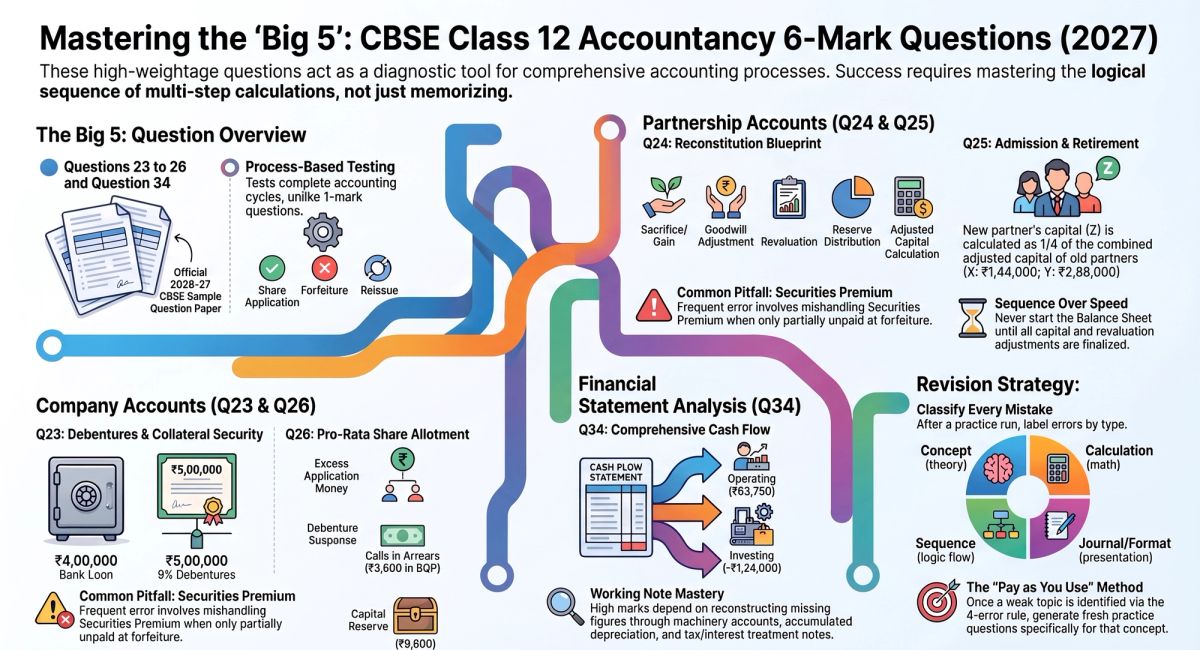
The official paper places 6-mark questions in Questions 23 to 26 and Question 34. These questions test complete accounting processes rather than isolated facts, so they are ideal for finding weak areas before the 2027 Boards. This article gives you the marking-scheme highlights for all five; where a question deserves a full worked walkthrough, it links to a dedicated post below.
Quick Reference: What Each Question Tests
Q23 tests Debenture issue, redemption and collateral security. Q24 tests reconstitution through a change in profit-sharing ratio. Q25 tests admission or retirement of a partner. Q26 tests pro-rata allotment, forfeiture and reissue of shares. Q34 tests the Cash Flow Statement. Together, these five questions cover almost the entire Company Accounts and Partnership syllabus at long-answer level.
Question 23: Issue of Debentures and Collateral Security
The question combines multiple debenture treatments: issue at discount; redemption at premium; issue at premium; loss on issue; collateral security; Balance Sheet presentation.
For the collateral-security part, the company raises a bank loan of ₹4,00,000 and issues ₹5,00,000 of 9% debentures as collateral.
The marking scheme records:
Bank A/c Dr. ₹4,00,000To Bank Loan A/c ₹4,00,000Debenture Suspense A/c Dr. ₹5,00,000To 9% Debentures A/c ₹5,00,000The Balance Sheet shows the bank loan under long-term borrowings, while the debentures are offset by Debenture Suspense.
What to Revise Before Attempting This
issue price vs face value; premium on redemption; loss on issue; collateral security methods; Balance Sheet disclosure.
Common mistake: treating the collateral debentures as an additional borrowing instead of security for the loan.
Question 24: Change in Profit-Sharing Ratio
This 6-mark question is a compact test of reconstitution.
The old ratio is 4:3:3 and the new ratio is 3:2:5.
The marking scheme gives: A sacrifices 1/10; B sacrifices 1/10; C gains 1/5; goodwill compensation = ₹30,000; net revaluation gain = ₹25,000; General Reserve and Profit & Loss balance are distributed in the old ratio; C’s adjusted capital = ₹2,22,500.
Why this question matters:
Students often revise goodwill, reserves and revaluation separately. CBSE combines them into one situation, so a strong answer needs the full sequence, not just one isolated skill.
Best approach:
- Step 1 — calculate sacrifice/gain.
- Step 2 — adjust goodwill.
- Step 3 — record revaluation.
- Step 4 — distribute reserves and accumulated balances.
- Step 5 — arrive at adjusted capital.
For the complete worked solution, including two extra practice questions on sacrificing ratios and goodwill compensation, see the dedicated Partnership Accounts 6-mark article.
Question 25: Admission or Retirement
The admission option requires full journal entries and a Balance Sheet after Z is admitted.
Adjustments include: goodwill brought partly through machinery and furniture; bad debts due to insolvency; increase in provision for doubtful debts; patents written off; stock overvaluation; unforeseen liability; new partner’s capital based on adjusted capitals.
The marking scheme calculates:
Adjusted capital of X = ₹1,44,000
Adjusted capital of Y = ₹2,88,000
Z’s capital = 1/4 of combined adjusted capital = ₹1,08,000
The alternative asks students to reconstruct Revaluation Account and Partners' Capital Accounts after retirement.
Exam lesson: retirement and admission questions reward disciplined sequencing. Do not start the Balance Sheet until all capital and revaluation adjustments are complete.
Question 26: Pro-Rata Allotment, Forfeiture and Reissue
This is one of the most important Company Accounts questions in the SQP.
The first option covers: applications for more shares than issued; rejection of some applications; pro-rata allotment; adjustment of excess application money; allotment; call; calls in arrears; forfeiture; reissue; Capital Reserve.
The marking scheme records calls in arrears of ₹3,600 and a transfer of ₹9,600 to Capital Reserve after reissue.
A clean solving sequence is: determine allotment ratio; calculate excess application money; adjust against allotment; calculate call money; identify unpaid amount; record forfeiture; record reissue; calculate Capital Reserve.
Common mistake: mishandling Securities Premium when the premium is partly unpaid at the time of forfeiture.
The dedicated Share Forfeiture article below walks through this exact question step by step, with the full sequence and two additional practice questions.
Question 34: Cash Flow Statement
For students choosing Analysis of Financial Statements, Q34 is a full 6-mark Cash Flow question.
The marking scheme calculates:
Net Cash Flow from Operating Activities = ₹63,750
Net Cash used in Investing Activities = ₹1,24,000
The working notes require: profit before tax; depreciation; goodwill amortisation; loss on sale of machinery; interest on debentures; gain on sale of land; changes in trade receivables and trade payables; tax paid; machinery account; accumulated depreciation.
This question is a reminder that Cash Flow cannot be mastered by memorising the three activity headings. You must be able to reconstruct missing figures, which is exactly what the dedicated Cash Flow deep-dive article walks through with a full working-note breakdown.
How to use these questions for revision
Attempt each 6-mark question without looking at the marking scheme. Then classify every error under one of four headings: Concept; Calculation; Journal/format; Sequence.
If your answer is wrong because of sequence, practise the same chapter with a fresh full-length question. If it is wrong because of one concept, revise only that concept and retry.
Quick Revision Checklist
Partnership
sacrificing/gaining ratio; goodwill; revaluation; reserves; capital adjustment; admission and retirement.
Company Accounts
debenture issue and redemption terms; collateral security; pro-rata allotment; forfeiture; reissue; Capital Reserve.
Financial Statement Analysis
operating vs investing classification; non-cash items; sale/purchase of fixed assets; tax and interest treatment.
ChampionsPrep Next Step
Solve each official 6-mark question once. Then practise two fresh questions from the same concept without referring back to the model answer. Registration on ChampionsPrep is free and you only pay as you use it, so once you know which of these five topics is your weakest, you can keep generating fresh practice on exactly that topic at no upfront cost.
Frequently Asked Questions
How many 6-mark questions are in the official Accountancy SQP? +
Questions 23 to 26 and Question 34 carry 6 marks in the official 2026-27 sample paper.
Which 6-mark topic is most calculation-heavy? +
Share Capital and Cash Flow both require careful multi-step calculations. Partnership questions can be equally demanding because multiple adjustments interact.
Should I memorise journal entries for these questions? +
Understand the logic and sequence rather than memorising exact entries, because the numbers and specific facts will change on the actual paper.
Where can I find a full worked solution for each of these 6-mark questions? +
Cash Flow (Q34), Share Forfeiture and Pro-Rata Allotment (Q26), and the Partnership questions (Q24, Q25) each have a dedicated, fully solved deep-dive article, linked in this post.
Which chapters carry compulsory 6-mark questions in Accountancy? +
The 6-mark questions consistently come from Issue of Debentures, Admission/Retirement of a Partner, Reconstitution/Change in PSR, and Cash Flow Statement.
Keep practising Accountancy
AI-powered feedback and structured revision for Accountancy — free to start, at your own pace.
AI-powered practice — free to start