

The official CBSE Class 12 Accountancy Sample Paper 2026-27 combines several Share Capital concepts into one sequence: oversubscription, pro-rata allotment, adjustment of excess application money, calls in arrears, forfeiture and reissue.
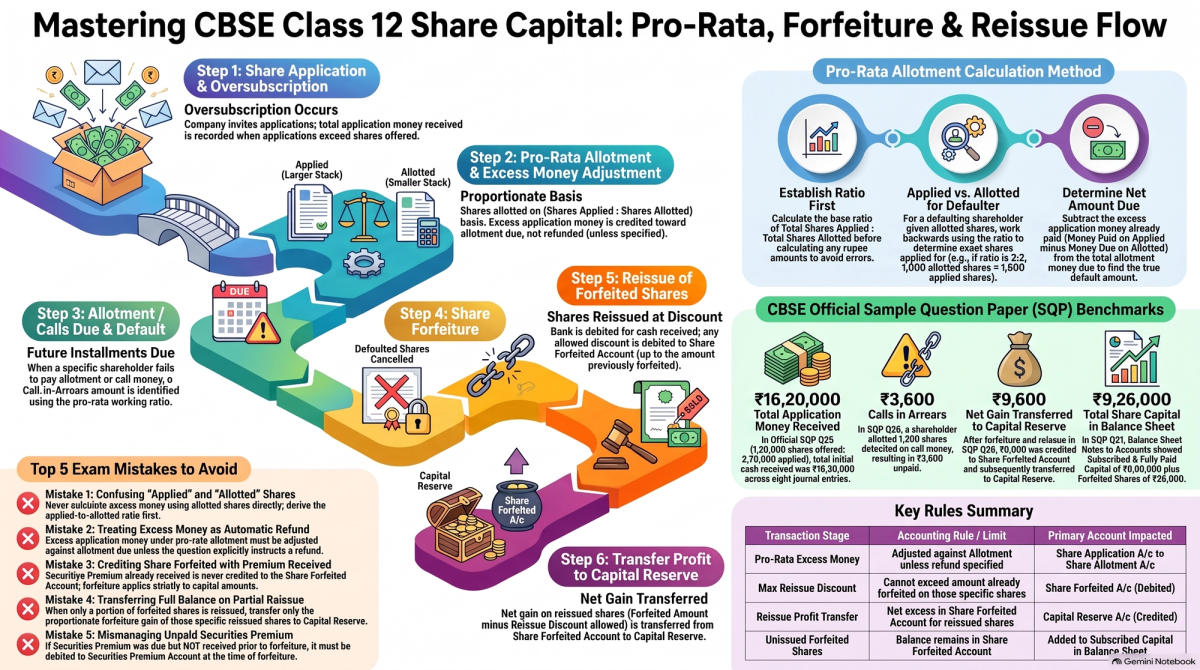
That is exactly how students should prepare for the 2027 Boards. These topics should not be revised as separate journal entries taught in isolation — CBSE consistently tests them as one connected story, and the marks are lost wherever the chain breaks.
The Complete Flow
Pro-Rata Allotment & Share Forfeiture Simulator
Model pro-rata ratio, excess application adjustment, calls-in-arrears, forfeiture, and transfer to Capital Reserve upon reissue.
Simplified illustration: application and allotment amounts are treated as share capital; securities premium is handled separately in the full journal-entry solution.
1. Pro-rata allotment
2. Adjustment and calls in arrears
3. Forfeiture and reissue
A typical integrated question can follow this order: the company invites applications; applications exceed shares offered; some applications may be rejected; remaining applicants receive shares on a pro-rata basis; excess application money is adjusted against allotment; allotment and call become due; a shareholder fails to pay; shares are forfeited; some or all forfeited shares are reissued; and profit on reissue is transferred to Capital Reserve.
Once you can name every stage in this order from memory, the actual numbers in any Board question become far less intimidating.
Q26: Share Issue, Pro-Rata Allotment and Forfeiture
In the first option, the company invites applications for 1,20,000 equity shares and receives applications for 2,70,000 shares. Some applications are rejected and the remaining shares are allotted proportionately.
A shareholder allotted 1,200 shares fails to pay call money. The shares are later forfeited and reissued.
The marking scheme records the sequence through eight journal entries.
Important figures from the marking scheme: Application money received = ₹16,20,000; Call in arrears = ₹3,600; Share Forfeited amount credited on forfeiture = ₹9,600; Transfer to Capital Reserve after reissue = ₹9,600.
How to Handle Pro-rata Allotment
The safest method is to create a ratio: Shares applied : Shares allotted.
Then, for the defaulting shareholder: identify shares allotted; work backwards to applications represented by those shares; calculate application money received; calculate excess application money; adjust it against allotment.
Do not jump directly to the unpaid amount. Students who skip the ratio step almost always get the excess-money adjustment wrong, even when every other part of their working is correct.
Forfeiture Treatment
At forfeiture, debit Share Capital with the amount called up on the forfeited shares.
Credit: unpaid call/allotment accounts for amounts due; Share Forfeited Account for the capital amount already received.
If Securities Premium was due but not received, its treatment must be handled separately. This is a common source of mistakes, because premium unpaid at the time of forfeiture is debited to Securities Premium Account rather than credited anywhere.
Reissue Treatment
When forfeited shares are reissued: Bank A/c is debited with cash received.
Share Capital is credited with the nominal amount treated as paid-up.If reissued at a discount, the discount is debited to Share Forfeited Account, subject to the limit of forfeiture available on those shares.
Profit attributable to the reissued shares is transferred from Share Forfeited Account to Capital Reserve.
Q21: Balance Sheet Presentation After Forfeiture
The sample paper also asks for Share Capital presentation after pro-rata allotment and forfeiture.
The marking scheme shows: Subscribed and fully paid-up capital = ₹9,00,000; Add: forfeited shares = ₹26,000; Share Capital shown = ₹9,26,000.
This reminds students that Share Capital questions may test presentation as well as journal entries — a Notes to Accounts disclosure question can appear even when no forfeiture entry is asked for directly.
Common Mistakes
Mistake 1
Confusing "applied" and "allotted" shares.
Always derive the pro-rata ratio first, before touching any rupee figure.
Mistake 2
Treating all application excess as refundable.
In pro-rata allotment, excess is usually adjusted against allotment unless the question explicitly states otherwise.
Mistake 3
Crediting Share Forfeited with premium received.
Share Forfeited relates to share capital actually received, not securities premium — premium already received is not forfeited even when the shares are.Mistake 4
Transferring the entire forfeiture balance to Capital Reserve when only some shares are reissued.
Transfer only the proportion of Share Forfeited Account relating to the shares actually reissued; the balance for shares still unissued stays in Share Forfeited Account.
Mistake 5
Ignoring premium not received at forfeiture.
Check exactly when premium became due and whether it was actually received before deciding how to treat it at forfeiture.
Practice It Yourself
Practice Question 1
A company invites applications for 50,000 shares of ₹10 each. Applications are received for 75,000 shares, and shares are allotted on a pro-rata basis to all applicants. A shareholder who applied for 1,500 shares was allotted 1,000 shares and failed to pay the allotment money of ₹3 per share. Calculate the excess application money to be adjusted against this shareholder’s allotment, assuming application money was ₹2 per share.
Approach & Solution: Find the pro-rata ratio (50,000:75,000, or 2:3). Application money paid by this shareholder = 1,500 × ₹2 = ₹3,000. Application money required on shares actually allotted = 1,000 × ₹2 = ₹2,000. Excess to adjust against allotment = ₹1,000.
Practice Question 2
800 shares of ₹10 each, originally issued at a premium of ₹2 per share, are forfeited for non-payment of the final call of ₹3 per share (premium already received in full). These shares are later reissued at ₹9 per share as fully paid. Calculate the amount transferred to Capital Reserve.
Approach & Solution: Amount already received and forfeited = ₹7 per share (application + allotment, excluding the unpaid final call) × 800 = ₹5,600. Loss on reissue = (₹10 − ₹9) × 800 = ₹800. Capital Reserve = Share Forfeited Account balance minus loss on reissue = ₹5,600 − ₹800 = ₹4,800.
Board Revision Checklist
Before the exam, practise: simple oversubscription; pro-rata allotment with excess adjustment; forfeiture after allotment; forfeiture after call; reissue at par; reissue at discount; reissue at premium; partial reissue; Capital Reserve calculation; and Balance Sheet presentation.
ChampionsPrep Next Step
Practise the full sequence as one problem, then attempt the two practice questions above without looking back at the working. Registration on ChampionsPrep is free and you only pay as you use it, so once you can move from application to Capital Reserve without breaking the chain, you can keep testing that skill on fresh numbers at no upfront cost.
Frequently Asked Questions
What is pro-rata allotment? +
Pro-rata allotment is proportionate allotment of shares when eligible applications exceed the number of shares actually available for issue.
Can forfeited shares be reissued at a discount? +
Yes, subject to the amount available in the Share Forfeited Account for those specific shares. The discount on reissue cannot exceed the amount already forfeited on them.
Where does the profit on reissue of forfeited shares go? +
The profit on reissue, after adjusting any discount allowed, is transferred from the Share Forfeited Account to Capital Reserve.
How is excess application money treated under pro-rata allotment? +
Unless the question states it is refunded, excess application money received from successful applicants under pro-rata allotment is adjusted against the amount due on allotment.
What is the maximum discount permitted on reissue of forfeited shares? +
The discount on reissue cannot exceed the amount already forfeited on those specific reissued shares, ensuring the company receives at least nominal face value.
Keep practising Accountancy
AI-powered feedback and structured revision for Accountancy — free to start, at your own pace.
AI-powered practice — free to start