
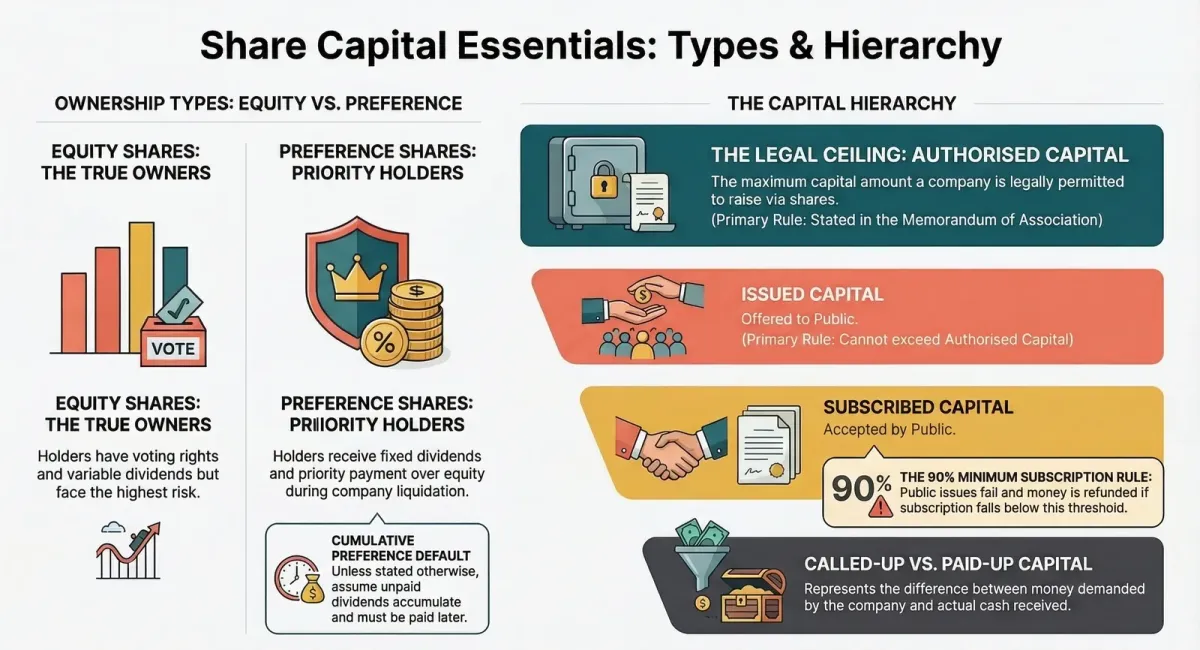
Share capital is the backbone of company accounts — and one of the highest-scoring topics in CBSE Class 12 Accountancy. Before you can tackle issue, forfeiture, or reissue problems, you need a solid grip on what share capital actually is and how its layers connect.
What Is Share Capital?
Share capital is the money raised by a company by issuing shares to the public. It is the primary source of long-term finance for companies and represents ownership stakes held by shareholders.
Every shareholder owns a piece of the company — and their rights, risks, and returns depend entirely on which type of share they hold.
Types of Shares
1. Equity Shares (Ordinary / Common Shares)
| Feature | Detail |
|---|---|
| Dividend | Variable — depends on profits after preference dividend |
| Voting rights | Yes — shareholders vote on company decisions |
| Claim on assets | Residual — paid last during liquidation |
| Risk profile | Higher risk, higher potential return |
Equity shareholders are the true owners of the company. In good years they benefit most; in bad years, they are last to be compensated.
2. Preference Shares
| Feature | Detail |
|---|---|
| Dividend | Fixed rate — paid before equity dividends |
| Voting rights | Usually none (except on matters affecting their rights) |
| Claim on assets | Priority over equity in liquidation |
| Risk profile | Lower risk, predictable return |
Types of Preference Shares to Know:
-
Cumulative: Unpaid dividends accumulate and must be paid in future years before any equity dividend is declared
-
Non-cumulative: Unpaid dividends lapse — they do not carry forward
-
Participating: Entitled to share in surplus profits after equity dividend is paid
-
Non-participating: Entitled to fixed dividend only — no share in surplus
Exam tip: “Cumulative” is the default assumption unless stated otherwise. If a question is silent on the type, treat preference shares as cumulative.
The Capital Hierarchy
This is one of the most commonly tested concepts in both board exams and CA Foundation MCQs. Know each level and how they relate.
1. Authorised Capital (also: Registered or Nominal Capital)
-
The maximum amount of share capital a company is legally permitted to raise
-
Stated in the Memorandum of Association
-
Sets the ceiling — the company cannot issue shares beyond this limit without legal amendment
2. Issued Capital
-
The portion of authorised capital that the company has actually offered to the public
-
Cannot exceed authorised capital
-
The company may choose not to issue all of its authorised capital at once
3. Subscribed Capital
-
The portion of issued capital that members of the public have actually agreed to take
-
For a public issue to succeed: minimum 90% subscription is required
-
If applications received are less than 90% of the issue, the entire issue fails and all application money must be refunded
4. Called-up Capital
-
The portion of subscribed capital that the company has actually demanded payment on
-
Companies rarely call the full amount at once — they collect it in instalments:
-
On application
-
On allotment
-
On first call, second call, etc.
5. Paid-up Capital
-
The amount actually received from shareholders
-
May be less than called-up capital if some shareholders have defaulted on payment
-
Represents the real cash the company has received
The Relationship at a Glance
Each level is a subset of the one above it. No level can ever exceed the one above.
The 90% Minimum Subscription Rule
This is a critical rule for public issues:
-
If the company receives applications for less than 90% of the shares offered, the issue is considered to have failed
-
All application money must be refunded in full within a stipulated time
-
The company cannot proceed with allotment on a failed issue
Why it matters in exams: Questions sometimes describe a scenario where subscription falls short of 90%. The correct treatment is full refund — not pro-rata allotment.
Quick Recall Table
| Level | Meaning | Key Rule |
|---|---|---|
| Authorised | Maximum permissible | Fixed in MoA; needs legal change to increase |
| Issued | Offered to public | Cannot exceed authorised |
| Subscribed | Accepted by public | Must be ≥ 90% of issued for issue to succeed |
| Called-up | Amount demanded | Collected in instalments |
| Paid-up | Amount received | May be less than called-up due to defaults |
What’s Next?
In Part 2 , we cover the issue of shares — at par, at premium, and at discount — including the securities premium account rules that are a favourite in CA Foundation MCQs, and how pro-rata allotment works when a share issue is oversubscribed.
AI-powered practice — free to start