
The official CBSE Class 12 Accountancy Sample Paper 2026-27 includes a full 6-mark Cash Flow Statement question under the Analysis of Financial Statements option. It is an excellent Board-preparation question because the cash flows cannot be calculated by reading the Balance Sheet mechanically. You have to reconstruct several missing figures using working notes, which is exactly the skill CBSE is testing across the paper.
If Cash Flow feels unpredictable, it is usually because the method has not been drilled into a fixed sequence. This guide walks through the official Q34 step by step, then gives you two additional practice questions to test whether you actually understand the logic.
Q34: Cash Flow Statement (Operating & Investing)
Students are given comparative Balance Sheet information and additional details relating to machinery, accumulated depreciation, debentures, provision for tax, goodwill, and the purchase and sale of land during the year.
The question asks for Cash Flow from Operating Activities and Investing Activities.
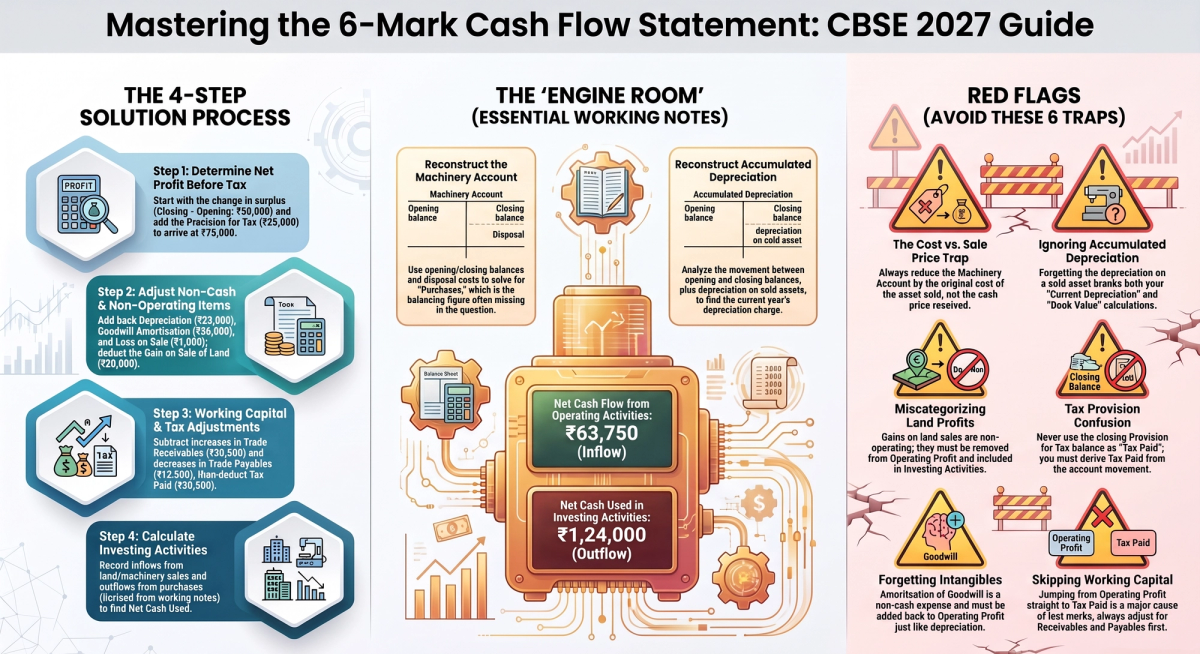
Step 1: Find Net Profit before Tax
The marking scheme starts with the change in surplus: closing surplus minus opening surplus = ₹50,000.
Add Provision for Tax = ₹25,000.
Net Profit before Tax and extraordinary items = ₹75,000.
Why this matters: Students often begin with the closing surplus itself. The correct starting point is the change in surplus, adjusted for the tax provision for the year.
Step 2: Add non-cash and non-operating items
The marking scheme adjusts for: Depreciation = ₹33,000; Amortisation of goodwill = ₹36,000; Loss on sale of machinery = ₹1,000; Interest on debentures = ₹10,250; Less: gain on sale of land = ₹20,000.
Operating Profit before Working Capital Changes = ₹1,35,250.
Step 3: Adjust working capital
The marking scheme shows: Increase in Trade Receivables = ₹20,500 outflow; Decrease in Trade Payables = ₹12,500 outflow.
Total working-capital adjustment = ₹33,000 outflow.
Cash generated from operations = ₹1,02,250.
Less: tax paid = ₹38,500.
Net Cash Flow from Operating Activities = ₹63,750.
Step 4: Calculate Investing Activities
The marking scheme records: Sale of Machinery = ₹3,000 inflow; Purchase of Machinery = ₹1,47,000 outflow; Purchase of Land = ₹2,00,000 outflow; Sale of Land = ₹2,20,000 inflow.
Net Cash used in Investing Activities = ₹1,24,000.
The Important Working Note: Machinery Account
Opening machinery = ₹5,00,000. Add purchases = ₹1,47,000. Less machinery disposed at cost = ₹12,000. Closing machinery = ₹6,35,000.
This reconstruction gives the purchase figure, which is never stated directly in the question.
Accumulated Depreciation Account
Opening accumulated depreciation = ₹75,000. Depreciation on machinery sold = ₹8,000. Closing accumulated depreciation = ₹1,00,000.
Therefore current-year depreciation charged to the Statement of Profit and Loss = ₹33,000.
Quick Formula Reference
Cash Flow from Operating Activities (indirect method) = Net Profit before Tax → add back non-cash and non-operating expenses (depreciation, amortisation, loss on sale of assets, interest on borrowings) → deduct non-operating incomes (profit/gain on sale of assets, interest or dividend received) → adjust for changes in current assets and current liabilities → deduct tax paid.
Keep this sequence in the same order every time you attempt a Cash Flow question — it prevents you from forgetting a step under exam pressure.
How to Recognise the Common Traps
Trap 1: Using the sale price to reduce the Machinery Account.
The asset account works at cost. The machinery sold must be removed at its original cost, not at the cash proceeds received on sale — mixing the two understates the purchase figure.
Trap 2: Ignoring accumulated depreciation on the asset sold.
You need it to calculate both the current year’s depreciation charge and the book value of the asset disposed of, so skipping this step breaks two calculations at once.
Trap 3: Treating land profit as operating cash.
The gain is removed from operating profit because the actual sale proceeds belong entirely in Investing Activities, not Operating Activities.
Trap 4: Using the closing provision for tax as tax paid.
Tax paid must be derived from the movement in the Provision for Tax account where required. The marking scheme gives the tax-paid amount after this adjustment, not the closing balance itself.
Trap 5: Forgetting goodwill amortisation.
Amortisation is non-cash and therefore added back in Operating Activities, just like depreciation on tangible assets.
Trap 6: Skipping the working-capital step entirely.
Some students calculate Operating Profit before Working Capital Changes correctly, then jump straight to "less tax paid" and forget to adjust for trade receivables and trade payables. This single omission accounts for a large share of lost marks in this question.
Final Answers
Net Cash Flow from Operating Activities: ₹63,750
Net Cash used in Investing Activities: ₹1,24,000
What CBSE Is Testing
This question tests whether you can distinguish cash from non-cash items, separate operating and investing flows, reconstruct asset purchases from account movements, calculate depreciation from accumulated depreciation, reverse non-operating gains and losses, and interpret working-capital movements correctly.
Practice It Yourself
Once you can reproduce Q34 without the solution in front of you, try these two variations to check real understanding rather than memorisation.
Practice Question 1
A company’s machinery account shows an opening balance of ₹8,00,000 and a closing balance of ₹9,60,000. During the year, machinery costing ₹40,000, with accumulated depreciation of ₹25,000, was sold for ₹10,000. Find the amount of machinery purchased during the year and the loss on sale.
Approach & Solution: Reconstruct the Machinery Account exactly as in Step 4 above — start from the opening balance, remove the asset sold at cost, and solve for purchases as the balancing figure. Loss on sale = book value (cost less accumulated depreciation) minus sale proceeds.
Practice Question 2
Trade Receivables increased by ₹15,000 and Trade Payables decreased by ₹8,000 during the year. Operating Profit before Working Capital Changes was ₹2,00,000, and tax paid was ₹45,000. Calculate Net Cash Flow from Operating Activities.
Approach & Solution: Deduct both working-capital movements from the operating profit figure (an increase in receivables and a decrease in payables are both cash outflows), then deduct tax paid, following the same sequence as Step 3 above.
How to Practise Cash Flow for Boards
Use a four-account revision set: Plant/Machinery Account, Accumulated Depreciation Account, Provision for Tax Account, and an Asset Disposal/Gain-Loss working. Once you are comfortable reconstructing all four from partial information, Cash Flow questions become far more predictable, whatever numbers CBSE substitutes on exam day.
Interactive Cash Flow Statement (AS-3)
Adjust operating profit, working capital changes, investing and financing flows to observe net cash movement and verify the closing cash balance.
Add the Balance Sheet closing-cash figure to check reconciliation.
(A) Operating Activities (Indirect Method)
(B) Investing & (C) Financing Activities
Final Statement Reconciliation
ChampionsPrep Next Step
Redo Q34 without looking at the solution, then attempt the two practice questions above. Registration on ChampionsPrep is free and you only pay as you use it, so you can move straight from this solved question into similar AI-generated practice and targeted concept revision without any upfront cost.
Frequently Asked Questions
Why is depreciation added back in a Cash Flow Statement? +
Depreciation reduces accounting profit but does not involve a cash outflow in the current period, so it is added back while calculating Cash Flow from Operating Activities under the indirect method.
Why is an increase in trade receivables deducted from operating profit? +
Because revenue has been recognised in the Statement of Profit and Loss without the corresponding cash having been collected yet, so the increase is deducted to arrive at actual cash generated.
Is purchase of land an investing activity in the Cash Flow Statement? +
Yes. Purchase and sale of long-term assets such as land and machinery are classified as investing activities.
How many marks does the Cash Flow Statement question carry in the CBSE Class 12 Accountancy sample paper? +
Question 34, under the Analysis of Financial Statements option, carries 6 marks in the official 2026-27 sample paper.
How are bank overdraft and cash credit classified in Cash Flow Statements? +
Under AS-3 (Revised), bank overdrafts and cash credits are treated as financing activities (short-term borrowings), not operating or cash equivalents.
Keep practising Accountancy
AI-powered feedback and structured revision for Accountancy — free to start, at your own pace.
AI-powered practice — free to start