
Every successful business begins with a plan. Whether it is Indian Oil Corporation Limited (IOCL) committing ₹2 lakh crore towards net-zero emissions by 2046, or a neighbourhood store deciding how much stock to order before festive season, both practise the same core managerial function — planning. This post breaks down the meaning, concept and importance of planning exactly as it appears in the Class 12 Business Studies syllabus.
What Is Planning? Meaning and Definition
In the simplest terms, planning is deciding in advance what to do and how to do it. It is one of the basic managerial functions and forms the base on which every other function of management — organising, staffing, directing and controlling — is built.
Before doing anything, a manager must first formulate an idea of how to work on a task. This is why planning is closely connected with creativity and innovation. But creativity alone is not enough — the manager must first set clear objectives, because only then does the manager know where the organisation has to go.
The Concept of Planning Explained
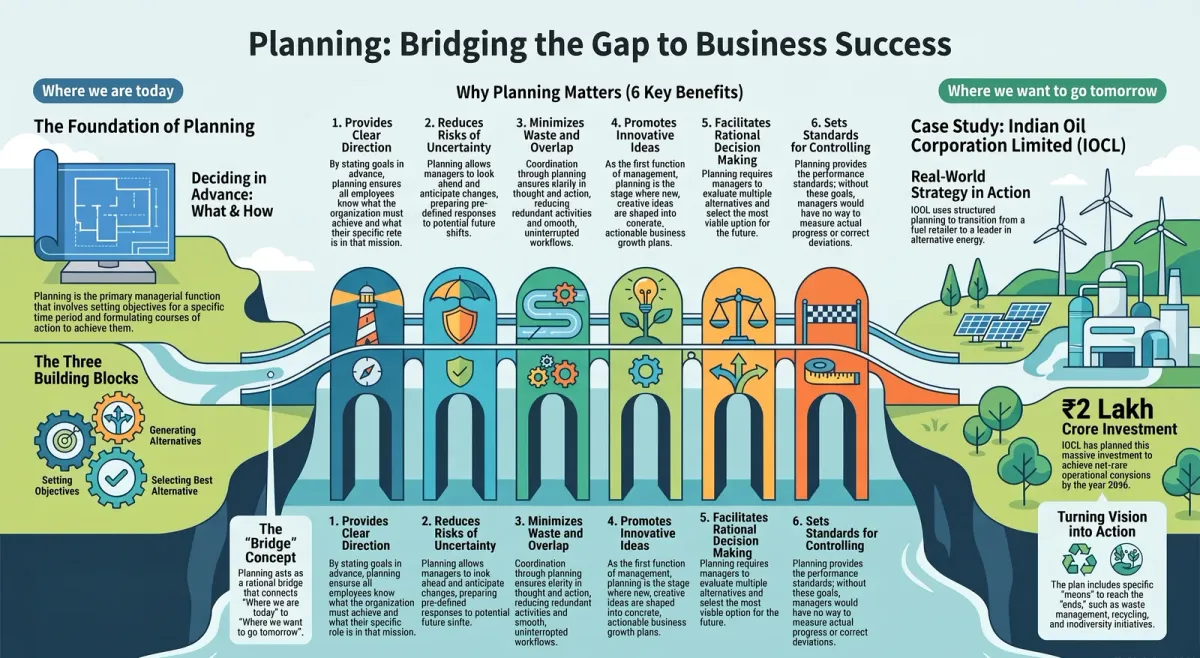
Planning Bridges the Gap Between “Where We Are” and “Where We Want to Go”
Planning is essentially a rational approach for achieving predetermined objectives. It requires taking decisions, since it involves making a choice from among several alternative courses of action. If there is only one possible course of action, there is no real need to plan — the need for planning arises only when genuine alternatives exist.
Planning Involves Both Ends and Means
Planning is concerned with both ends (what is to be done) and means (how it is to be done). Organisational goals set the targets against which actual performance is later measured. Planning always operates within a defined time frame — time is a limited resource, and if it is ignored, changing conditions can make an entire plan go to waste.
A Comprehensive Definition of Planning
Putting all of this together, planning can be comprehensively defined as setting objectives for a given time period, formulating various courses of action to achieve them, and then selecting the best possible alternative from among the courses of action available. This definition captures the three essential building blocks of planning: objective-setting, alternative-generation, and alternative-selection.
Why Is Planning Important? 6 Key Benefits
Planning is important because it tells an organisation where to go, provides direction, and reduces the risk of uncertainty by preparing forecasts. The major benefits of planning, as outlined in the NCERT textbook, are explained below.
1. Planning Provides Direction
By stating in advance how work is to be done, planning provides direction for action. When goals are clearly defined, employees know exactly what the organisation must achieve and what they personally need to do to help achieve it. Without planning, employees would work in different directions, and the organisation would struggle to reach its desired goals.
2. Planning Reduces the Risks of Uncertainty
Planning enables a manager to look ahead and anticipate change. By deciding in advance which tasks need to be performed, planning shows the way to deal with uncertain events. Changes cannot be eliminated entirely, but they can be anticipated, and responses can be developed in advance.
3. Planning Reduces Overlapping and Wasteful Activities
Planning coordinates the activities and efforts of different divisions, departments and individuals. Since it ensures clarity in thought and action, work proceeds smoothly without interruptions, and redundant activities are minimised.
4. Planning Promotes Innovative Ideas
Since planning is the first function of management, it is the stage at which new ideas can take the shape of concrete plans. It is often the most challenging activity for management, because it guides all future actions leading to the growth and prosperity of the business.
5. Planning Facilitates Decision Making
Planning helps managers look into the future and make a choice from among various alternative courses of action. Each alternative must be evaluated, and the manager must select the most viable proposition — a process that directly supports rational decision-making.
6. Planning Establishes Standards for Controlling
Planning provides the goals or standards against which actual performance is later measured. By comparing actual performance to these standards, managers can identify deviations and take corrective action. In this sense, planning is a prerequisite for controlling — without goals and standards, finding deviations (a core part of controlling) would simply not be possible.
IOCL: A Real-World Example of Planned Growth
The NCERT chapter opens with Indian Oil Corporation Limited (IOCL), a Maharatna PSU and India’s largest fuel retailer. IOCL has planned diversification into alternative energy sources, targeting net-zero operational emissions by 2046 through an investment of ₹2 lakh crore, backed by waste management, recycling and biodiversity initiatives — showing how large organisations turn big-picture goals into structured, actionable plans over a defined time horizon.
Quick Recap
-
Planning means deciding in advance what to do and how to do it.
-
It involves setting objectives, generating alternatives, and selecting the best course of action.
-
Planning provides direction, reduces uncertainty, reduces wastage, promotes innovation, aids decision-making, and sets standards for control.
-
Planning has no meaning unless it contributes to achieving predetermined organisational goals.
Ready to Master Business Studies for Boards?
Struggling to remember every definition for Chapter 4? ChampionsPrep’s AI-powered platform gives Class 12 Commerce students unlimited chapter-wise MCQs, instant explanations, and exam-style long-answer practice for just ₹10 per session. Visit https://app.championsprep.in and start practising Planning today.
Test Your Knowledge

Planning in Business Studies: Meaning, Concept & Importance (Class 12)
Frequently Asked Questions
What is the simplest definition of planning in Business Studies? +
Planning is deciding in advance what to do and how to do it. It is one of the basic managerial functions that precedes all other functions.
Why is planning called the primary function of management? +
Because all other managerial functions — organising, staffing, directing and controlling — are performed within the framework of the plans that have already been drawn up.
What are the six benefits of planning mentioned in the CBSE Class 12 syllabus? +
Planning provides direction, reduces risks of uncertainty, reduces overlapping and wasteful activities, promotes innovative ideas, facilitates decision making, and establishes standards for controlling.
Why does planning require decision-making? +
Planning involves choosing from among alternative courses of action. If there were only one possible course of action, there would be no need to plan, since no choice exists to make.
How does the IOCL example illustrate the concept of planning? +
IOCL has set a long-term objective (net-zero emissions by 2046), backed it with a defined investment (₹2 lakh crore) and a course of action (renewable energy, recycling, waste management) — exactly matching the textbook definition of planning as setting objectives and selecting the best course of action to achieve them.
AI-powered practice — free to start