

Case-study questions are one of the most important parts of Class 12 Business Studies preparation because they test whether you can recognise a textbook concept when CBSE removes the chapter heading and places it inside a real business situation.
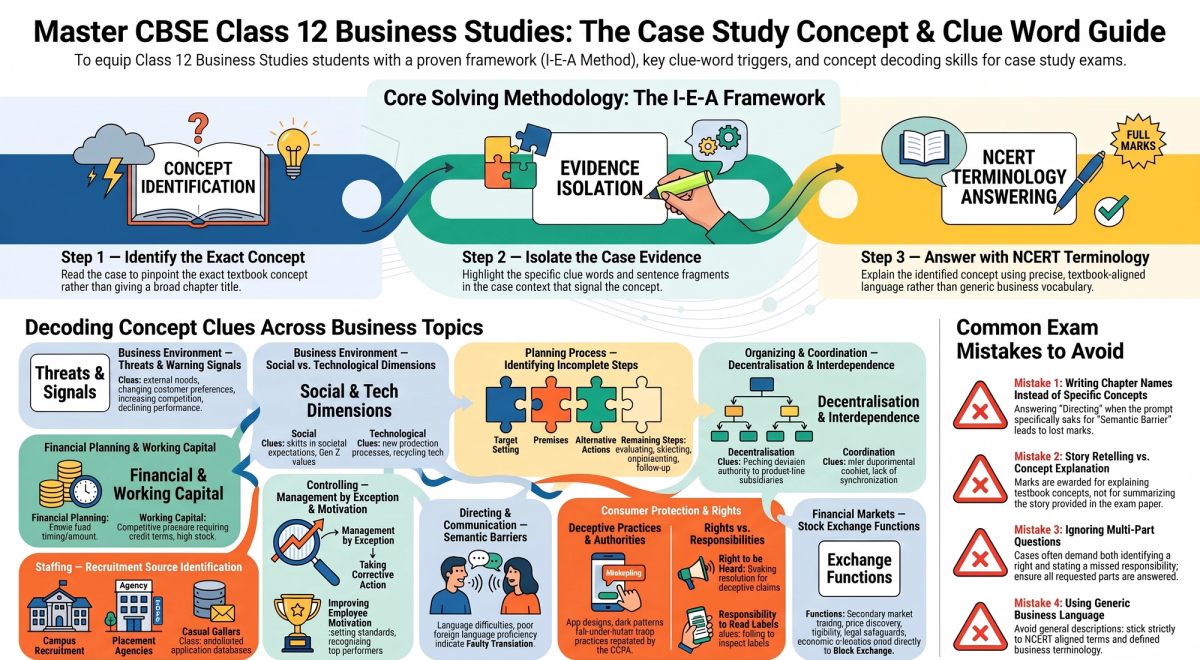
The 2026-27 official Sample Question Paper contains several strong examples. The best way to prepare is not to memorise the case. It is to learn the clues that reveal the concept.
Q5 (Case 1): Business Environment — Threats & Early Warnings
A restaurant loses customers to multinational food chains after failing to understand changes in customer preferences and competition.
The correct idea is the importance of Business Environment in identifying threats and early warning signals.
Clue words: external trends; changing customer preferences; increasing competition; declining performance.
Exam method: First identify the exact point of importance. Then connect one line of the case to the concept.
Q11 (Case 2): Consumer Protection — Dark Patterns
The paper refers to app designs intended to deceive users, nudge them to spend more or compromise privacy.
The authority identified in the marking scheme is the Central Consumer Protection Authority.
Clue words: unfair trade practice; consumer rights; deceptive design; regulatory action.
Do not confuse the authority with a consumer commission. Read whether the question is asking about regulation, complaint adjudication or appeal.
Q13 (Case 3): Planning Process Steps
A small eco-friendly business sets a sales target, develops planning premises and identifies alternative courses of action.
The question asks which planning steps are still incomplete.
The correct sequence requires students to recognise that setting objectives, developing premises and identifying alternatives have already happened, while evaluating alternatives, selecting one, implementing it and follow-up remain.
Case-study skill: map each sentence to a planning step before choosing the option.
Q14 (Case 4): Financial Planning Objectives
A growing company estimates how much money will be needed, when it will be needed and how it can be arranged.
The concept is Financial Planning.
Clue words: future financial requirements; amount and timing of funds; sources of finance; avoiding disruption.
Q15 (Case 5): Working Capital & Competition
A beverage company faces new competitors and responds with credit terms, discounts, promotional schemes and higher inventory.
The factor affecting working-capital requirement is Level of Competition.
Why: Competition can force a business to hold more stock or offer liberal credit, both of which increase working-capital needs.
Q17 (Case 6): Consumer Rights & Responsibilities
A customer buys a breakfast cereal after seeing a weight-loss claim but fails to read the label carefully. She later contacts the company helpline.
The marking scheme identifies: Right to be heard; responsibility to read labels carefully.
This is a two-part case, so answer both the right exercised and the responsibility ignored.
Q18 (Case 7): Controlling & Motivation
A company communicates standards in advance, reviews performance, gives feedback, recognises high performers and trains underperformers.
The case illustrates Improving Employee Motivation as an importance of controlling.
Do not automatically choose "ensuring order and discipline" simply because supervisors are monitoring work. Focus on the outcome described.
Q20 (Case 8): Semantic Barriers in Communication
A telesales employee in France struggles because of weak proficiency in French.
The specific barrier is Faulty Translation under Semantic Barriers.
The marking scheme then expects two additional barriers from the same group.
Exam method: name the barrier; name the group; explain only barriers from that group.
Q22 (Case 9): Sources of Recruitment
The company considers: management institutes; private agencies and professional bodies; its database of unsolicited applicants.
The expected sources are: Campus Recruitment; Placement Agencies and Management Consultants; Casual Callers.
Q24 (Case 10): Management by Exception
Most expenses are within limits, but maintenance cost exceeds the permissible range. Senior management ignores routine deviations and investigates the significant exception.
Concept: Management by Exception.
Next step in the controlling process: Taking Corrective Action.
Clue words: permissible limit; significant deviation; routine matters not escalated; investigation of the exception.
Q27 (Case 11): Business Environment — Sustainable Fashion
A garment company notices a shift in Generation Z expectations towards ethical fashion and collaborates with an inventor who converts plastic bottles into sustainable fabric.
The marking scheme identifies: Social Environment; Technological Environment.
Why: Changing values and expectations are social forces. A new production technology is a technological force.
Q29 (Case 12): Coordination in Management
Production raises output, Sales lacks enough orders, Finance delays funds and departmental heads fail to share information.
The missing concept is Coordination.
The marking scheme accepts characteristics including: continuous process; all-pervasive; integrates group efforts; ensures unity of action; responsibility of all managers; deliberate function.
Clue words: lack of synchronisation; interdependent departments; conflict; poor information sharing.
Q30 (Case 13): Stock Exchange Liquidity
A company issues shares, then participates in a market where existing securities are bought and sold. The case highlights price changes, legal safeguards, liquidity and productive allocation of savings.
The institution is the Stock Exchange.
Expected functions: liquidity and marketability; pricing of securities; safety of transactions; contribution to economic growth. A fully worked version of this case, with two extra practice questions, is in the dedicated Stock Exchange article linked above.
Q33 (Case 14): Decentralisation in Organising
An IT company facing AI disruption reorganises into product-line subsidiaries and pushes decision authority closer to the point of action.
The concept is Decentralisation.
Expected benefits include: initiative among subordinates; managerial development; quicker decisions; relief to top management; growth; better control.
The Best Way to Answer Case Studies
Use the I-E-A method:
Identify — state the exact textbook concept.
Evidence — point to the clue in the case.
Answer — explain using textbook language.
Common Mistakes
- Writing the chapter instead of the concept.
"Directing" is too broad if the question asks for "semantic barrier".
- Ignoring the second part.
Many case questions ask both identification and explanation.
- Retelling the story.
Marks come from the concept, not a summary of the company.
- Using generic business language.
Use NCERT-aligned terms wherever possible.
ChampionsPrep Next Step
Build a "case clue" notebook. For every case you solve, write one line: clue → concept. Registration on ChampionsPrep is free and you only pay as you use it, so after 30-40 cases, when recognition becomes much faster, you can keep testing it on fresh cases at no upfront cost.
Frequently Asked Questions
Are Business Studies case studies difficult? +
They become much easier once you learn the clue words for each concept.
Should I quote the case in my answer? +
Usually not. Use a brief connection to the case, then explain the concept in textbook language.
How should I practise Business Studies case studies? +
Read the case with the question hidden and first identify the chapter and concept. Only then write the answer.
What method helps identify the concept inside a case quickly? +
The I-E-A method: Identify the exact textbook concept, point to the Evidence in the case, then Answer using textbook language.
What is the best technique for solving lengthy business case studies? +
Read the question requirement at the bottom first, then scan the case narrative to highlight specific trigger words that match NCERT management terminology.
Keep practising Business Studies
AI-powered feedback and structured revision for Business Studies — free to start, at your own pace.
AI-powered practice — free to start