

The official CBSE Business Studies Sample Paper for 2026-27 contains four 6-mark questions at the end of the paper. Together they cover Marketing, Financial Markets, Organising and Planning.
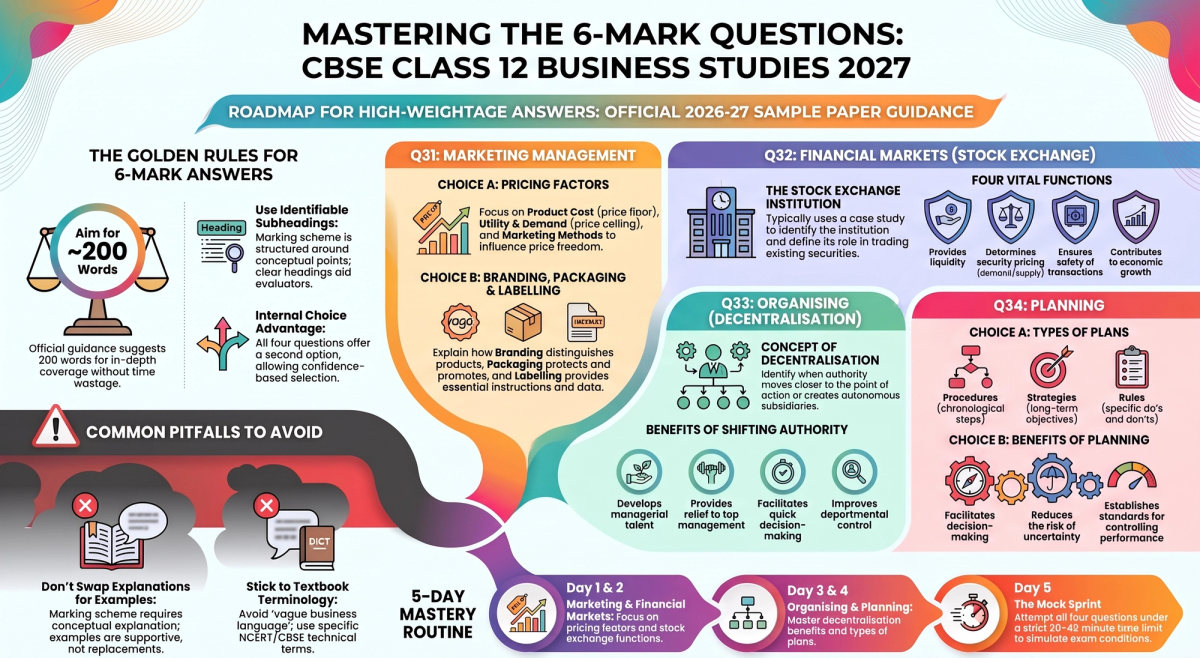
These are excellent revision questions because the marking scheme shows exactly how a 6-mark answer should be structured, and because all four appear as internal-choice questions, meaning the paper always gives you a second route into the marks if your first choice is weaker.
Quick Reference: What Each Question Tests
Q31 tests Marketing (pricing factors, or branding/packaging/labelling). Q32 tests Financial Markets through a Stock Exchange case study. Q33 tests Organising through a Decentralisation case study. Q34 tests Planning (types of plans, or benefits of planning). Notice the pattern: three of the four are built around real business situations rather than bare definitions, so recognising the concept inside the case is half the battle.
Question 31: Pricing factors OR Branding, Packaging and Labelling
Option A asks students to explain three factors determining the price of a product: Product Cost; Utility and Demand; Marketing Methods Used.
Product Cost
Cost includes the cost of producing, distributing and selling the product. It generally creates the lower limit or floor for price in the long run.
Utility and Demand
Utility and the intensity of demand influence the upper limit a buyer may be willing to pay.
Marketing Methods Used
Distribution, sales force, advertising, promotion, packaging, product differentiation, credit and customer service can influence price-setting freedom.
Option B asks students to describe: Branding; Packaging; Labelling.
Branding gives a product a name, sign or symbol that helps distinguish it from competitors.
Packaging is the design and production of the container or wrapper.
Labelling provides information on the package and may range from a simple tag to detailed graphics and instructions.
Answer-writing tip: Use three subheadings. A 6-mark answer becomes easier to evaluate when each concept is clearly separated. The dedicated Marketing article linked below solves this question in full and adds two extra practice questions.
Question 32: Stock Exchange
The case describes a company participating in a market where existing securities are traded.
The institution is the Stock Exchange.
The marking scheme expects: Name of the institution; Definition; Functions discussed in the case.
Functions include:
Providing Liquidity and Marketability
A continuous market lets investors buy and sell existing securities.
Pricing of Securities
Demand and supply help determine market prices and provide continuous valuation.
Safety of Transactions
Rules and regulation provide greater safety and fairness to investors.
Contribution to Economic Growth
Savings can move towards productive investment opportunities, supporting capital formation.
Case-study tip: The case itself contains the function clues. Map each clue to the textbook heading. The dedicated Stock Exchange article below walks through this exact case sentence by sentence.
Question 33: Decentralisation
The case describes an IT company splitting into product-line subsidiaries, each with its own functions, while decision-making authority is moved closer to the point of action.
The concept is Decentralisation.
The marking scheme asks for any four benefits.
Develops Initiative
Lower-level managers gain confidence because they make decisions within their authority.
Develops Managerial Talent
Independent assignments help create managers capable of handling larger responsibilities.
Quick Decision-making
Decisions are made closer to the point of action, reducing delay and distortion.
Relief to Top Management
Top management can focus on major issues rather than routine decisions.
Facilitates Growth
Autonomous divisions can function according to their needs and support expansion.
Better Control
Performance can be evaluated by level or department and accountability becomes clearer.
Scoring tip: If asked for four benefits, write four complete points. A fifth point is useful only if time permits, since the marking scheme typically stops crediting once the required number of points is covered.
Question 34: Types of Plans OR Benefits of Planning
Option A asks for: Procedure; Strategy; Rule.
Procedure
A procedure specifies routine steps in chronological order for carrying out an activity.
Strategy
A strategy is a comprehensive plan dealing with long-term objectives, course of action and resource allocation.
Rule
A rule is a specific statement of what must or must not be done and generally allows no discretion.
Option B asks for three benefits of planning.
Planning Facilitates Decision-making
Planning requires evaluating alternatives and selecting the most appropriate course of action.
Planning Reduces the Risk of Uncertainty
Planning cannot eliminate uncertainty, but it helps managers anticipate change and prepare responses.
Planning Establishes Standards of Controlling
Planning sets goals and standards against which actual performance can later be compared.
How Marks Are Typically Earned
The supplied marking scheme frequently uses a heading-plus-explanation pattern.
That means a strong 6-mark answer should: state the exact heading; explain it fully; use the terminology expected by the chapter; avoid combining two separate points into one paragraph.
Common Mistakes
- Giving examples instead of explanations.
- Writing vague business language instead of textbook terminology.
- Missing one required heading.
- Writing too much on the first point and rushing the last.
- Failing to connect a case-study clue to the correct concept.
Day 4: Planning
Day 5: Attempt all four in 35-40 minutes
ChampionsPrep Next Step
After learning the model structure, rewrite each answer from memory using only the question. Then compare the headings you used with the official marking logic. Registration on ChampionsPrep is free and you only pay as you use it, so once your headings match the marking scheme consistently, you can keep testing that structure on fresh case studies at no upfront cost.
Frequently Asked Questions
How long should a 6-mark Business Studies answer be? +
The official SQP guidance says around 200 words may be appropriate for a 6-mark answer.
Should I use headings in a 6-mark Business Studies answer? +
Yes. The marking scheme itself is structured around identifiable conceptual points, so clear subheadings make an answer easier to evaluate.
Are these the only important 6-mark chapters for the 2027 Boards? +
No. They are the chapters represented in this official sample paper and are therefore high-priority practice areas, not a complete prediction of the Board paper.
Which chapters do the four official 6-mark questions cover? +
Marketing (Q31), Financial Markets/Stock Exchange (Q32), Organising/Decentralisation (Q33), and Planning (Q34).
How should students structure a 6-mark answer in Business Studies? +
State the concept clearly, define it in 1-2 sentences, and present 3 to 4 distinct subheadings with concise real-world explanations to secure full marks.
Keep practising Business Studies
AI-powered feedback and structured revision for Business Studies — free to start, at your own pace.
AI-powered practice — free to start