

If you are preparing for the CBSE Class 12 Commerce Board examinations in 2027, the official 2026-27 Sample Question Papers are one of the most useful documents to study. They do more than show a paper format. They reveal the kinds of situations, calculations and application-based questions CBSE expects students to handle.
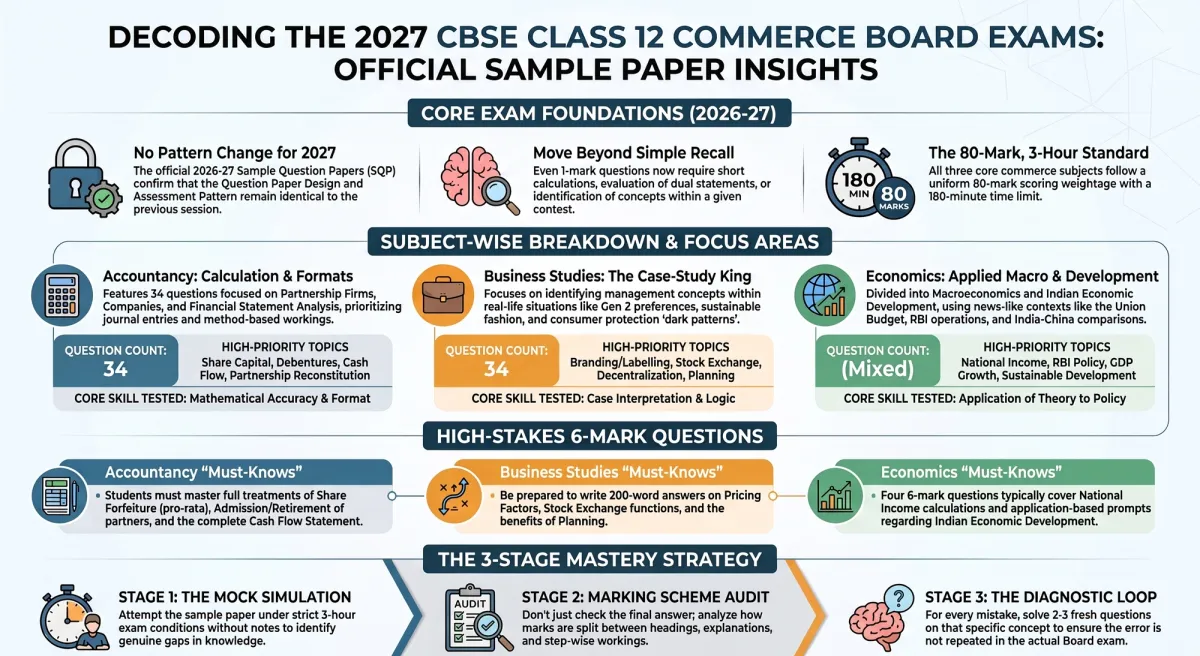
For Commerce students, three papers matter most: Accountancy, Business Studies and Economics. All three are 80-mark, three-hour papers, but they test students in very different ways.
Accountancy is calculation- and format-heavy. Business Studies is increasingly case-based. Economics combines conceptual knowledge with data, current policy examples and application.
This guide gives you the big picture before you move into the complete subject-wise solved papers.
What the 2026-27 CBSE sample papers tell Commerce students
The most important takeaway is that CBSE has not announced a change in the question-paper design and assessment pattern for 2026-27 in these sample papers. That means preparation should focus less on chasing a “new pattern” and more on mastering how the existing pattern is being applied.
The papers also show a consistent shift away from simple recall. Even one-mark questions often require a short calculation, interpretation of a situation, identification of a concept, or evaluation of two statements.
Accountancy: what the official sample paper focuses on
The Accountancy paper contains 34 questions. Part A covers Accounting for Partnership Firms and Companies. Part B offers a choice between Analysis of Financial Statements and Computerised Accounting.
The paper includes:
-
1-mark questions testing concepts and quick calculations
-
3-mark questions requiring short workings or journal entries
-
4-mark questions involving presentation, adjustments or analysis
-
6-mark questions requiring full treatment of a topic
The 6-mark questions are especially important. They include issue of debentures, change in profit-sharing ratio, admission or retirement of a partner, share capital, and a full Cash Flow Statement question in the Financial Statement Analysis option.
This tells you something important about preparation: do not treat Partnership Accounts, Share Capital, Debentures and Cash Flow as isolated chapters. CBSE is testing whether you can combine multiple steps correctly.
High-priority Accountancy topics from the SQP:
-
Goodwill and reconstitution
-
Admission and retirement of a partner
-
Revaluation
-
Share issue, forfeiture and reissue
-
Pro-rata allotment
-
Debentures
-
Financial ratios
-
Cash Flow Statement
Business Studies: case-study interpretation matters
The Business Studies paper also contains 34 questions. CBSE specifically indicates approximate answer lengths: 3-mark answers may be 50-75 words, 4-mark answers about 150 words, and 6-mark answers about 200 words.
The paper uses numerous real-life situations. Students are expected to identify the underlying management concept and then explain it using textbook language.
Examples include:
-
A business failing to respond to changes in its environment
-
Dark patterns and consumer protection
-
Gen Z preferences and sustainable fashion
-
Management by exception
-
Coordination failure across departments
-
Stock-exchange functions
-
Decentralisation in a large organisation
The 6-mark questions focus on:
-
Pricing factors or branding, packaging and labelling
-
Stock exchange and its functions
-
Decentralisation
-
Types or benefits of planning
The implication is clear: memorising definitions is not enough. You need to recognise the chapter hidden inside a case.
Economics: textbook concepts applied to real events
Economics is divided into Section A: Macroeconomics and Section B: Indian Economic Development.
The paper has 20 one-mark MCQs, 3-mark questions, 4-mark questions and four 6-mark questions.
The official SQP uses recent policy and economic contexts such as:
-
Union Budget measures
-
Cash Reserve Ratio changes
-
RBI open market operations
-
FDI and Balance of Payments
-
GDP growth and real GDP
-
Human capital and human development
-
India-China development comparisons
-
Renewable energy and sustainable development
This is a strong signal for preparation. Students should know definitions and formulas, but they should also practise applying them to a short news-like passage.
How to use these sample papers properly
Do not simply solve the paper once and check the answer key.
Use a three-stage method.
Stage 1: Attempt under exam conditions
Give yourself three hours. Avoid notes. Mark every question you were unsure about.
Stage 2: Compare with the marking scheme
Do not only check whether the final answer is correct. Look at how marks are split. In Business Studies and Economics, headings and explanation points matter. In Accountancy, method, workings and presentation matter.
Stage 3: Practise the concept again
For every question you got wrong, solve two or three fresh questions testing the same idea. That converts a sample paper from a mock exam into a diagnostic tool.
Where to start
If Accountancy is your weak subject, begin with the 6-mark questions and Cash Flow. These expose calculation and presentation gaps quickly.
If Business Studies is your weak subject, begin with case studies. Practise identifying the chapter before writing the answer.
If Economics is your weak subject, begin with RBI, national income, aggregate demand and the application-based Indian Economic Development questions.
Subject-wise solved sample papers
Use the detailed ChampionsPrep guides for:
Each guide includes a question map, marking logic, common mistakes and links to similar practice. All three papers are also on the CBSE Class 12 sample papers hub .
ChampionsPrep next step
Do not stop after checking the answer key. Use the official paper to find the concepts costing you marks, then practise those concepts until the method becomes automatic. Registration on ChampionsPrep is free and you only pay as you use it, so you can move from the solved question to similar practice, concept revision and AI Tutor support, and every mistake in the sample paper becomes a targeted revision task.
Frequently Asked Questions
Is the CBSE 2026-27 sample paper relevant for the 2027 Board exam? +
Yes. The 2026-27 academic-session sample paper is the official sample paper for students preparing for the Board examinations held in 2027.
Has CBSE changed the paper pattern for 2026-27? +
The supplied official SQPs state that there is no change in the Question Paper Design and Assessment Pattern for the 2026-27 academic session.
Should I solve only the official CBSE sample paper? +
No. Treat it as the most authoritative pattern reference, then practise additional questions built around the same concepts and difficulty.
Which Commerce subject is most case-study heavy? +
Business Studies relies heavily on case interpretation. Economics also uses passage- and context-based application. Accountancy remains more calculation- and treatment-oriented.
Where can I access the official CBSE SQP and Marking Scheme PDFs? +
You can download the official PDFs directly from the CBSE academic portal (cbseacademic.nic.in) or access the interactive breakdown on the ChampionsPrep Sample Papers Hub.
AI-powered practice — free to start