
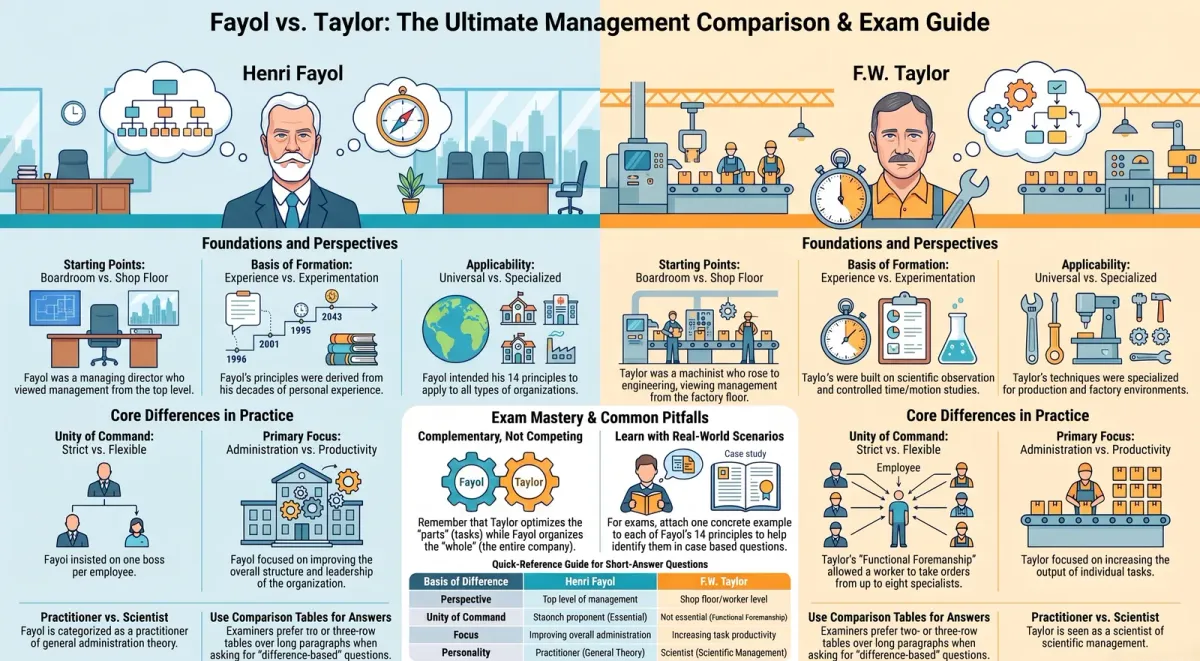
Henri Fayol and F.W. Taylor are the two names CBSE Class 11 Business Studies students associate most closely with Chapter 2, and exam papers love asking students to compare them. Both contributed enormously to management as a discipline, and their ideas are genuinely complementary rather than contradictory — but they approached management from very different vantage points. This post lays out the key differences and closes with practical exam tips.
Two Different Starting Points
Taylor was an American mechanical engineer who began as an apprentice machinist and rose through Midvale Steel and Bethlehem Steel. His view of management was shaped by years on the factory floor, watching workers perform individual tasks. Fayol, by contrast, was a French mining engineer who spent thirty years as managing director of a mining company, observing management from the boardroom. This difference in starting point explains almost every difference in their conclusions.
Fayol vs Taylor: Point-by-Point Comparison
Perspective
Taylor’s ideas came from the shop floor level of a factory, focused on the individual worker and task. Fayol’s ideas came from the top level of management, focused on how the organisation as a whole should be run.
Unity of Command
Fayol was a staunch proponent of unity of command, insisting every employee should answer to only one superior. Taylor, on the other hand, did not treat this as essential — under his system of functional foremanship, a single worker could take instructions from as many as eight different specialists at once.
Applicability
Fayol intended his fourteen principles to be applicable universally, across all types of organisations and management levels. Taylor’s principles and techniques were more specialised, developed specifically for production and factory-floor situations.
Basis of Formation
Fayol’s principles were drawn primarily from his own personal experience running a large organisation over several decades. Taylor’s, by contrast, were built on direct observation and controlled experimentation — time studies, motion studies, and trial wage systems tested on the shop floor.
Focus
Fayol’s focus was on improving overall administration — the structure, coordination, and leadership of an organisation. Taylor’s focus was narrower and more concrete: increasing productivity at the level of the individual task.
Personality and Expression
Fayol is often described as a practitioner whose ideas took the form of a general theory of administration, applicable at every level of a business. Taylor is often described as a scientist whose ideas took the specific form of scientific management, aimed at optimising work itself.
Why Their Contributions Are Complementary, Not Competing
It is tempting to frame Fayol and Taylor as rivals, but a more accurate view is that they examined different layers of the same organisation. Taylor’s techniques — functional foremanship, standardisation, work study, differential wages — answer how to get the most out of an individual worker or task. Fayol’s fourteen principles — division of work, authority, unity of command, scalar chain, esprit de corps — answer how to structure and lead an entire organisation so those efficient tasks add up to a coherent whole. A well-run modern company still needs both layers working together.
Common Confusion Points to Watch For
Two errors show up often in student answers. First, students assume Taylor rejected unity of command as a bad idea — in reality, he simply built a different system (functional foremanship) that didn’t need it, since his focus was narrow, task-based supervision rather than organisation-wide coordination. Second, students mix up unity of command with unity of direction; command is about one employee answering to one boss, while direction is about one plan and one head for each group of activities across the organisation.
Exam Prep Tips for Chapter 2
Learn the Principles With One Real Example Each
Examiners frequently ask you to identify which principle is being followed — or violated — in a short case-based scenario. Rather than memorising definitions in isolation, attach one concrete example to each principle so you can recognise it quickly in an unfamiliar case.
Practise the Case-Study Format
This chapter is a favourite for case-based and application questions, where a short paragraph describes a company situation and asks you to name the principle involved, explain it, and suggest what the company should do differently. Practising this format specifically — not just theory recall — makes a real difference to your score.
Keep the Nature and Significance Points Ready as a Quick List
Short-answer questions often ask you to state the nature or significance of management principles directly. Being able to list these points crisply, with one line of explanation each, is far more exam-efficient than writing long paragraphs under time pressure.
Don’t Neglect the Difference-Based Questions
Beyond Fayol versus Taylor, this chapter also invites “difference between” questions — such as unity of command versus unity of direction, or centralisation versus decentralisation. Prepare these as two- or three-row comparison tables rather than prose, since that is usually how the answer is expected to look.
Conclusion
Fayol and Taylor approached management from opposite ends of the organisation — one from the boardroom, one from the shop floor — yet both left behind frameworks still taught in business schools today. Understanding where their ideas overlap, where they differ, and how examiners like to test that difference will put you in strong shape for Chapter 2 of your CBSE Class 11 Business Studies exam.
Ready to Master Business Studies Chapter 2?
Test yourself with unlimited AI-generated exam-style questions on Fayol, Taylor, and Principles of Management for just ₹10 per session on ChampionsPrep. Build exam confidence chapter by chapter, at your own pace. Visit https://app.championsprep.in to get started today.
Test Your Knowledge

Fayol vs Taylor: A Complete Comparison and Exam Prep Guide
Frequently Asked Questions
What is the main difference between Fayol and Taylor's approach to management? +
Fayol focused on top-level administration and the organisation as a whole, while Taylor focused on shop-floor efficiency at the level of the individual worker and task.
Did Taylor believe in the principle of unity of command? +
No, Taylor did not treat unity of command as essential; under his functional foremanship system, a worker could receive instructions from up to eight different specialists.
Are Fayol's principles applicable to all organisations? +
Yes, Fayol intended his fourteen principles to be universally applicable, while Taylor's principles and techniques were developed specifically for production and factory settings.
How are Fayol's and Taylor's contributions related to each other? +
They are complementary rather than competing — Taylor's techniques improve efficiency at the task level, while Fayol's principles guide how the whole organisation is structured and led.
What is the best way to prepare Chapter 2, Principles of Management, for exams? +
Learn each principle with a real example, practise case-based application questions, keep nature and significance points as quick lists, and prepare comparison-style answers for topics like unity of command versus unity of direction.
AI-powered practice — free to start