
When a sole proprietor’s business outgrows one person’s capital, skills, and risk-bearing capacity, the natural next step is often partnership. This is one of the most detailed and exam-heavy sections of Chapter 2, “Forms of Business Organisation,” in CBSE Class 11 Business Studies — and for good reason, since it covers legal definitions, six types of partners, two classification systems for partnerships, and the registration process.
What Is a Partnership?
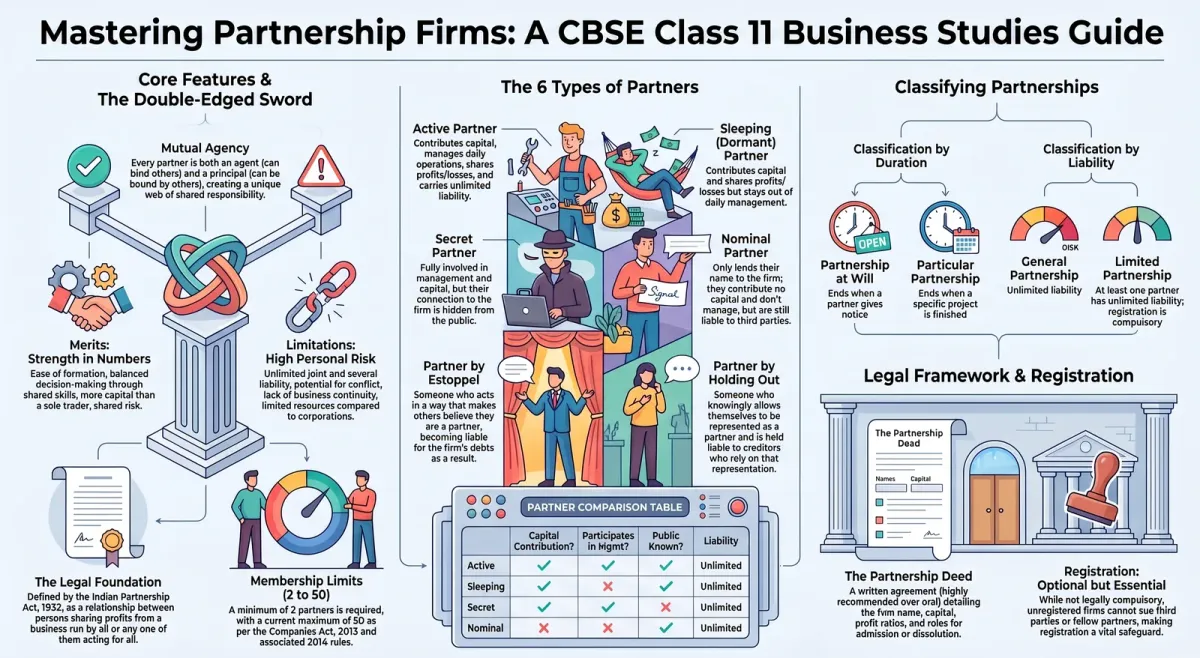
The Indian Partnership Act, 1932 defines partnership as “the relation between persons who have agreed to share the profit of the business carried on by all or any one of them acting for all.” In simple terms, two or more people come together, contribute capital and skills, and agree to share profits and losses from a jointly run business.
Features of Partnership
Formation: A partnership is created through a legal agreement specifying how profits, losses, and responsibilities will be shared. Registration of the firm is optional, though — as we’ll see below — it carries real consequences.
Liability: Partners have unlimited liability, and this liability is both joint and several. This means each partner can individually be held responsible for the firm’s entire debt, though they can later recover a proportionate share from the other partners.
Risk-bearing: Partners share both the risks and the rewards of the business in an agreed ratio.
Decision-making and control: Day-to-day decisions are typically made with mutual consent among the partners.
Continuity: A partnership lacks automatic continuity — death, retirement, insolvency, or insanity of any partner can dissolve the firm, although the remaining partners may choose to continue under a fresh agreement.
Number of partners: A minimum of two partners is required. As per Section 464 of the Companies Act, 2013 and Rule 10 of the Companies (Miscellaneous) Rules, 2014, the maximum number of partners currently allowed is 50.
Mutual agency: Every partner is both an agent and a principal — they can bind the other partners through their actions, and are similarly bound by the actions of others.
Merits and Limitations of Partnership
On the plus side, partnerships offer ease of formation and closure, balanced decision-making through division of responsibilities, more funds than a sole proprietor could raise alone, shared risk, and legal secrecy since accounts don’t need to be published.
However, partnerships also carry real drawbacks: unlimited liability exposes personal wealth to business debts, limited resources cap growth, possible conflicts can arise from shared decision-making, lack of continuity threatens long-term stability, and lack of public confidence results from the absence of mandatory public disclosure.
Types of Partners
CBSE frequently tests this classification, so it’s worth knowing precisely:
-
Active partner: Contributes capital, actively participates in management, shares profits/losses, and has unlimited liability.
-
Sleeping (dormant) partner: Contributes capital and shares profits/losses but does not participate in daily management.
-
Secret partner: Participates in management and shares profits/losses, but their association with the firm is unknown to the general public.
-
Nominal partner: Lends their name to the firm without contributing capital or participating in management, but remains liable to third parties.
-
Partner by estoppel: Someone who, through their conduct, gives others the impression they are a partner — and becomes liable as though they actually were.
-
Partner by holding out: Someone who knowingly allows themselves to be represented as a partner, and consequently becomes liable to creditors who extended credit based on that representation.
Types of Partnerships
Partnerships can be classified in two ways:
Classification by Duration
-
Partnership at will — continues as long as partners wish, terminated by a notice of withdrawal.
-
Particular partnership — formed for a specific project or time period, dissolving automatically once that purpose is fulfilled.
Classification by Liability
-
General partnership — liability is unlimited and joint; registration is optional.
-
Limited partnership — at least one partner has unlimited liability, while others may have limited liability; registration is compulsory. This form was permitted in India only after the New Small Enterprise Policy of 1991.
The Partnership Deed
A partnership deed is the written agreement specifying the terms and conditions governing the partnership. While an oral agreement is legally valid, a written deed is strongly advisable as documentary evidence. It typically covers the firm’s name, nature and duration of business, capital contribution, profit-sharing ratio, partners’ duties, salary and drawing rules, and the procedure for admission, retirement, or dissolution.
Why Registration Matters
Registering a partnership firm with the Registrar of Firms is optional under the Indian Partnership Act, 1932 — but an unregistered firm faces significant consequences: a partner cannot sue the firm or fellow partners, the firm cannot sue third parties, and it cannot file a case against its own partners. Given these risks, most firms choose to register voluntarily, even though the law does not require it.
Related Reading
-
Sole Proprietorship: Meaning, Features, Merits and Limitations
-
Joint Hindu Family Business: Meaning, Features, Merits and Limitations
-
Cooperative Society: Features, Types and the Amul Case Study
-
Choosing the Right Form of Business Organisation: A Complete Comparison
Ready to Master Chapter 2?
Partnership is one of the most detail-heavy topics in this chapter — from the six types of partners to the registration consequences. Reinforce your understanding with structured, exam-focused practice on ChampionsPrep. Registration is completely free, and you pay only for what you use. Start practising today at https://app.championsprep.in .
Test Your Knowledge

Partnership Firm: Types of Partners, Partnership Deed and Registration
Frequently Asked Questions
What is the maximum number of partners allowed in a partnership firm in India? +
As per the Companies Act, 2013 and its associated rules, the maximum is currently 50 partners.
What is the difference between a sleeping partner and a secret partner? +
A sleeping partner does not participate in management but is publicly known as a partner. A secret partner does participate in management, but their identity as a partner is unknown to the public.
Is it compulsory to register a partnership firm? +
No, registration is optional under the Indian Partnership Act, 1932, but an unregistered firm loses important legal rights, such as the ability to sue third parties or other partners.
What is meant by mutual agency in a partnership? +
Mutual agency means every partner acts as both an agent and a principal — their actions can bind the other partners, and they are similarly bound by the actions of fellow partners.
What is the difference between partnership at will and particular partnership? +
A partnership at will continues indefinitely until a partner gives notice of withdrawal, while a particular partnership is formed for a specific project or time period and dissolves once that purpose is achieved.
AI-powered practice — free to start