
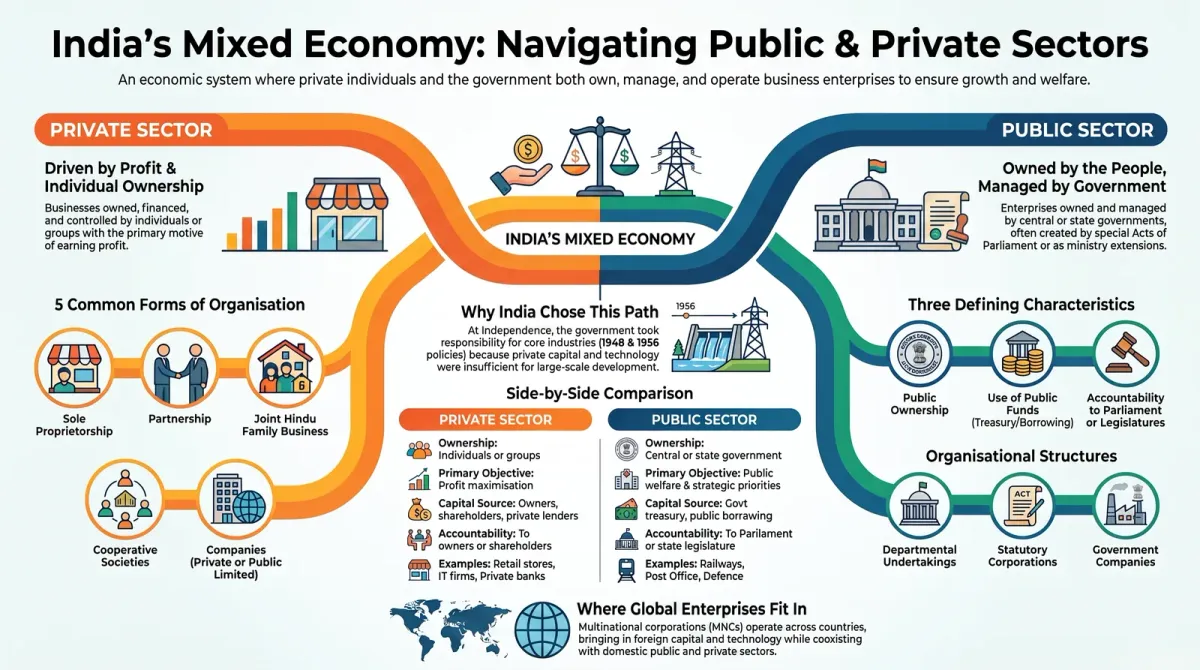
Walk through any Indian city and you will brush against both sectors of the economy within minutes. The neighbourhood grocery store, the local tailor, and the app-based cab you booked belong to the private sector. The railway station you passed, the post office at the corner, and the electricity board that powers your home belong to the public sector. Both exist side by side, and understanding why is the starting point of Chapter 3, “Private, Public and Global Enterprises,” in CBSE Class XI Business Studies.
What Is a Mixed Economy?
India did not choose between capitalism and socialism at Independence. Instead, it adopted a mixed economy, where private individuals and the government both own, manage, and operate business enterprises. Neither sector is meant to eliminate the other; each fills gaps the other cannot or will not cover. The private sector chases profit and consumer demand efficiently, while the public sector steps in wherever national priorities — infrastructure, defence, public utilities — need attention regardless of immediate profitability.
Why India Chose a Mixed Economy
At Independence, India lacked the capital, technology, and industrial base to compete globally. Private investors were unwilling to fund capital-intensive projects with long gestation periods, such as steel plants or power generation. The government’s Industrial Policy Resolutions of 1948 and 1956 formally divided industries between the two sectors, giving the public sector responsibility for core and strategic industries while leaving consumer goods largely to private enterprise. The 1991 industrial policy later reversed much of this rigidity, opening most sectors to private participation — a shift covered in detail later in this series.
The Private Sector: Ownership by Individuals and Groups
The private sector consists of businesses owned, financed, and controlled by individuals or groups of individuals rather than the government. Profit is usually the primary motive, though private businesses also create employment and contribute to economic growth.
Forms of Private Sector Organisation
Private businesses in India can take several legal forms, each suited to different scales of operation:
-
Sole Proprietorship — a business owned and run by a single individual, common among small shopkeepers and service providers.
-
Partnership — two or more individuals share ownership, capital, and profits, typical of professional firms like legal or accounting practices.
-
Joint Hindu Family Business — governed by Hindu law, where the business is owned by members of an undivided family.
-
Cooperative Society — a voluntary association of members pooling resources for mutual benefit rather than pure profit.
-
Company — a separate legal entity that can be either a private limited company or a public limited company, depending on how it raises capital and how many shareholders it has.
The Public Sector: Business Owned by the Government
The public sector consists of enterprises owned and managed, wholly or partly, by the central or state government. These organisations may function as an extension of a government ministry or may be created through a special Act of Parliament. Unlike private businesses, public enterprises are accountable to the public through Parliament, and their funding and operations are subject to government oversight.
Key Characteristics of Public Enterprises
Three features consistently define a public sector enterprise, regardless of its specific organisational form:
-
Public ownership — the enterprise is owned wholly or substantially by the government.
-
Public funds — capital typically originates from government treasury allocations, borrowings, or public shareholding.
-
Public accountability — management decisions must ultimately answer to Parliament or the state legislature, not just shareholders.
Depending on the nature of its operations and its relationship with the government, a public enterprise may be organised as a departmental undertaking, a statutory corporation, or a government company — each with distinct features, merits, and limitations that the next two posts in this series examine closely.
Public Sector vs Private Sector: A Quick Comparison
| Basis | Private Sector | Public Sector |
|---|---|---|
| Ownership | Individuals or groups | Central or state government |
| Primary objective | Profit maximisation | Public welfare and strategic priorities |
| Capital source | Owners, shareholders, private lenders | Government treasury, public borrowing |
| Accountability | To owners or shareholders | To Parliament or state legislature |
| Typical examples | Retail stores, private banks, IT firms | Railways, post office, defence undertakings |
Where Global Enterprises Fit In
Alongside these two domestic sectors, India’s economy also hosts global enterprises — multinational corporations that operate across several countries and bring in foreign capital, technology, and management practices. These businesses coexist with public and private enterprises, sometimes competing with them and sometimes collaborating through joint ventures. A dedicated post later in this series explores their features and role in detail.
Why This Topic Matters for CBSE Class XI Exams
Questions on the public–private sector distinction appear frequently in CBSE Class XI school exams, and the concept resurfaces in entrance exams like CUET Commerce. Examiners often ask students to classify examples into the correct sector or explain why a mixed economy suits India better than a purely private or state-controlled model. A clear grasp of ownership, funding, and accountability differences is usually enough to answer both short and long-answer questions confidently.
Related Reading
-
Cooperative Society: Features, Types and the Amul Case Study
-
Choosing the Right Form of Business Organisation: A Complete Comparison
Master This Chapter with ChampionsPrep
Want to test how well you’ve understood the public and private sector distinction? ChampionsPrep offers AI-powered practice questions, chapter notes, and mock tests mapped exactly to your CBSE or Maharashtra State Board syllabus. Registration is free, and you pay only as you use — no subscriptions, no hidden fees. Start practising Chapter 3 today at ChampionsPrep .
Test Your Knowledge

Public Sector vs Private Sector: Understanding India's Mixed Economy
Frequently Asked Questions
What is the main difference between the public sector and the private sector? +
The public sector consists of enterprises owned and managed by the government and is accountable to Parliament, while the private sector consists of businesses owned by individuals or groups and is primarily driven by profit.
Why is the Indian economy called a mixed economy? +
It is called a mixed economy because both privately owned and government-owned business enterprises are allowed to coexist and operate, with each sector contributing to different areas of economic activity.
What are the different forms of private sector organisation? +
The private sector includes sole proprietorship, partnership, joint Hindu family business, cooperative society, and company (which can be private limited or public limited).
What are the three forms a public sector enterprise can take? +
A public enterprise may be organised as a departmental undertaking, a statutory corporation, or a government company, depending on its operations and relationship with the government.
Do global enterprises belong to the public or private sector? +
Global enterprises, or multinational corporations, are typically privately owned but operate across multiple countries, making them a distinct category alongside the domestic public and private sectors.
AI-powered practice — free to start