
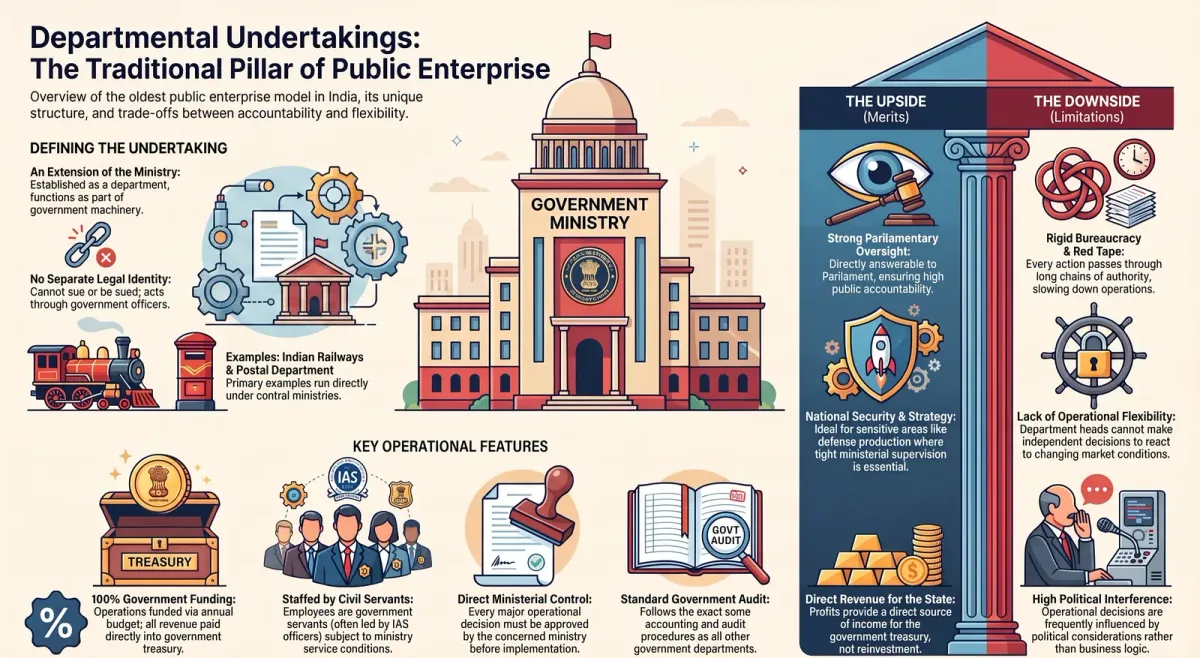
When you post a letter or board a train, you are dealing with a departmental undertaking — the oldest and most traditional way the Indian government organises its business enterprises. Unlike a private company or even a government-owned corporation, a departmental undertaking is not a separate legal entity at all. It is simply an extension of a government ministry, run by government employees under government rules. This post, part of our series on CBSE Class XI Business Studies Chapter 3, unpacks exactly how this form works, and why the government still relies on it for some of the country’s most sensitive services.
Definition of a Departmental Undertaking
A departmental undertaking is a public enterprise established as a department of a ministry, functioning as an integral part of the government’s own machinery rather than as an independent organisation. It has no separate legal identity — it cannot sue or be sued in its own name, and it acts entirely through government officers and employees. The Indian Railways and the Postal Department are the textbook examples, both organised directly under their respective central ministries.
Features of Departmental Undertakings
Several distinguishing characteristics set departmental undertakings apart from other forms of public enterprise:
Government Funding and Treasury Control
The enterprise is funded through an annual appropriation from the government budget, and any revenue it earns is paid straight back into the government treasury rather than being retained for reinvestment.
Government Employees and IAS Leadership
Staff working in a departmental undertaking are government servants, recruited and governed under the same service conditions as any other central or state government employee. Such undertakings are typically headed by Indian Administrative Service (IAS) officers, who may be transferred between ministries during their careers.
Direct Ministerial Control
A departmental undertaking is considered a subdivision of its parent ministry and remains under the ministry’s direct control. Every major decision routes through the concerned ministry before it can be implemented.
Subject to Government Accounting and Audit
These enterprises follow the same accounting and audit procedures applied to other government departments, ensuring their finances are scrutinised with the same rigour as any ministry’s budget.
Merits of Departmental Undertakings
Despite sounding rigid, this organisational form offers genuine advantages, particularly where public accountability matters more than commercial flexibility:
-
Strong parliamentary control — Parliament can exercise direct and effective oversight over the undertaking’s operations.
-
High public accountability — because the undertaking is part of the government itself, its actions are easily traceable and answerable to citizens through elected representatives.
-
Direct revenue to the treasury — any profit generated flows straight into government funds, becoming a source of public income.
-
Suitability for national security — where strategic or security considerations dominate, such as defence production, this form keeps the enterprise under tight ministerial supervision.
Limitations of Departmental Undertakings
The same features that make departmental undertakings accountable also make them slow and inflexible in a competitive economy:
-
Lack of flexibility — rigid government procedures make it difficult to respond quickly to changing business conditions.
-
No independent decision-making — department heads cannot act without ministry approval, causing delays exactly when prompt decisions are needed.
-
Missed business opportunities — an over-cautious, risk-averse bureaucratic approach often prevents the undertaking from pursuing profitable but slightly riskier ventures.
-
Red tape — every action must pass through proper channels of authority, slowing down day-to-day operations considerably.
-
Political interference — because the undertaking sits inside a ministry, political considerations frequently influence operational decisions.
-
Weak consumer responsiveness — these organisations are often criticised for being insensitive to consumer needs and providing inadequate service quality.
Departmental Undertakings vs Other Public Enterprise Forms
Departmental undertakings represent just one of three organisational forms a public enterprise can take. The other two — statutory corporations and government companies — trade off some of this direct government control in exchange for greater operating flexibility and financial independence. Our next post in this series compares both forms in detail, explaining exactly when the government prefers one structure over another.
Why Departmental Undertakings Still Matter
Even in a liberalised economy, departmental undertakings remain relevant wherever the government wants uncompromising control — national security, essential public services, or activities requiring direct parliamentary oversight. Understanding their strengths and weaknesses helps CBSE Class XI students answer both conceptual and application-based questions, especially those asking why a specific service (like postal delivery or railway operations) continues to be run departmentally despite competition from private courier or transport firms.
Related Reading
-
Public Sector vs Private Sector: Understanding India’s Mixed Economy
-
Cooperative Society: Features, Types and the Amul Case Study
Master This Chapter with ChampionsPrep
Need more practice distinguishing departmental undertakings from statutory corporations and government companies? ChampionsPrep gives you AI-generated question banks, concept notes, and mock tests aligned to your exact CBSE or Maharashtra State Board chapter. It’s free to register, and you only pay as you use — no bundled subscriptions. Start practising at ChampionsPrep .
Test Your Knowledge

Departmental Undertakings: The Oldest Form of Public Enterprise in India
Frequently Asked Questions
What is a departmental undertaking? +
A departmental undertaking is a public enterprise organised as a department of a government ministry, functioning as an extension of the ministry itself, with no separate legal identity of its own.
What are two examples of departmental undertakings in India? +
Indian Railways and the Post and Telegraph Department are the two most commonly cited examples of departmental undertakings in India.
Who are the employees of a departmental undertaking? +
Employees of a departmental undertaking are government servants, recruited and governed under the same rules and conditions of service as other central or state government employees.
What is the biggest limitation of a departmental undertaking? +
The biggest limitation is a lack of operational flexibility, since department heads cannot take independent decisions without ministry approval, leading to delays and missed business opportunities.
Why is the departmental undertaking form suitable for national security matters? +
This form keeps the enterprise under the direct control and supervision of the concerned ministry, making it well suited to areas like defence where strategic oversight is essential.
AI-powered practice — free to start