
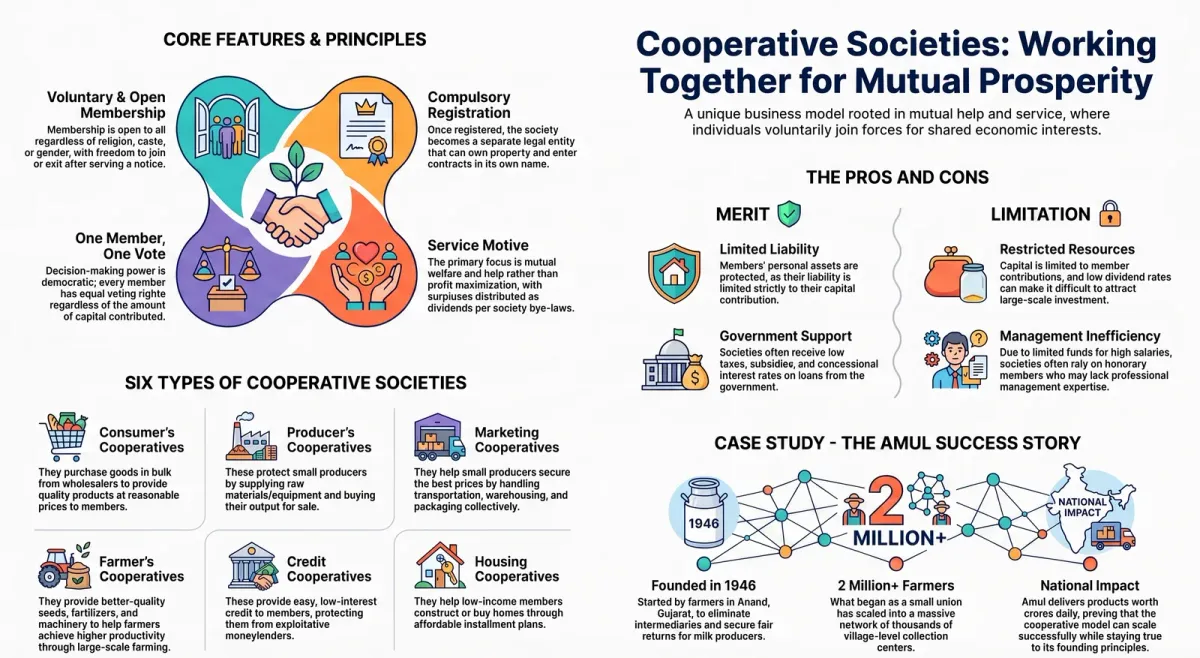
Not every business is built purely for profit maximisation. Some are built on the principle of mutual help — people joining together to protect their shared economic interests. This is the essence of a cooperative society, the fourth form of business organisation covered in CBSE Class 11 Business Studies, Chapter 2.
What Is a Cooperative Society?
The word “cooperative” means working together with others toward a common purpose. According to the International Cooperative Alliance, “a cooperative is an autonomous association of persons united voluntarily to meet their common economic, social and cultural needs, and aspirations through a jointly-owned and democratically-controlled enterprise.”
In India, cooperative societies operating within a single state are governed by that state’s Cooperative Societies Act, while those operating across multiple states fall under the Multi-State Cooperative Societies Act, 2002.
Features of a Cooperative Society
1. Voluntary Membership
Anyone can join or leave a cooperative society freely, regardless of religion, caste, or gender. While a member may need to serve a notice before exiting, there is no compulsion to remain.
2. Legal Status
Registration is compulsory for a cooperative society. Once registered, it becomes a separate legal entity, distinct from its members — it can own property, enter contracts, and sue or be sued in its own name. Because of this separate identity, the entry or exit of individual members does not affect the society’s existence.
3. Limited Liability
Members’ liability is limited to the amount of capital they have contributed, protecting their personal assets from business debts.
4. Democratic Control
Decision-making power rests with an elected managing committee, and every member gets a vote — this gives the cooperative society a genuinely democratic character.
5. Service Motive
Unlike a purely profit-driven business, a cooperative society emphasises mutual help and welfare. Any surplus generated is distributed among members as dividend, in line with the society’s bye-laws.
Merits of Cooperative Societies
Equality in voting status: The principle of “one member, one vote” applies regardless of how much capital a member has contributed.
Limited liability: Personal assets remain safe from business debts.
Stable existence: Death, bankruptcy, or insanity of members does not affect the society’s continuity, since it is a separate legal entity.
Economy in operations: Members often offer honorary services, and eliminating middlemen reduces costs while also lowering the risk of bad debts.
Support from government: Cooperative societies typically enjoy government support in the form of low taxes, subsidies, and concessional loan interest rates.
Ease of formation: The registration process involves relatively few legal formalities.
Limitations of Cooperative Societies
Limited resources: Capital is restricted to members’ contributions, and low dividend rates can discourage additional investment.
Inefficiency in management: Cooperative societies often cannot afford to pay high salaries, so they struggle to attract professional managers — honorary volunteer members may lack the expertise to manage operations effectively.
Lack of secrecy: Disclosure obligations under the Societies Act and open discussions in member meetings make it difficult to maintain confidentiality.
Government control: In exchange for government support, cooperatives must comply with rules on auditing and accounts, which can limit their operational freedom.
Differences of opinion: Internal disagreements can create decision-making difficulties, especially if personal interests start to override the collective welfare motive.
Six Types of Cooperative Societies
CBSE exams frequently ask students to identify or differentiate between these types:
-
Consumer’s cooperative societies — protect consumer interests by purchasing goods in bulk directly from wholesalers, cutting out middlemen to offer quality products at reasonable prices.
-
Producer’s cooperative societies — protect small producers by supplying raw materials and equipment, and by buying their finished output for sale.
-
Marketing cooperative societies — help small producers sell their output at the best possible price by handling transportation, warehousing, and packaging collectively.
-
Farmer’s cooperative societies — provide better-quality seeds, fertilisers, and machinery to help farmers benefit from large-scale farming and higher productivity.
-
Credit cooperative societies — provide easy, low-interest credit to members, protecting them from exploitative moneylenders.
-
Cooperative housing societies — help people with limited income construct homes at reasonable cost, often through installment-based payment options.
Case Study: Amul’s Cooperative Success Story
The chapter’s featured example is one of India’s most celebrated cooperative success stories: Amul. Starting in December 1946 with a group of farmers in Anand, Gujarat, who wanted to free themselves from intermediaries, the Kaira District Cooperative Milk Producers’ Union grew into a network covering over 2 million farmers across thousands of village-level collection centres. Amul today collects lakhs of litres of milk daily and delivers products worth crores of rupees to retail outlets nationwide — a powerful demonstration of how the cooperative model can scale while staying true to its founding principle of eliminating middlemen for the benefit of its member-producers.
Related Reading
-
Sole Proprietorship: Meaning, Features, Merits and Limitations
-
Joint Hindu Family Business: Meaning, Features, Merits and Limitations
-
Partnership Firm: Types of Partners, Partnership Deed and Registration
Ready to Master Chapter 2?
From the six types of cooperative societies to the Amul case study, this topic rewards students who practise with real exam-style questions. Sharpen your preparation on ChampionsPrep. Registration is completely free, and you pay only for what you use. Start practising today at ChampionsPrep .
Test Your Knowledge

Cooperative Society: Features, Types and the Amul Case Study
Frequently Asked Questions
Is registration compulsory for a cooperative society? +
Yes, registration is compulsory. This gives the society a distinct legal identity separate from its members.
What is the "one member, one vote" principle? +
It means every member of a cooperative society has equal voting rights, regardless of how much capital they have contributed — unlike shareholding-based voting in companies.
What are the main types of cooperative societies? +
The main types are consumer's, producer's, marketing, farmer's, credit, and cooperative housing societies, each formed to protect the specific economic interests of its members.
Why is Amul considered a successful cooperative example? +
Amul demonstrates how a cooperative can scale to serve millions of farmer-members by eliminating middlemen, ensuring fair returns to producers, and reinvesting surplus for collective benefit.
What is a major limitation of the cooperative form of organisation? +
A major limitation is limited resources, since capital depends on members' contributions and low dividend rates can discourage further investment.
AI-powered practice — free to start