
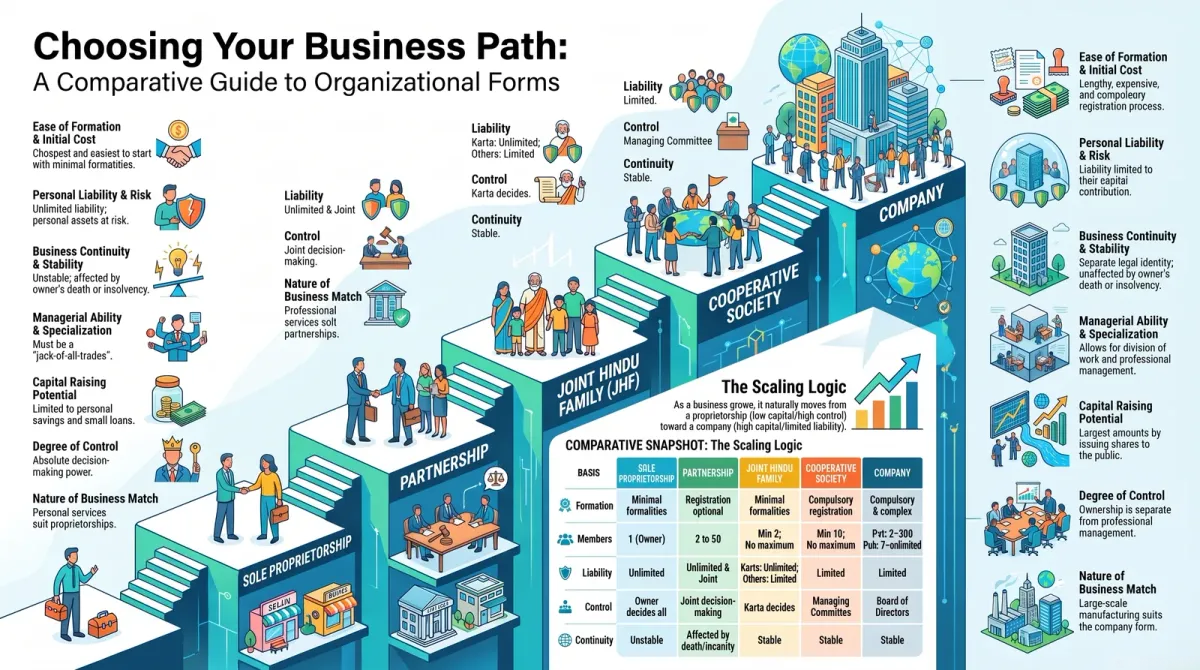
Recall Neha from the opening case of this chapter — a student who turned a pottery-painting hobby into a small sole proprietorship, made a profit of ₹2,500, and now faces a genuine dilemma: should she stay a sole proprietor, form a partnership with her cousin, or eventually convert her business into a company? This is exactly the decision every entrepreneur faces, and it’s the focus of the final and most application-heavy section of CBSE Class 11 Business Studies, Chapter 2.
There is no single “best” form of business organisation. The right choice depends on weighing the advantages and disadvantages of each form against the specific needs of the business. Let’s walk through the key factors that determine this choice.
Key Factors Determining the Choice
1. Cost and Ease of Setting Up
Sole proprietorship is the cheapest and easiest way to start a business — minimal legal formalities, minimal cost. Partnership is similarly straightforward, since registration is optional. Cooperative societies and companies, however, must be compulsorily registered, and forming a company is a lengthy, expensive process. If initial cost is the primary concern, sole proprietorship wins; if complexity is acceptable for other benefits, a company may still make sense.
2. Liability
In sole proprietorship and partnership, liability is unlimited — owners may have to pay business debts from personal assets. In a Joint Hindu Family business, only the karta bears unlimited liability. In cooperative societies and companies, liability is limited to members’ capital contribution. From an investor protection standpoint, the company form is most advantageous.
3. Continuity
Sole proprietorship and partnership are vulnerable to disruption from the death, insolvency, or insanity of the owner(s). Joint Hindu Family businesses, cooperative societies, and companies are unaffected by such events because of built-in succession (karta) or a separate legal identity. A permanent structure suits company or cooperative form; short-term ventures suit proprietorship or partnership.
4. Managerial Ability
A sole proprietor must handle purchasing, selling, and financing alone — a real limitation, since few excel across all these areas. Partnerships and companies allow division of work and specialisation, leading to more balanced decisions, though this can also introduce conflicts. Complex, professionalised operations favour the company form; simpler operations suit proprietorship or partnership.
5. Capital Considerations
Companies can raise large amounts of capital by issuing shares to a wide investor base — a clear advantage for large-scale operations. Partnerships benefit from pooled resources of multiple partners, exceeding what a sole proprietor can typically raise. This is precisely the logic behind Neha’s father’s suggestion: as the business grows, moving toward partnership — and eventually a company — becomes the sensible path.
6. Degree of Control
If an owner wants absolute, unshared decision-making power, sole proprietorship is the natural fit. If owners are comfortable sharing control, partnership or company forms become viable — with companies offering complete separation between ownership and management, since professionals independently run operations.
7. Nature of Business
Businesses requiring direct personal contact with customers — like a grocery store or salon — tend to suit sole proprietorship. Large manufacturing operations, where direct customer contact isn’t essential, suit the company form better. Where professional services are involved, partnership tends to work particularly well.
Comparative Snapshot: All Five Forms at a Glance
| Basis | Sole Proprietorship | Partnership | Joint Hindu Family | Cooperative Society | Company |
|---|---|---|---|---|---|
| Formation | Minimal formalities | Registration optional | Minimal formalities | Registration compulsory | Registration compulsory, complex |
| Members | Only owner | 2 to 50 | 2+, no maximum | At least 10, no maximum | Private: 2–200, Public: 7–unlimited |
| Liability | Unlimited | Unlimited & joint | Unlimited for karta; limited for others | Limited | Limited |
| Control | Owner decides all | Partners jointly decide | Karta decides | Elected managing committee | Board of Directors |
| Continuity | Unstable | More stable, but affected | Stable | Stable | Stable |
A Reminder: These Factors Are Interconnected
It’s worth emphasising a key point the NCERT chapter itself makes: these factors don’t operate in isolation. Capital requirements and risk tolerance change as a business grows in scale — a form that suits a small operation may become entirely unsuitable once the same business scales up. That’s exactly why Neha’s situation is presented as evolving: what worked for her as a solo hobbyist may no longer work once she’s running a larger operation with her cousin, and might change again if the business eventually needs company-level capital and structure.
Bringing It All Together
Across this chapter, we’ve covered five distinct forms of business organisation — sole proprietorship, Joint Hindu Family business, partnership, cooperative society, and joint stock company — each with its own blend of advantages and trade-offs around liability, control, continuity, and capital access. For CBSE Class 11 exams, the ability to compare these forms directly, using specific factors like liability and continuity, is just as important as knowing each form’s individual features. Practising comparison-based and application-based questions is the best way to build this skill.
Related Reading
-
Sole Proprietorship: Meaning, Features, Merits and Limitations
-
Joint Hindu Family Business: Meaning, Features, Merits and Limitations
-
Partnership Firm: Types of Partners, Partnership Deed and Registration
-
Cooperative Society: Features, Types and the Amul Case Study
Ready to Master Chapter 2?
Comparison-based questions on the choice of business organisation are a CBSE favourite — and the best way to prepare is through targeted practice. Build your confidence with structured, chapter-wise question banks on ChampionsPrep. Registration is completely free, and you pay only for what you use. Start practising today at ChampionsPrep .
Test Your Knowledge
Choosing the Right Form of Business Organisation: A Complete Comparison
Frequently Asked Questions
Which form of business organisation is best for raising large amounts of capital? +
The company form is best suited for raising large capital, since it can issue shares to a wide base of investors and access institutional loans more easily than other forms.
Which forms of business have unlimited liability? +
Sole proprietorship and partnership both have unlimited liability. In a Joint Hindu Family business, only the karta has unlimited liability.
Why did Neha's father suggest she consider partnership and then a company? +
Because as her business scales up, she will need more capital and shared responsibility for risks — needs that sole proprietorship cannot fully meet, but partnership and eventually a company can.
Which form of business organisation offers the most stability and continuity? +
Joint Hindu Family businesses, cooperative societies, and companies all offer more continuity than sole proprietorship or partnership, since they are not directly disrupted by an individual owner's death or insolvency.
What factors should be considered before choosing a form of business organisation? +
Key factors include cost and ease of formation, liability, continuity, managerial ability required, capital needs, desired degree of control, and the nature of the business itself.
AI-powered practice — free to start