
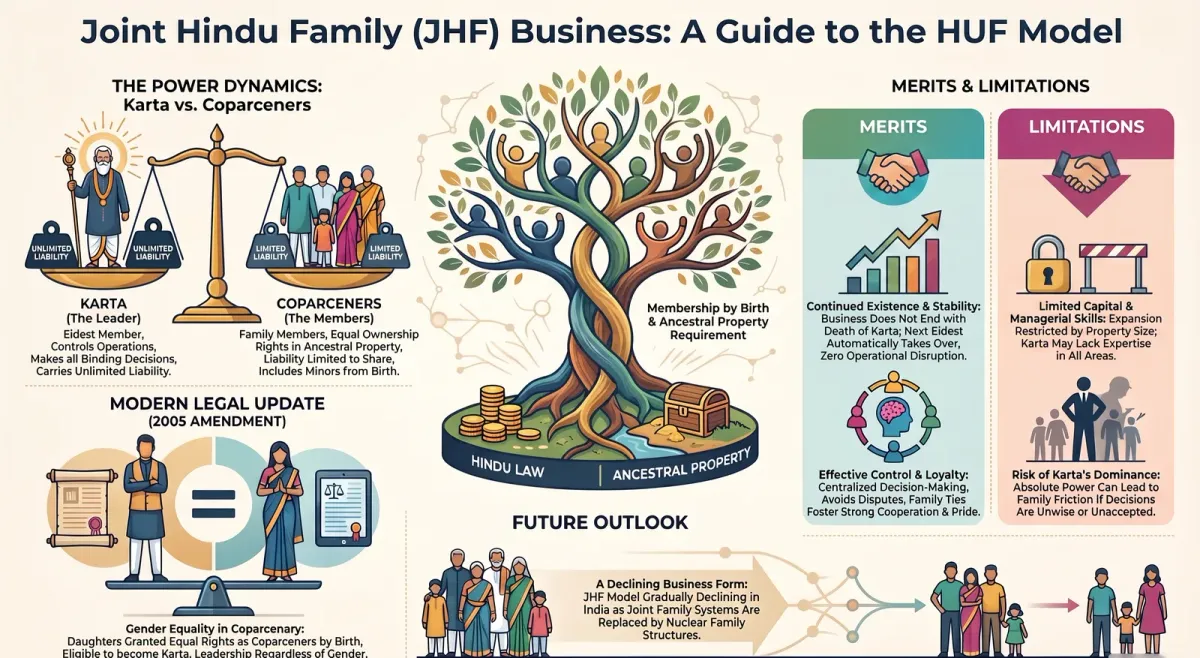
Among all the forms of business organisation covered in CBSE Class 11 Business Studies, Joint Hindu Family (JHF) business stands out as unique — it is a form found only in India, rooted in Hindu personal law rather than a general commercial statute. Understanding it well is important not just for exams but for appreciating how family-owned businesses have historically operated in the country.
What Is a Joint Hindu Family Business?
A Joint Hindu Family business is owned and carried on by the members of a Hindu Undivided Family (HUF). Unlike a partnership, which is created by agreement, membership in a JHF business arises automatically through birth into the family. It is governed by Hindu law — specifically, the Hindu Succession Act, 1956.
Three successive generations of the family can be members of the business simultaneously, and all such members hold equal ownership rights over ancestral property. These members are known as co-parceners.
Who Runs the Business? Understanding the Karta
The business is controlled by the eldest member of the family, called the karta. The karta:
-
Takes all major business decisions
-
Manages the day-to-day operations
-
Has decisions that are binding on all other members
-
Bears unlimited liability, unlike the other co-parceners
This concentration of authority in a single person is one of the most distinctive features of the JHF business form.
Features of Joint Hindu Family Business
1. Formation
A JHF business requires at least two family members and ancestral property to be inherited. Because membership arises automatically through birth, no formal agreement is needed to start the business.
2. Liability
Here’s an important exam point: liability is not uniform across all members. The liability of every co-parcener except the karta is limited to their share in the co-parcenary property. The karta alone carries unlimited liability, since he takes on the full responsibility of running the business.
3. Control
As explained above, the karta holds absolute control. This concentration avoids the kind of disputes that can arise when decision-making authority is shared, and it also enables prompt, flexible decisions.
4. Continuity
The business does not end with the karta’s death. The next eldest member simply steps into the role, and the business continues uninterrupted. However, members can mutually agree to terminate the business if they choose to.
5. Minor Members
Since membership is based on birth rather than contractual capacity, even minors can be members of a Joint Hindu Family business — a feature that distinguishes it sharply from a partnership, where a minor cannot become a full partner.
Gender Equality: A Modern Legal Update
An important development worth remembering for exams is the Hindu Succession (Amendment) Act, 2005. Before this amendment, only male descendants were recognised as coparceners. The 2005 amendment changed this: a daughter of a coparcener now becomes a coparcener by birth, with equal rights in the property at the time of partition, regardless of gender. Importantly, the eldest member of the family — male or female — can now become the karta, and a married daughter has equal rights in the property of a Joint Hindu Family.
Merits of Joint Hindu Family Business
Effective control: Because the karta has absolute decision-making power, conflicts over authority are minimised, and decisions can be made quickly and flexibly.
Continued existence: The business survives the death of the karta, since the next eldest member automatically takes over — there is no disruption to operations.
Limited liability of members: Except for the karta, all co-parceners enjoy limited liability restricted to their share in the business, making their financial risk well-defined.
Increased loyalty and cooperation: Because the business is run by family members, there is typically a stronger sense of shared pride and cooperation linked to the family’s collective reputation.
Limitations of Joint Hindu Family Business
Limited resources: Since capital depends mainly on ancestral property, the scope for raising funds — and therefore for expansion — is restricted.
Unlimited liability of the karta: While other members enjoy limited liability, the karta bears the full weight of business risk, including exposure of personal property to repay business debts.
Dominance of the karta: A single individual’s decisions may not always be acceptable to other members, and this can create friction or even threaten the unity of the family.
Limited managerial skills: No individual, however capable, can be an expert in every area of management. If the karta’s decisions are unwise, the business — and by extension, the family’s finances — can suffer.
Why Is This Form Declining?
The chapter notes an important real-world trend: Joint Hindu Family businesses are on the decline in India, primarily because the number of joint (undivided) Hindu families itself is shrinking as nuclear family structures become more common. Even so, the concept remains a key part of the CBSE Class 11 syllabus and appears frequently in short-answer and comparison-based exam questions.
Related Reading
-
Sole Proprietorship: Meaning, Features, Merits and Limitations
-
Partnership Firm: Types of Partners, Partnership Deed and Registration
-
Cooperative Society: Features, Types and the Amul Case Study
-
Choosing the Right Form of Business Organisation: A Complete Comparison
Ready to Master Chapter 2?
From the karta’s authority to coparcenary rights, this topic has plenty of scope for tricky exam questions. Build your confidence with structured, chapter-wise practice on ChampionsPrep. Registration is completely free, and you pay only for what you use. Start practising today at https://app.championsprep.in .
Test Your Knowledge

Joint Hindu Family Business: Meaning, Features, Merits and Limitations
Frequently Asked Questions
What law governs a Joint Hindu Family business? +
It is governed by Hindu law, specifically the Hindu Succession Act, 1956, along with the Hindu Succession (Amendment) Act, 2005 for coparcenary rights.
Who has unlimited liability in a Joint Hindu Family business? +
Only the karta has unlimited liability. All other co-parceners have liability limited to their share in the business.
Can a minor be a member of a Joint Hindu Family business? +
Yes. Membership arises through birth into the family, so minors can be members, unlike in a partnership firm.
Can a daughter become the karta of a Joint Hindu Family business? +
Yes, following the Hindu Succession (Amendment) Act, 2005, the eldest member of the family — regardless of gender — can become the karta.
Why is the Joint Hindu Family form of business declining in India? +
It is declining mainly because of the diminishing number of joint (undivided) Hindu families in the country, as nuclear family structures have become more common.
AI-powered practice — free to start