
Every business, big or small, begins with a choice: what legal shape should it take? For most first-time entrepreneurs in India, the answer is the simplest one available — sole proprietorship. This is the starting point of Chapter 2, “Forms of Business Organisation,” in the CBSE Class 11 Business Studies syllabus, and it remains one of the most frequently tested topics across board exams and CUET.
In this post, we break down what a sole proprietorship is, its defining features, its merits, and its limitations — all explained with the kind of clarity you need for both conceptual understanding and exam answers.
What Is Sole Proprietorship?
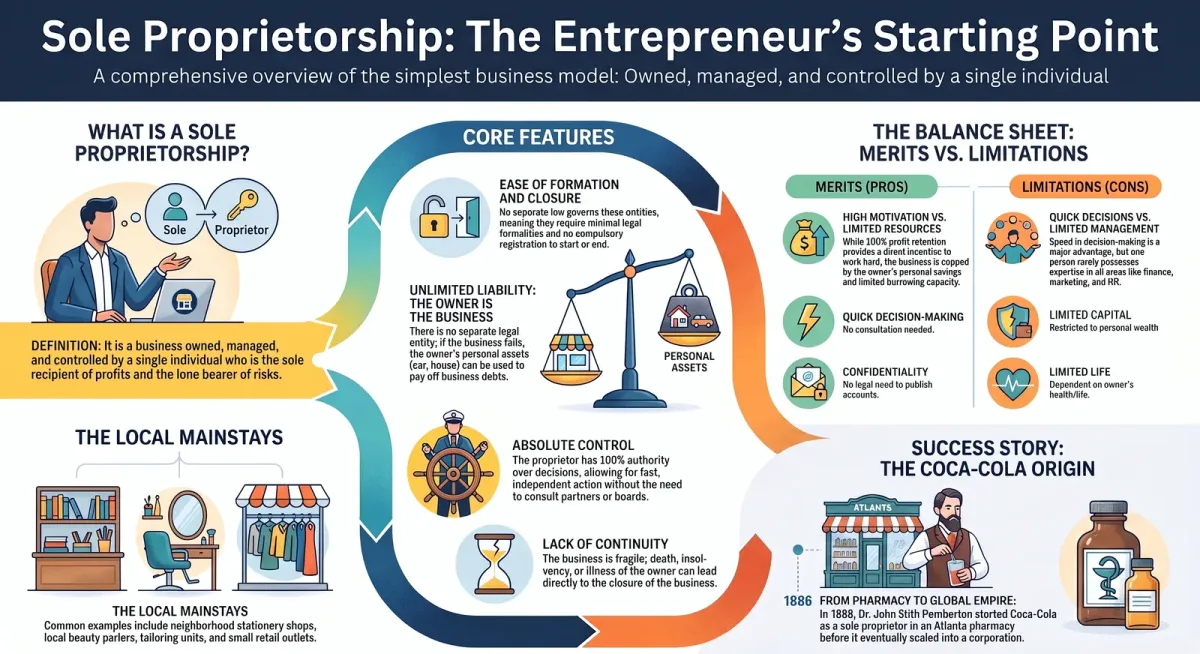
The word “sole” means only, and “proprietor” means owner. A sole proprietorship, therefore, is a business owned, managed, and controlled by a single individual. That person contributes the capital, takes all the decisions, bears all the risks, and is entitled to keep all the profits.
This form is extremely common in India — think of your neighbourhood stationery shop, a local beauty parlour, or a small tailoring unit. NCERT’s own opening illustration in this chapter follows Neha, a student who turns her pottery-painting hobby into a small business run entirely by herself, before later considering whether to bring in a partner or scale up into a company.
Features of Sole Proprietorship
1. Formation and Closure
There is no separate law governing sole proprietorships in India. Starting one requires hardly any legal formality, though certain businesses may need a specific license (a food stall, for instance, needs an FSSAI license). Closing the business is just as simple. This ease of entry and exit is a defining characteristic.
2. Unlimited Liability
This is arguably the most important feature to remember. The owner’s liability is not limited to the money invested in the business — it extends to their personal assets. If the business cannot pay its debts from business assets alone, creditors can recover the shortfall from the proprietor’s personal property, such as a car or house.
3. Sole Risk Bearer and Profit Recipient
Because there is only one owner, that person alone bears the risk of failure — and alone enjoys the rewards of success. There is no profit-sharing, which is both an incentive and a burden.
4. Complete Control
The proprietor has absolute authority over business decisions. There is no need to consult partners or a board, which allows for fast, independent decision-making.
5. No Separate Legal Entity
In the eyes of the law, the sole proprietor and the business are one and the same. The business has no identity distinct from its owner.
6. Lack of Business Continuity
Since the business is entirely dependent on one person, events like the death, insolvency, imprisonment, or serious illness of the proprietor can directly affect — or even end — the business.
Merits of Sole Proprietorship
Quick decision-making: With no partners or committees to consult, the proprietor can respond to market opportunities immediately.
Confidentiality: A sole trader is not legally required to publish accounts, allowing complete secrecy over business operations, pricing strategy, and supplier relationships.
Direct incentive: Every rupee of profit belongs to the owner, which motivates hard work and personal investment in the business’s success.
Sense of accomplishment: Running a business independently builds confidence and a genuine sense of personal achievement.
Ease of formation and closure: Minimal legal formalities make this the easiest and least expensive form of business to start — and to wind up.
Limitations of Sole Proprietorship
Limited resources: The proprietor’s capital is restricted to personal savings and whatever can be borrowed. Banks are often hesitant to extend large, long-term loans to individual traders, which caps the business’s growth potential.
Limited life: Because the business and the owner are legally inseparable, the proprietor’s death, insolvency, or incapacity can end the business.
Unlimited liability: As discussed above, a poor decision or an unfavourable market swing can put the owner’s personal wealth at risk, which often makes proprietors cautious about taking bold, expansion-oriented risks.
Limited managerial ability: One person cannot be an expert in purchasing, selling, finance, and HR all at once. This can lead to unbalanced decisions, and limited funds often prevent hiring skilled specialists.
A Real-World Example: Coca-Cola’s Sole Proprietor Origins
NCERT’s chapter includes a fascinating case study: Coca-Cola began in 1886 as the creation of Dr. John Stith Pemberton, a pharmacist in Atlanta who sold his syrup as a sole proprietor from Jacobs’ Pharmacy. Ownership eventually passed to Asa G. Candler, who ran it as a sole proprietorship until 1892, when it was finally incorporated as The Coca-Cola Corporation. This illustrates a common real-world pattern — many large companies started as one-person ventures before scaling into bigger organisational forms.
Why Do Entrepreneurs Still Choose This Form?
Despite its limitations, sole proprietorship remains the most popular form of business organisation worldwide because it requires the least capital, involves the fewest formalities, and is ideally suited to businesses that thrive on personalised service — salons, tailoring shops, tutoring services, and small retail outlets, for example.
Related Reading
-
Joint Hindu Family Business: Meaning, Features, Merits and Limitations
-
Partnership Firm: Types of Partners, Partnership Deed and Registration
-
Cooperative Society: Features, Types and the Amul Case Study
-
Choosing the Right Form of Business Organisation: A Complete Comparison
Ready to Master Chapter 2?
Understanding sole proprietorship is just the first step in mastering “Forms of Business Organisation.” Practice chapter-wise MCQs, case-based questions, and long-answer questions tailored to the CBSE Class 11 Commerce syllabus on ChampionsPrep. Registration is completely free, and you pay only for what you use — no subscriptions, no hidden costs. Start practising today at https://app.championsprep.in .
Test Your Knowledge
Sole Proprietorship: Meaning, Features, Merits and Limitations
Frequently Asked Questions
What is the main disadvantage of a sole proprietorship? +
The biggest disadvantage is unlimited liability — the owner's personal assets can be used to repay business debts if business assets are insufficient.
Is registration compulsory for a sole proprietorship in India? +
No separate law governs sole proprietorships, so registration is generally not compulsory, though specific licenses (like GST registration or a trade license) may be required depending on the nature of the business.
Who bears the risk in a sole proprietorship? +
The sole proprietor alone bears all business risk and, correspondingly, receives all the profit.
Why is sole proprietorship suitable for small businesses? +
It requires minimal capital, has simple formation and closure procedures, and suits businesses where customers value personalised service and direct interaction with the owner.
What happens to a sole proprietorship if the owner dies? +
Since the business has no separate legal identity from the owner, it typically ceases to exist unless heirs choose to continue it under a new arrangement.
AI-powered practice — free to start