
Of all the forms of business organisation covered in CBSE Class 11 Business Studies Chapter 2, the joint stock company is the most structurally complex — and also the one best suited to large-scale operations. If a business needs to raise huge amounts of capital, operate on a national or global scale, and survive well beyond the involvement of any single founder, the company form is usually the answer.
What Is a Joint Stock Company?
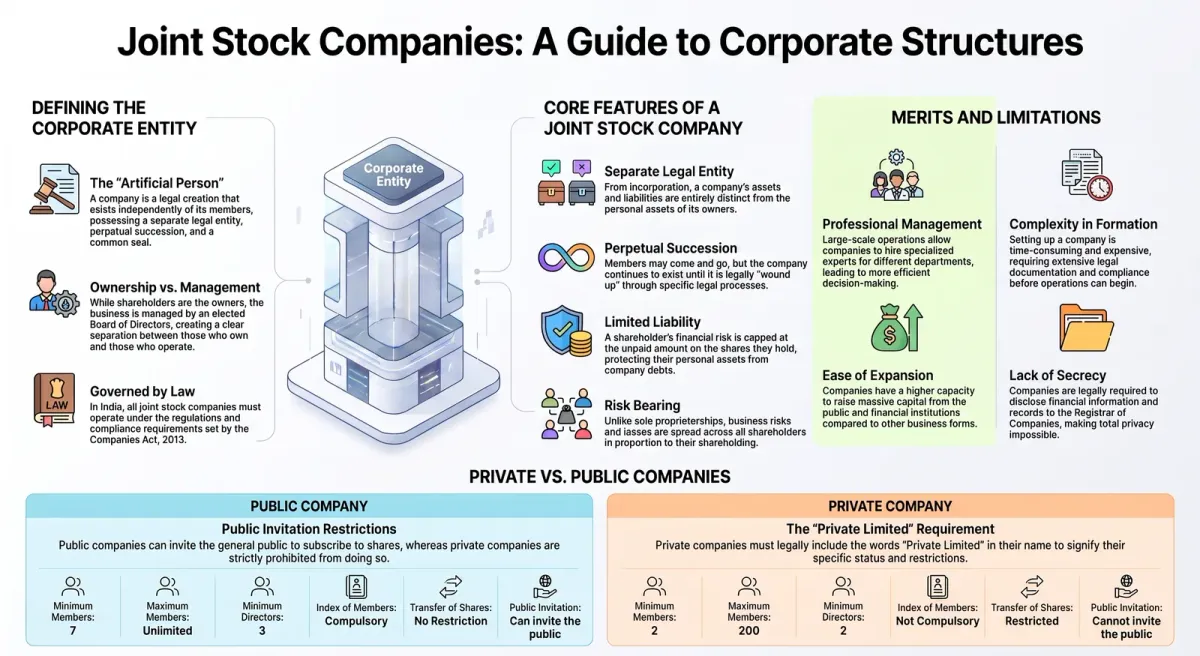
A company is an association of persons formed to carry out business activities, with a legal status entirely independent of its members. It is described as an artificial person having a separate legal entity, perpetual succession, and a common seal. In India, companies are governed by the Companies Act, 2013.
The owners of a company are its shareholders, while the Board of Directors — elected by shareholders — manages the business. The company’s capital is divided into small units called shares, which (except in a private company) can be freely transferred from one shareholder to another.
Features of a Joint Stock Company
1. Artificial Person
A company exists independently of its members. Like a natural person, it can own property, incur debts, borrow money, and sue or be sued — but unlike a natural person, it cannot breathe, eat, or talk. Hence the term “artificial person.”
2. Separate Legal Entity
From the moment of incorporation, the company’s assets and liabilities are entirely distinct from those of its owners. The law does not treat the business and its members as one and the same — a sharp contrast to sole proprietorship.
3. Formation
Forming a company is a time-consuming, expensive, and legally complex process, involving multiple documents and compliance requirements before the business can begin operating.
4. Perpetual Succession
A company, being a creation of the law, can only be ended through a legal process called winding up. Members may come and go, but the company itself continues to exist.
5. Control
Management is undertaken by the Board of Directors, who are directly accountable to shareholders. Shareholders themselves do not have the right to be involved in day-to-day operations.
6. Limited Liability
A shareholder’s liability is limited to the unpaid amount on the shares they hold. For example, if Akshay holds 2,000 shares of ₹10 each and has already paid ₹7 per share, his maximum liability is ₹6,000 — the unpaid ₹3 per share — regardless of how large the company’s debts are.
7. Risk Bearing
Unlike sole proprietorship or partnership, where one or a few people bear all the losses, risk in a company is spread across all shareholders in proportion to their shareholding.
Merits of a Joint Stock Company
Limited liability protects shareholders’ personal assets and reduces investment risk. Transfer of interest makes shares (especially in a public company) easy to convert into cash. Perpetual existence ensures the business survives changes in ownership. Scope for expansion is far greater, since companies can raise capital from the public and financial institutions. Professional management allows companies to hire specialists and divide work by department, leading to balanced, efficient decision-making.
Limitations of a Joint Stock Company
Complexity in formation demands significant time, money, and legal expertise. Lack of secrecy results from mandatory disclosure requirements to the Registrar of Companies. Impersonal work environment can arise from the separation of ownership and management. Numerous regulations around audits, filings, and certifications reduce operational flexibility. Delay in decision-making occurs due to multiple layers of management. Oligarchic management means that, in practice, a small Board of Directors often wields disproportionate power over a large, dispersed shareholder base. Conflict of interests among employees, consumers, and shareholders can make balancing diverse demands genuinely difficult.
Private Company vs Public Company
This comparison is one of the most exam-relevant parts of the entire chapter.
| Basis | Public Company | Private Company |
|---|---|---|
| Minimum members | 7 | 2 |
| Maximum members | Unlimited | 200 |
| Minimum directors | 3 | 2 |
| Index of members | Compulsory | Not compulsory |
| Transfer of shares | No restriction | Restricted |
| Invitation to public | Can invite public to subscribe | Cannot invite the public |
A private company must add “Private Limited” to its name, restricts share transfers, and cannot invite the public to subscribe to its securities. It enjoys several privileges: it can be formed with just two members, doesn’t need to issue a prospectus, can allot shares without a minimum subscription, needs only two directors, and isn’t required to maintain an index of members.
A public company, by contrast, has no restriction on share transfers and is free to invite the public to subscribe to its shares or debentures — giving it much greater access to capital, but also subjecting it to stricter compliance requirements.
Related Reading
-
Sole Proprietorship: Meaning, Features, Merits and Limitations
-
Joint Hindu Family Business: Meaning, Features, Merits and Limitations
-
Partnership Firm: Types of Partners, Partnership Deed and Registration
-
Cooperative Society: Features, Types and the Amul Case Study
Ready to Master Chapter 2?
The private vs public company comparison is a favourite for CBSE short-answer and application-based questions. Build exam-ready confidence with structured practice on ChampionsPrep. Registration is completely free, and you pay only for what you use. Start practising today at ChampionsPrep .
Test Your Knowledge

Joint Stock Company: Private vs Public Company Explained
Frequently Asked Questions
What does "limited liability" mean for a shareholder? +
It means a shareholder's liability is capped at the unpaid amount on the shares they hold — their personal assets beyond that cannot be used to settle company debts.
What is the minimum number of members needed to form a private company? +
A private company can be formed with just two members, compared to seven for a public company.
Why is a company called an "artificial person"? +
Because it is a creation of law that can own property, borrow money, and sue or be sued like a natural person, yet has no physical existence of its own.
Can a private company invite the public to buy its shares? +
No, a private company is prohibited from inviting the public to subscribe to its securities — this is one of its core distinguishing features from a public company.
What is meant by perpetual succession in a company? +
It means the company's existence is unaffected by the death, resignation, or exit of any member — it continues until formally wound up under the Companies Act, 2013.
AI-powered practice — free to start