
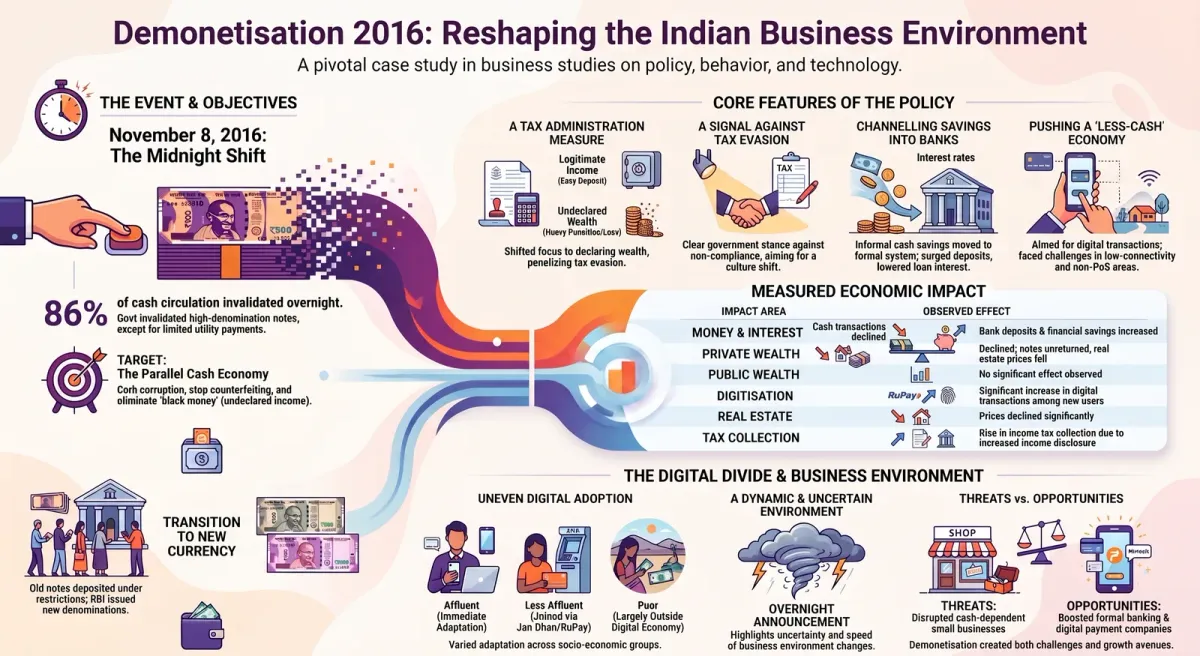
On the night of November 8, 2016, the Government of India made an announcement that instantly changed how millions of Indians handled money. Within hours, the two largest currency denominations in circulation stopped being legal tender. This event, known as Demonetisation, is a key example in Chapter 3 of CBSE Class 12 Business Studies of how a single government policy decision can ripple through every dimension of the business environment — economic, social, technological, and legal — almost overnight.
What Was Demonetisation?
Demonetisation refers to the Government of India’s announcement, made with immediate effect from the midnight of November 8, 2016, declaring the ₹500 and ₹1,000 currency notes invalid as legal tender, except for a few specified purposes such as paying certain utility bills. This single move rendered about 86% of the money in circulation invalid overnight. People across the country had to deposit their old, invalid currency notes in banks, and restrictions were simultaneously placed on cash withdrawals — meaning restrictions were effectively placed on the convertibility of domestic money and bank deposits. New currency notes in the denominations of ₹500 and ₹2,000 were subsequently issued by the Reserve Bank of India.
Why Was Demonetisation Introduced?
The stated aim of demonetisation was to curb corruption, counterfeiting, and the use of high-denomination notes for illegal activities — and especially to target the accumulation of “black money,” meaning income that had not been declared to tax authorities. It was designed as a decisive move against the parallel cash economy that had built up over decades.
Key Features of Demonetisation
1. A Tax Administration Measure
Demonetisation is best understood as a tax administration measure. Cash holdings that came from declared, legitimate income could be readily deposited in banks and exchanged for new notes without difficulty. However, individuals holding undeclared black money were forced to either declare their unaccounted wealth and pay taxes at a penalty rate, or risk holding onto now-worthless currency.
2. A Signal Against Tax Evasion
Demonetisation is also widely interpreted as a clear signal from the government that tax evasion would no longer be tolerated or quietly accepted, marking a shift in the broader compliance culture the government wanted to build.
3. Channelling Savings into the Formal Financial System
The move pushed a significant volume of previously informal cash savings into the formal banking system. While much of the cash deposited was eventually withdrawn again, several new deposit schemes introduced by banks continued to offer loans at comparatively lower interest rates as a result of the surge in deposits.
4. Pushing Toward a Less-Cash Economy
Another defining feature of demonetisation was its push toward creating a “less-cash” or “cash-lite” economy — channelling more savings through the formal financial system and improving overall tax compliance. Critics pointed out that digital transactions require cell phones for customers and functioning Point-of-Sale machines with internet connectivity for merchants, which posed real challenges in less-connected areas. Supporters countered that these short-term disadvantages were outweighed by the longer-term benefit of bringing more people into the formal economy, increasing financial savings, and reducing tax evasion.
The Measured Impact of Demonetisation
The effects of demonetisation, as documented in the Economic Survey covering this period, can be summarised across six key areas:
| Impact Area | Observed Effect |
|---|---|
| Money and interest rates | Decline in cash transactions; bank deposits increased; increase in financial savings |
| Private wealth | Declined, since some high-denomination notes were never returned and real estate prices fell |
| Public sector wealth | No significant effect observed |
| Digitisation | Digital transactions among new users (RuPay/AEPS) increased |
| Real estate | Prices declined |
| Tax collection | Rise in income tax collection due to increased disclosure |
Digitalisation’s Uneven Reach Across Society
Demonetisation’s broader push toward digitalisation did not affect all sections of society equally. It broadly impacted three groups differently: the poor, who largely remained outside the digital economy; the less affluent, who gradually became part of the digital economy through instruments like Jan Dhan Accounts and RuPay cards; and the affluent, who were already fully conversant with digital transactions and adapted almost immediately.
Why Demonetisation Is a Strong Example of Business Environment in Action
Demonetisation is a particularly powerful case study for this chapter because it demonstrates several features of business environment simultaneously. It shows the dynamic nature of environment (a single overnight announcement changed how business was transacted across the country), its uncertainty (businesses and citizens had almost no advance warning), its inter-relatedness (a monetary policy decision affected real estate prices, tax collection, and digital adoption all at once), and its role as a source of both threats (disruption to cash-dependent small businesses) and opportunities (a boost for digital payment companies and formal banking channels).
Related Reading
-
Liberalisation, Privatisation and Globalisation (LPG) — The 1991 Economic Reforms
-
Economic Environment in India: From Independence to the 1991 Crisis
-
Dimensions of Business Environment: Economic, Social, Technological, Political and Legal
Ready to Master Business Studies Chapter 3?
Practice AI-generated questions on demonetisation and its impact on the Indian economy at just ₹10 a session on ChampionsPrep — built for CBSE and Maharashtra Board Class 12 Commerce students.
Test Your Knowledge

Demonetisation 2016: Meaning, Features and Impact on the Indian Economy
Frequently Asked Questions
When was demonetisation announced in India? +
Demonetisation was announced by the Government of India with effect from the midnight of November 8, 2016.
Which currency notes were demonetised? +
The ₹500 and ₹1,000 currency notes were demonetised and ceased to be legal tender, except for a few specified purposes; new ₹500 and ₹2,000 notes were later issued.
What was the main aim of demonetisation? +
The main aim was to curb corruption, counterfeiting, and the use of high-denomination notes for illegal activity, and specifically to target undeclared black money.
What impact did demonetisation have on tax collection? +
Tax collection rose because increased disclosure and deposit of previously undeclared cash brought more income under the formal tax net.
How did demonetisation affect real estate and private wealth? +
Real estate prices declined and private wealth fell in some cases, particularly where high-denomination notes were never redeposited into the banking system.
AI-powered practice — free to start