
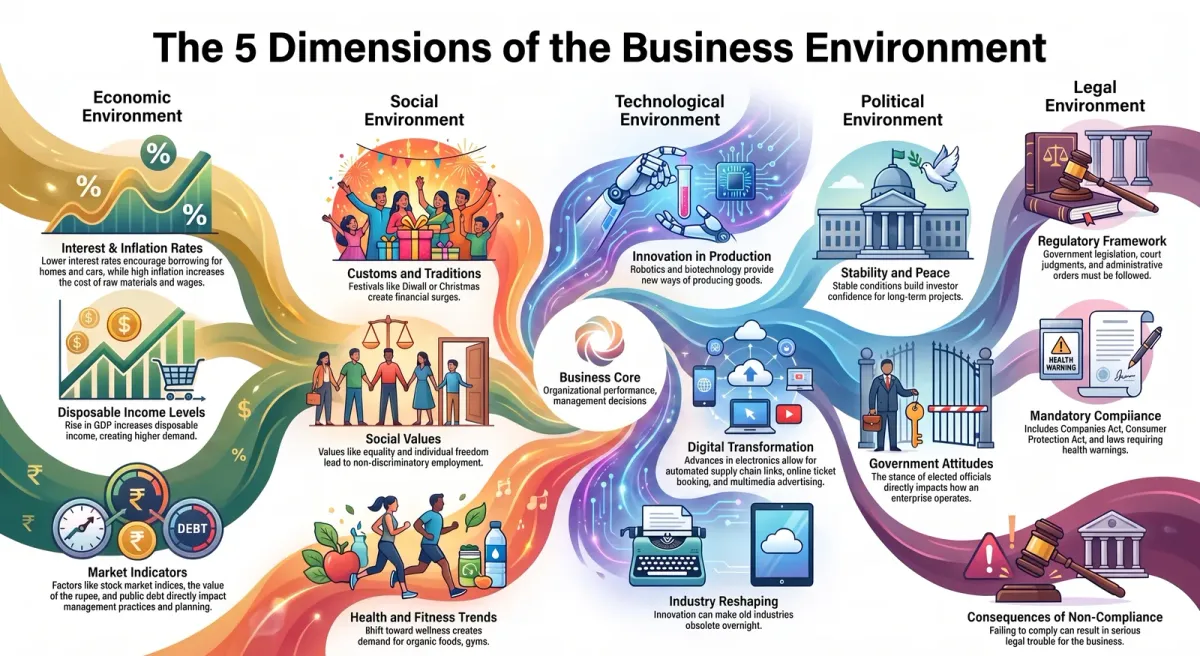
Every business, whether a small shop or a global corporation, is shaped by five broad categories of general external forces. In CBSE Class 12 Business Studies, these are known as the dimensions of business environment: economic, social, technological, political, and legal. Unlike specific forces that affect one firm directly, these dimensions explain the general environment that influences many enterprises at the same time. This post walks through each dimension with clear explanations and practical examples.
What Are Dimensions of Business Environment?
The dimensions of business environment are the broad categories of conditions considered relevant for decision-making and improving enterprise performance. While these factors don’t hit every firm as directly as a specific force like a supplier or competitor, no management can afford to be disinterested in them. A useful illustration is the discovery of a long-lasting, energy-efficient light bulb technology — senior managers at major lighting companies recognised its potential to significantly affect unit growth and profitability, so they closely tracked the research and used its findings to their advantage.
1. Economic Environment
The economic environment includes factors like interest rates, inflation rates, changes in people’s disposable income, stock market indices, and the value of the rupee — all of which can affect management practices in a business enterprise.
Short and long-term interest rates significantly affect demand for products and services. For construction companies and automobile manufacturers, lower long-term interest rates are beneficial because they encourage consumers to borrow money for buying homes and cars. Similarly, a rise in disposable income due to growth in a country’s gross domestic product creates rising demand for products in general. High inflation, on the other hand, generally creates constraints for businesses because it increases the cost of raw materials, machinery, wages, and salaries.
Other components include the economy’s public-private structure, saving and investment rates, import-export volumes, balance of payments, industrial production trends, money supply, and public debt.
2. Social Environment
The social environment includes social forces like customs and traditions, values, social trends, and society’s expectations from business. Traditions define social practices that have lasted for decades, such as the celebration of festivals like Diwali, Eid, Christmas, and Guru Parv in India — occasions that create major financial opportunities for greeting card companies, sweet and confectionery manufacturers, and tailoring businesses.
Values refer to concepts a society holds in high esteem. In India, ideas like individual freedom, social justice, equality of opportunity, and national integration are cherished values that, in business terms, translate into freedom of choice in the market and non-discriminatory employment practices. Social trends also present opportunities and threats — the growing health-and-fitness trend among urban populations, for instance, has created strong demand for organic food, gyms, bottled water, and food supplements.
3. Technological Environment
The technological environment includes forces relating to scientific improvements and innovations that provide new ways of producing goods and services. Advances in computers and electronics have transformed how companies advertise, with computerised information kiosks and multimedia web pages now commonplace. Retailers maintain direct digital links with suppliers to replenish stock automatically, manufacturers use flexible manufacturing systems, and airline companies let customers check flight schedules and book tickets entirely online.
Continuing innovation in fields like lasers, robotics, biotechnology, food preservation, medicine, and telecommunication has created enormous opportunities — and equally significant threats — for different enterprises. Historical shifts like the move from vacuum tubes to transistors, or from typewriters to computer-based word processors, show how technological change has repeatedly reshaped entire industries and created new businesses altogether.
4. Political Environment
The political environment includes political conditions such as general stability and peace in the country, along with the specific attitudes elected government representatives hold toward business. Political conditions matter because business success depends heavily on predictability — stable political conditions build confidence among business people to invest in long-term projects, while political instability and threats to law and order can shake that confidence and discourage investment. The attitude of government officials toward business, whether supportive or restrictive, also has a direct impact on how enterprises operate.
5. Legal Environment
The legal environment includes various legislations passed by the government, administrative orders issued by government authorities, court judgments, and decisions rendered by various commissions and agencies at every level — central, state, or local. It is essential for every enterprise’s management to have adequate knowledge of the rules and regulations that apply to them, because non-compliance can land a business in serious legal trouble.
In India, important legislations affecting business include the Companies Act, the Industries (Development and Regulations) Act, the Foreign Exchange Management Act, the Factories Act, the Consumer Protection Act, and the Competition Act, among many others. A practical example of legal environment in action is the regulation requiring cigarette advertisements to carry statutory health warnings, or the prohibition on advertising alcoholic beverages — rules that every business must follow regardless of how they feel about them.
How the Five Dimensions Work Together
While each dimension is studied separately for clarity, real business decisions are rarely affected by just one dimension at a time. A single government policy change can simultaneously alter the economic environment (new tax rules), the legal environment (new compliance requirements), and even the social environment (shifting how the public views an industry). Recognising these dimensions individually is the first step — the next is seeing how they interact, which later sections of this chapter, such as the economic environment in India and the 1991 LPG reforms, build on.
Related Reading
Ready to Master Business Studies Chapter 3?
Test your understanding of all five dimensions of business environment with AI-powered practice questions on ChampionsPrep — just ₹10 per session, built for CBSE and Maharashtra Board Class 12 Commerce students.
Test Your Knowledge

Dimensions of Business Environment: Economic, Social, Technological, Political and Legal
Frequently Asked Questions
What are the five dimensions of business environment? +
The five dimensions are economic, social, technological, political, and legal environment — each representing a broad category of general external forces that affect business.
What does the economic environment of business include? +
It includes interest rates, inflation rates, disposable income levels, stock market indices, currency value, savings and investment rates, and trade and industrial production trends.
How does the social environment affect business decisions? +
Social customs, traditions, values, and trends shape consumer demand and expectations, creating opportunities for businesses that align with them, such as festival-driven sales or health-conscious product lines.
Why is the legal environment important for businesses? +
Because non-compliance with laws like the Companies Act or Consumer Protection Act can lead to legal penalties, so managers must stay informed about applicable legislation and regulatory requirements.
How does political stability influence business investment? +
Political stability builds confidence among investors to commit to long-term projects, while political instability creates uncertainty that can discourage investment and disrupt business planning.
Keep practising Business Studies
AI-powered feedback and structured revision for Business Studies — free to start, at your own pace.
AI-powered practice — free to start